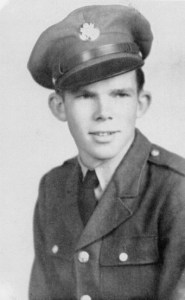
Chuckie was one of more than three million who joined the Army in 1942, the year after Pearl Harbor. At the outset of World War II, the United States Army was short of properly trained and prepared Soldier. To answer the call for more combat troopers, the Army built induction centers all over the country. New recruits and draftees had to be inducted into the Army, trained, and shipped to war as quickly and efficiently as possible.
Like Chuckie, the new additions were mostly young Americans who would normally have been pursuing jobs, schooling, and family life, but instead were answering the nation’s call to arms. Each were assigned serial numbers. I found Chuckie’s record in the The National Archives. Many of them had never even traveled outside their home state, let alone Europe, Asia, or the Pacific Islands. Preparing these millions of civilians for war would be one of the military’s most daunting challenges.
All new recruits went through a few weeks of basic training, often called “boot camp.” The goal was to turn the wide variety of individuals who entered the service into teams of fighters who could work seamlessly with one another to achieve their objectives.
Soldiers who needed training to perform specialized jobs, such as mechanics or radio operators, shipped off to special schools to learn their new trade. Soldiers serving as infantry, paratroopers, or artillery went to basic training to learn to be a soldier in their specific branch.
Camp personnel shaved the heads of the recruits and assigned them serial numbers. Platoons of recruits slept, ate, and learned together, and even did hours upon hours of physical fitness training as a unit. Following commands, they practiced the same basic skills over and over— marching, loading, unloading, and cleaning their weapons. Drill instructors used tough methods to force the newcomers to become attentive to detail and protocol. Even the smallest mistakes could result in extra kitchen duty or a challenging physical punishment—sometimes for the entire group.
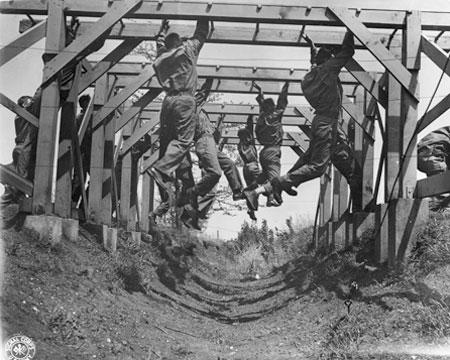
Photo credit: U.S Army Heritage and Education Center
The Library of Congress holds thousands of images from World War II in its collections — from sources as diverse as the soldiers themselves, civilians, government agencies, professional photographers, and more. information can be found on the The National WWII Museum’s website.

(Image: Library Of Congress, LC-USW33-000257-ZC.)
 Unforgotten Glory