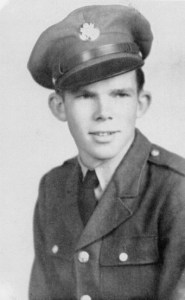
By 1944, US forces reached their greatest numbers in preparation for the Normandy Invasion. After training in the US for two years, Chuckie arrived to Royal Air Force (RAF) Alconbury in England some time in the Jan-Feb 1944 period. He was part of the 36th Bombardment Squadron enhancement forces for the planned Allied Invasion in June.
Chuckie’s unit was formed in November 1943 to clandestinely deliver agents and supplies into Nazi-occupied Europe for the Office of Strategic Services (O.S.S.). To address this mission, specially modified B-24 Liberators were formed and activated at RAF Alconbury, England. This was the very beginning of Operation Carpetbagger.
Chuckie was part of pilot George W. Ambrose’s crew on “The Worry Bird” a specially modified B-24D Liberator aircraft. Carpetbagger aircraft flew spies called “Joes” and commando groups prior to the Allied invasion of Europe on D-Day and afterward and retrieved over 5,000 officers and enlisted men who had escaped capture after being shot down. The low-altitude, nighttime operation was extremely dangerous and took its toll on these airmen. The first aircrews chosen for this operation came from the anti-submarine bomb groups because of their special training in low altitude flying and pinpoint navigation skills.
My research uncovered that Chuckie and his fellow “Ambrose” crew successfully completed five classified Carpetbagger missions in the month of April 1944 before its fiery crash in France behind enemy lines.
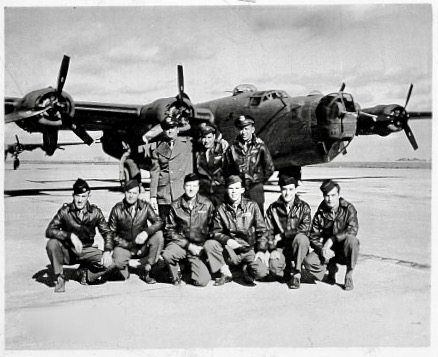
B-24 Liberator “The Worry Bird” Picture Date: December 1943
Back Row Left to Right:
1st Lieut. George W. Ambrose (Pilot); 2nd Lieut. Peter Roccia; 2nd Lieut. Robert H. Redhair
Front Row, Left to Right: Sgt. Eddy Dwyer; Staff Sgt. George Henderson; Sgt.Wilford Bollinger;
Staff Sgt. Charles M. Wilson; Sgt. Donald Dubois; Sgt. James Heddelson
Attending “Pathfinder” School
Although Great Britain is a small nation, for many young American pilots newly arrived from the Midwest and used to training over the blue skies over Texas, it was easy to get lost. England was a patchwork of fields, towns, and villages. Pilots have written that it all looked remarkably similar from the air. There were more than 140 airfields in the UK.
Getting around on the ground wasn’t any easier as the British had removed practically all the road signs and mile markers as a German invasion was always a threat. Navigation became such a problem that a special “Pathfinder” school was established at the RAF Alconbury (AAF-102) in Huntingfonshire, which today was amalgamated into Cambridgeshire. Chuckie and his crew were likely there on orders to learn the mysteries of navigation from the experts of the 482 Bombardment Group.
A new airfield under construction in the depths of rural Northamptonshire, RAF Harrington (Station 179) would be the Ambrose Crew’s next destination. It proved ideal for Carpetbagger operations and the heavy equipment and aircraft.
Soon the Ambrose Crew would move there.
 Unforgotten Glory