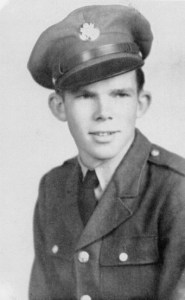
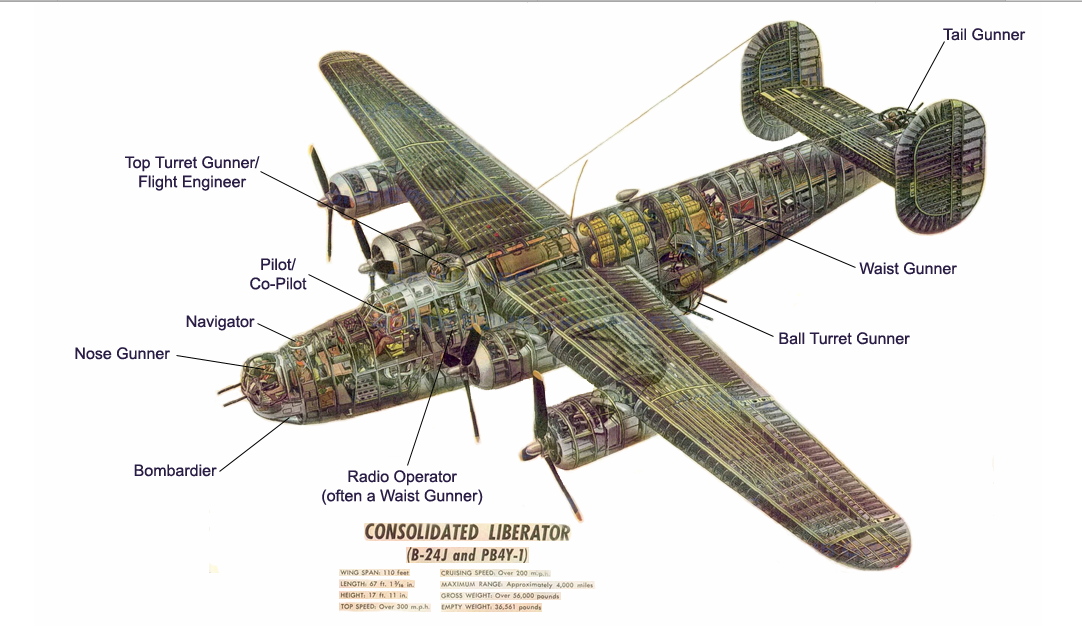
Records show that Chuckie was the Flight Engineer of “The Ambrose Crew” on the B-24 Liberator “The Worry Bird” for those Carpetbagger missions in April 1944. A B-24 carried a crew of eight to ten men (a ten man crew was most common) comprised of both officers and enlisted men. Among the six enlisted crewmen, each crew typically had three specialists: the Flight Engineer which Chuckie was; Radio Operator; and Aircraft Armorer.
The Flight Engineer had to be a qualified airplane mechanic. Chuckie had gone through training school (and in all probability) at Kesssler Air Force Base, in Biloxi, Mississippi. It focused on specialized training in Consolidated B-24 Liberator maintenance. The Liberator was a complicated and advanced machine, leading to prolonged training programs.
The Engineer perhaps knew more about the B-24 than any other member of the crew, including the airplane commander. In emergencies, the airplane commander turned to the engineer. The duties of the flight engineer were to assist the pilot and copilot in monitoring the performance of the engines and to keep track of fuel burn.
The Engineer was usually also the top turret gunner, a position that allowed him to monitor the four engines and where the Pilot could call to him in a hurry, when something went wrong and needed fixing, while in the air. The Pilot and Co-Pilot’s attention were needed in the duties of flying the plane. The top turret gunner’s position provided a good view of the engines as well as a panoramic view of the surrounding airspace.
The May 1, 1945 version of the B-24 Pilot Training Manual provides the following duties for the Flight Engineer:
- Principal duty: Aerial Engineer
- Secondary duty: Top Turret Gunner
- Added duty: Qualified for Copilot Duties
- Added duty: Parachute Officer
- Added duty: First Aid Specialist
- Added duty: Assistant Radio Operator
One veteran noted that the Engineer usually got to fly the plane many times, and on occasion, to even take off. Maybe Chuckie got to do that too.
 Unforgotten Glory