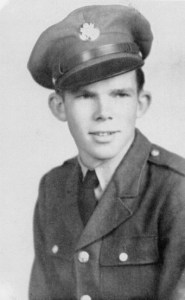
Chuckie’s B-24 Liberator made its slow progress to the runway. On receiving a green “Go” signal light from the tower, Pilot Ambrose and The Worry Bird crew roared down the runway and took off into the dark night sky at 10:29 PM beginning their two and a half hour flight to the drop zone in German occupied France.
The majority of Carpetbagger flights were made during the moon period, or on those nights when the moon was out, making the ground visible to the navigator and bombardier who visually identified the target and made the drops.
On this night, The Worry Bird crew were one of the first Carpetbaggers to fly out at night without benefit of the full moon, according to the first person account of crash survivor James Heddelson.
The aviators of the 801st Bomb Group of the 36th Bomb Squadron on the B-24 Liberator, The Worry Bird, on Operation Lackey 3A that fateful night:
- Lieut. George W Ambrose, Pilot; of Springdale, PA
- Lieut. Robert H Redhair , Co-Pilot; of Bartlesville, OKC
- S Sgt. Charles M Wilson, Engineer; of Beaver, PA
- Lieut. Arthur B Pope, Navigator; of Fulton, GA
- Lieut. Peter Roccia, Bombardier; of Washington, D.C.
- Sgt. James J Heddleson, Radio Operator; of Louisville, OH
- Sgt. George W Henderson, Tail Gunner; of Santa Monica, CA
- Sgt. James C Mooney, Dispatcher; of Englewood, NJ – He volunteered for this mission (his first) – the rest of the crew only met him shortly before take-off, as regular crew member Sgt. W. Bollinger had reported off sick that day.
Operations Log – Station 179 Harrington U.K.
I was able to locate an image of the actual handwritten Harrington flight log from that night. Chuckie’s take off time of “22:29” is noted beside an empty white box where the return home time was to have been written, then a chilling “MIA” written.

Entrie Dated Chuckie’s plane – the Ambrose Crew
Low altitude flying
To avoid action with the enemy, flights were also at low level, usually 2,000 feet. A low altitude made it more difficult for the enemy to detect the aircraft either by sound or by radar detection devices. Obstacles on the ground distort the sound of a low flying aircraft far more than they do the noise of a high flying one, because of the sharper angles of sound reflection. Radar and sound detection devices had less time in which to focus on a low flying aeroplane, and the range of effective detection was shorter at low altitudes.
After take off, radio operator James Heddelson was soon busy with his signals. The Intelligence Office at Harrington contacted Special Operations in London notifying them of the target and the route The Worry Bird was taking.
A “crack code” was then broadcast over the BBC radio that notified the resistance on the ground in France that the delivery was on its way.
Once the enemy coast was reached, the bombardier Peter Roccia and navigator Arthur Pope began preparations for the drop. The pilot usually flew at a height of 1,500 – 2,000 feet, giving known airfields and flak areas a wide berth; night fighters were always a hazard, but by flying at low altitudes, this threat was minimized. Chuckie and George Henderseon would have kept a constant lookout for German enemy predators, their guns were fitted with large anti flash discs to lessen the loss of night vision if they were fired.
As they neared the drop zone near Lyon in central France, the reception party on the farmland below heard the throb of engines and established contact by ‘S’ Phone.
Chuckie and crew reach the drop site at 1:00 AM, as planned, seeing the target lights on the ground on the first confirming fly over pass.
 Unforgotten Glory