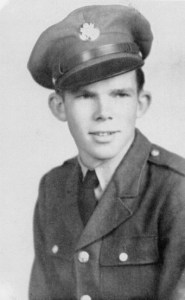
Of the three airmen to survive the crash that killed Chuckie and four other airmen, two successfully evaded the enemy before safely returning four months later to RAF Harrington.
Just before the crash Sergeant James Heddleson had gone to an open hatch in the tail to exchange recognition signals, flashing lights, with people waiting below in a clearing surrounded by high hills. Suddenly the plane shook violently, as if the aircraft or its wingtip had hit something. Heddleson fell across the hatch. Both he and the tail gunner Sergeant George Henderson were thrown free as the rear fuselage tumbled and broke apart.
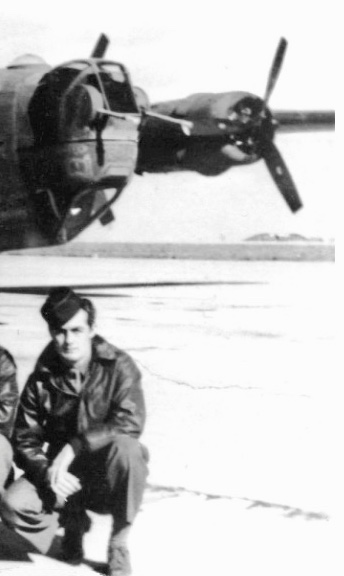
Heddleson and Henderson found each other amid the burning remains of the plane and exploding bullets. Staggering on battered but fortunately unbroken legs, they limped to the nearby woods, then turned and watched The Worry Bird erupt in a final fireball.
The pair spent the next few days traveling across the countryside, begging food from startled French civilians and eluding Germans searching for them with dogs and planes.
After several days of hiding and only moving at night, we ended up in a cemetary, when daylight came we decided we better hole up for the day, when we saw an old man walking towards us. We really scared him when we approached him for food or help or anything. I showed him my “wings” and he motioned for us to follow him, at a distance. Eventually we ended up in the garage of a schoolhouse.
They eventually met a man who told the airmen to stay in a vineyard where they had hidden, then returned an hour later with a note, in English, from the local school master, who promised to meet them at 5 p.m. The teacher kept his promise and after bringing them food, left to bring back a member of the local Resistance, or Maquis, who was so heavily armed that “he looked like a walking arsenal,” Heddleson said.
We were given some bread, cheese and wine and after dark a group of men came in a car, it was M. Benoit the school teacher. They were all armed with pistols and rifles. After a few questions and some very vague answers, they decided we were the two Americans that everybody was looking for. I also knew then, that at last, we had made contact with the French underground (Maquis). We then were taken to a farm (in the car) and hidden in the barn. This place was owned by a Mme. De Havrincourt. We stayed there a couple of weeks, hiding sometimes in the nearby woods and barn and house. She had a doctor come and he fixed up my forehead, he opened up the gashes and re-stitched them. I mean the hard way , with a needle and thread. I can still remember that. We were spotted by the wrong person at this farm and she told the Germans “she thought she had seen some English fliers”. When the Germans came through the gate, we escaped out the back of the barn to the woods. We could see them looking everywhere, but to no avail. Mme. De Havrincourt convinced them (the Germans) the woman was demented and they finally left.

Heddleson and Henderson were given false identity cards during the four-month stay with the French Resistance. It identified the as deaf-mutes, to reduce the risk of exposing them as a fugitive, non-French-speaking Allied airman.
Needless to say the Maquis decided it was time for us to move on. We were taken to the Jean Crozet farm near St. Germain Laval. The main structure was walled in and a person could feel slightly safer. While there, we participated in two different night parachute drops. This was not only dangerous but a lot of work. The parachutes were everywhere. We loaded them into trucks and even oxen-drawn wagons. We stored them in various barns before daylight. I can still remember looking up and seeing those B-24’s flying very low and turn and head back to England, Harrington, I assumed. It gave you an empty feeling in your stomach. I spelled my name with a flashlight in Morse code several times but I never knew if they received it.
Heddleson and Henderson were shuttled from one hideout to another, narrowly escaping capture several times. Heddleson learned later that the Germans had posted a 25,000-franc reward on the heads of two surviving downed Allied airmen.
From the Crozet farm we went to the village of St. Germain Laval to stay. We first stayed at the home of Rene Simons for a few days, never venturing out of doors. From here we went to the home of Jean Boyer. He was an officer in the Maquis. We stayed with the Boyers the longest, about 8 weeks. It was through Jean Boyer that we participated in several raids with the Maquis. I can recall one raid in particular that involved Jean Boyer, Henderson, Joseph Tournaire, and myself.
Heddleson and Henderson started working with Maquis groups in the area, assembling Carpetbagger-dropped weapons and training partisans in their use. They accompanied resistance fighters in raids on the homes and shops of suspected collaborators. As the Allied D-Day of France neared, the underground was ordered to destroy railroads and bridges that the Germans could use to resupply their coastal defenses.
We rode at night on a bicycle, quite a distance from St. Germain Laval to a railroad trestle that we were going to blow up (sabotage). It crossed over a small river. Boyer and myself went to the center of the trestle and we climbed down over the side carrying our explosives. We had a timing device for it, and we thought we had plenty of time to make our escape and would be well on our way back to St. Germain Laval, before any action took place. I could look back over my shoulder and see the trestle behind us, when all hell broke loose. Obviously our timer was wrong. ( I believe these were from a parachute drop). In the still of the night the explosion was felt from where we were.
We made our departure immediately away from there. Several times we would hide along the road as the Germans would pass us on their way to the trestle, or what was left of it, not seeing us. We made it back to the Boyer’s house just as the sun was coming up. Needless to say we were very shaken and tired. The Boyer’s house was located almost in the center of St. Germain Laval and had a small walled-in area about 24ft by 20ft. It was here we would spend our time cleaning and assembling British machine guns, that were parachuted to the Maquis at night. Many a time we would go to the basement of the schoolhouse where the walls were about 4 to 5 feet thick, and testfire these weapons, always on the lookout for the enemy, because of the noise.
Edited from transcribed copy of letter by crash survivor James Heddelson in the archives at the Air Force Academy June – 1998
After D-Day, Heddleson hoped he could return to his unit in England, but it was another two months before he and a handful of other escaped fliers could hop on a British plane that landed by moonlight in a field behind enemy lines.
Brian Albrecht interviewed Heddelson, shortly before his death at aged 85, for an article which ran in the The Plain Dealer in March 2009 portions of which have been reprinted here.
 Unforgotten Glory