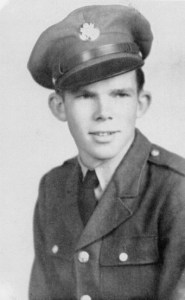
The third crewman to survive the crash that killed Chuckie, Sergeant James Cyril Mooney plummeted through the open “Joe hole” where the bottom ball gun-turret had been removed so agents could parachute from the plane. Mooney was rescued by the French resistance on the morning of 28 April 1944 when The Worry Bird crashed but his back was broken and he was wounded so badly that they had to turn him over to the Germans for medical treatment.
“His condition was such, I found out later, that the man whose house he was taken to, had to turn him over to the Germans. He told me personally how sorry he was for having to do this. But I tried to assure him that in Sgt Mooney’s case (broken back) he probably saved his life as I heard the Germans took him to a hospital.“
Edited from transcribed copy of letter by crash survivor James Heddelman in the archives at the Air Force Academy June – 1998
Mooney was hospitalized for months and then marched on foot back to Germany and eventually to a POW camp in Poland.
Stalag Luft III was located 100 miles southeast of Berlin in what is now Poland. “Luft” means “air” in German, and it designated a camp holding mostly Allied airmen. The officer airmen who were POWs in the German camps at Stalag Luft III arrived there through an accident of war. They varied widely in age, military rank, education, and family background, but had several common experiences:
- They all volunteered to go to war as airmen.
- They all managed to complete flying training.
- They all entered into combat flying in airplanes.
- They all were survivors of a traumatic catastrophe in the air.
By early 1945, the war was going badly for the Germans, with Allied forces poised to overrun Hitler’s homeland. As the Russian army approached from the east, the Germans decided to move the occupants of certain POW camps, called stalags, farther west.
From a total of 257,000 western Allied prisoners of war held in German military prison camps, over 80,000 western Allied prisoners of war held in German military prison camps were forced to walk on foot on “The Great March” westward across Poland, Czechoslovakia, and Germany in extreme winter conditions to prisoners of war (POWs) camps (with part of the distance covered by cattle train) over about four months between January and April 1945.
The march started at Stalag Luft IV in German Pomerania (now part of Poland), a POW camp for US and British aircrew men which likely held Mooney and an estimated 9,000-10,000 other POWs.
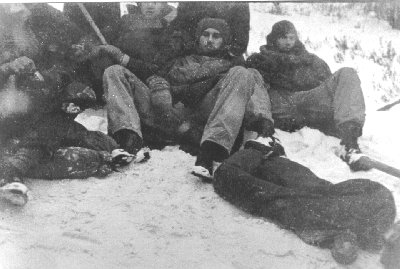
by the time they were liberated, and some had walked nearly 930 miles.
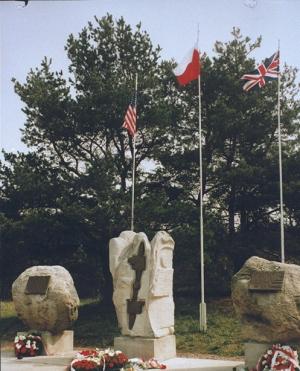
Published in AIR FORCE Magazine September 1997, Vol. 80, No. 9
In 1992, the American survivors of the march funded and dedicated a memorial at the former site of Stalag Luft IV in Poland, the starting place of a march that is an important part of Air Force history.
Mooney was held prisoner in a German POW camp until the British liberated his POW camp in Poland at the end of the war in 1945.
 Unforgotten Glory