Resistance movements during World War II occurred in every occupied country by a variety of means, ranging from non-cooperation to propaganda to hiding crashed pilots and even to outright warfare and the recapturing of towns. In many countries, resistance movements were sometimes also referred to as The Underground.
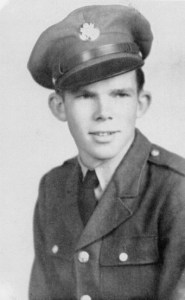
Chuckie and the Carpetbaggers supplied the Maquis and the French Resistance before the invasion of Normandy and continued throughout the summer of 1944. A previous post provided information on the B-24 crew preparation of the Carpetbagger missions.
Carpetbaggers parachuted in bazookas, carbines, rifles, Sten guns, small arms, grenades and other items in heavy demand especially designed for sabotage. Explosives had to be handled very carefully. Because they were not units that the United States had formally agreed to logistically support, they were not eligible to receive the standard U.S. equipment that was provided to French regular army units. Thus, the French resistance units often clothed themselves in nonstandard uniforms or uniforms of 1940 vintage. The same condition existed with weapons, with the use of captured German infantry weapons a common practice. Because of the mix of American, British, French, German, and other weapons, the supply of ammunition and spare parts was complicated and often difficult to accomplish.
Medical supplies, radios and other breakable items were placed in tins and baskets that were placed inside wire bins stuffed with moisture resistant corrugated paper to help them withstand the impact of the drop. These were covered with canvas call “panniers.”
The cylindrical containers the B-24s dropped were designed with a shock absorbing buffer on one end. They consisted of five individual cells and carried a variety of items. This included rounds of ammunition, boots, socks and other clothing, bicycles, tires., gasoline, and riffles. The Carpetbaggers supplied over 20,000 rifles during the course of the operations. Parachutes were then attached to the containers prior to take off. Once fully loaded, the containers could weigh up to 300 pounds each.
The bomb bay of the B-24 carried 12, fully packed, 300-pound containers. The same push button method used to drop the bombs was employed to drop the containers. Packages were stored forward in the aircraft until after takeoff and later placed on roller conveyers leading to the Joe Hole.
The Maquis waiting on the ground and gathered the canisters and supplies and dispersed them to the resistance army. The word “Maquis” cam from the type of terrain in which the resistance groups were hiding. Members were called “Maquisards” and operated in the isolated mountainous areas of rural France. The hilly region was perilous and dangerous to the big B-24 Liberators as Chuckie and fellow crew tragically found.
Individual circuits behind enemy lines inside France were identified by a specific code name. Usual, the name referred to a corresponding location or occupation such as ‘Wrestler”, ‘Lockey, or ‘Headmaster’.
The supply requests from each circuit were sent by radio to Special Operations in London and then on the the Carpetbaggers in Harrington. The exact location of the reception committee was determined by matching the code name to the secret files kept at Carpetbagger headquarters in Harringon.
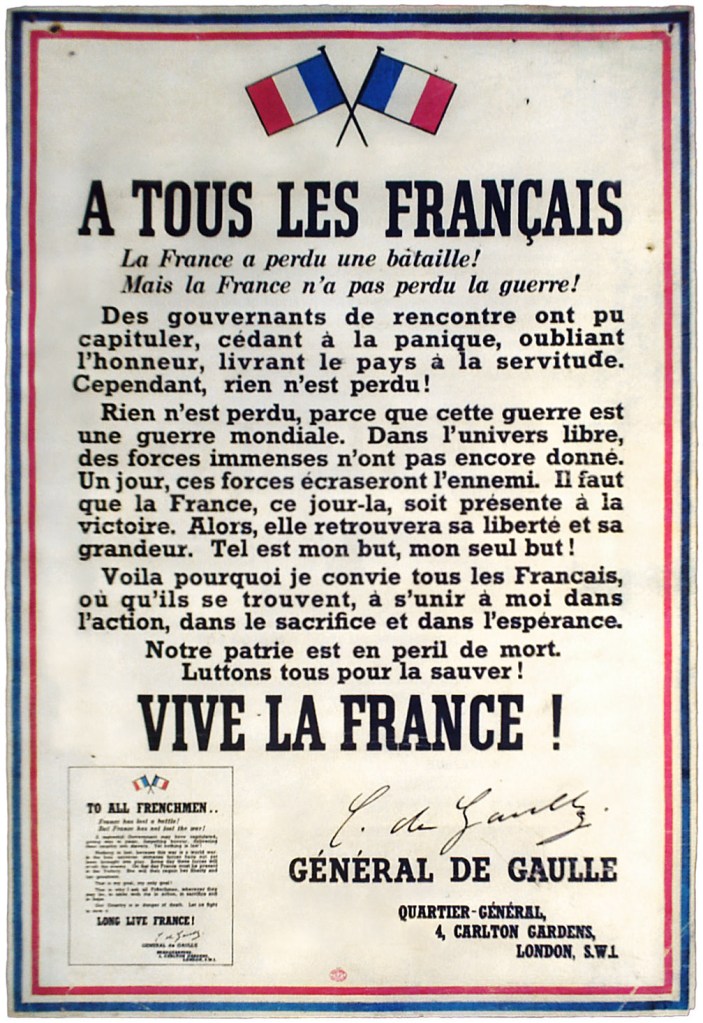
Charles André Joseph Marie de Gaullew was a French army officer and statesman who led the French Resistance against Nazi Germany in World War II and chaired the Provisional Government of the French Republic from 1944 to 1946 in order to reestablish democracy in France after the war.
TRANSLATION: TO ALL FRENCHMEN!
France has lost a battle! But France has not lost the war! Some that have happened into governing positions may have capitulated, ceding to panic, forgetting honour, delivering the country to servitude. However, nothing is lost! Nothing is lost, because this war is a world war. In the free universe, immense forces have yet to get into the fray. One day, those forces will crush the enemy. That day, France must be there for victory. Then she will find her liberty and her greatness again. Such is my goal, my only goal! This is why I invite all Frenchmen, wherever they may be, to join me in action, in sacrifice, and in hope. Our motherland is in lethal danger. Let us all fight to save her! LONG LIVE FRANCE! General de Gaulle Head-Quarters, Carlton Gardens 4 London, S.W.1.
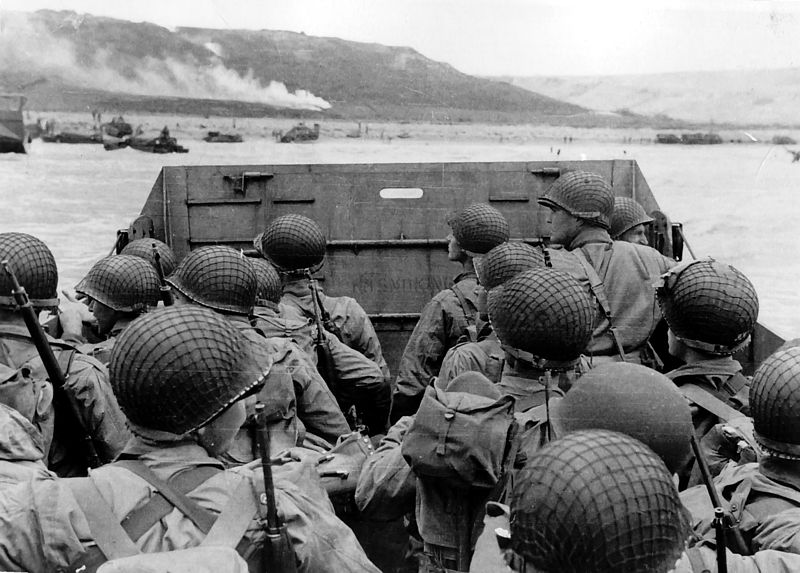
On 6 June 1944. Celebrated as “D-Day”– the Allied Forces began a massive invasion of Europe, landing 156,000 British, Canadian and American soldiers on the beaches of Normandy, France. The Carpetbaggers and the French Resistance were credited with delaying German mobilization by blowing up railroad track and repeatedly attaching German Army equipment and garrison trains.
Omaha, commonly known as Omaha Beach, was the code name for one of the five sectors of the Allied invasion of German-occupied France in the Normandy landings on June 6, 1944, during World War II. “Omaha” refers to a section of the coast of Normandy, France, facing the English Channel.
Taking Omaha was to be the responsibility of United States Army troops, with sea transport, mine sweeping, and a naval bombardment force provided predominantly by the United States Navy and Coast Guard, with contributions from the British, Canadian, and Free French navies.
Many years later, Churchill, Eisenhower and Patton acknowledged the inestimable value of Chuckie and the Carpetbaggers contribution to defeating the enemy. According to General Patton, the rapid advance of his army through France would have been impossible without the fighting aid of the French resistance which the Carpetbaggers supplied.
 Unforgotten Glory