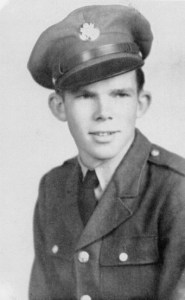
Four months after they walked away from B-24 Liberator The Worry Bird crash landing that killed Chuckie and four others airmen of the 801st Bomb Group, two of the three survivors returned back to RAF Harrington on 27 August 1944 after successfully evading the German enemy with the help of the French.
“Only on one occasion we had a very close call. We were eating at an outside restaurant along the Rhone River, when word came that the Germans were stopping everyone for their papers. We climbed over a wall and dropped down to the river bank. Just as we cleared the wall I spotted the Germans, we made it. From here we were taken to a farm to hide out. We met several more French people who were also escaping back to England. The plane was supposed to come in July but didn’t arrive until the last week of August.
We were taken to a field before dark and hid in the nearby woods. As we heard the plane approaching, the Maquis lit several fires for the plane to land, when it came in and landed we were waiting to climb aboard. It only took several minutes to take off. We were overloaded but we made it.“
Edited from transcribed copy of letter by crash survivor James Heddelman in the archives at the Air Force Academy June – 1998
Historical records note they boarded on board RAF Hudson (Operation Machette) 27 August 1944.
When an aircraft has completed its mission and returned to the home base, its crew are driven directly to the Intelligence Library situated at the rear of the Group Operations Building, for interrogation by S-2 Officers. In the case of Heddelson and Henderson, they had much to report. Their first person accounts given about the crash and Chuckie were posted in a previous post.

Photo credit Harrington Aviation Museum.
After the interrogation, the crew go to the Mess Hall, where under the supervision of a medical officer, each man is given a two ounce medicinal ration of whiskey. The man signs a receipt for his whiskey, which is issued for operational use only and serves to relax tense nerves.
More than 25 B-24s and 208 Carpetbaggers were lost in those lonely flights over enemy territory. Heddelson and Henderson were one of the very few Carpetbaggers to make the complete circle:
(a) flew the parachute missions from England.
(b) participated in the drops from the ground.
(c) fought with the Maquis and did some sabotage.
(d) escaped back to England by the secret landings.
After the war
Heddleson wound up back in his hometown Louisville, Ohio after the war, worked as senior works engineer of the Hoover Co. During World War II, the Hoover Company switched its production from vacuum cleaners to items needed for the American war effort, such as helmet liners and bomb fuses. Hoover won numerous government awards for its contributions to the nation’s war production. Once the war ended, the company returned to producing vacuum cleaners.
Heddelson and his wife, Ruth, raised four sons, and the couple twice traveled to France, where they visited the scenes of his wartime exploits.
I have been unable to find much about what happened to Henderson after the war.
 Unforgotten Glory