In memoriam: Charles M. Wilson, Killed in Action April 28, 1944
Category 801 Bomb Group
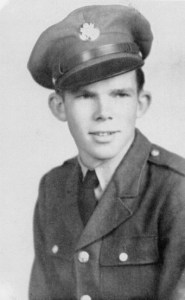
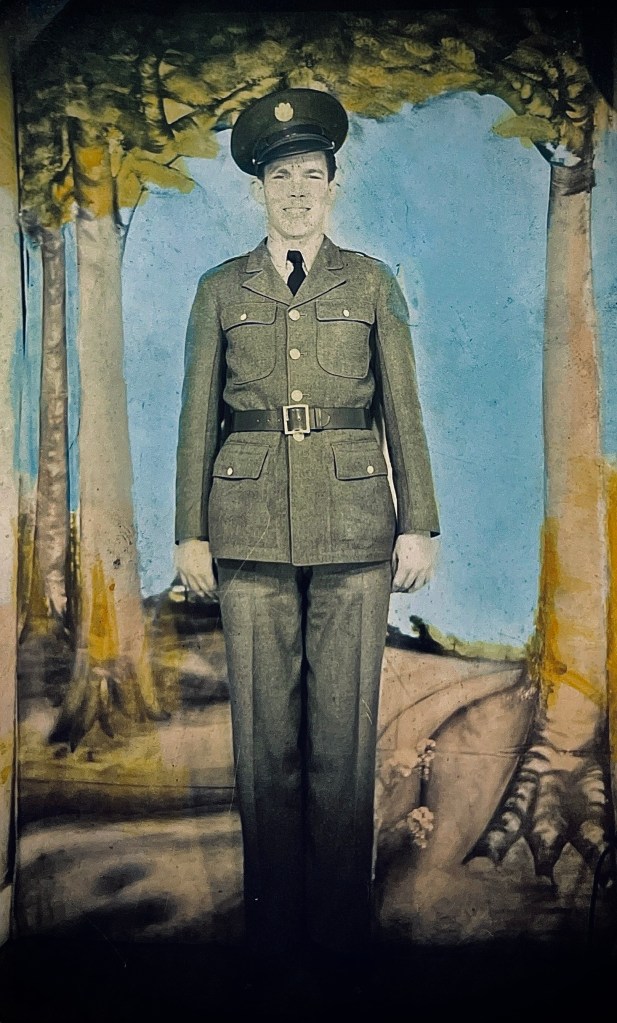
Chuckie as a toddler sitting in frontwith his older brother behindChuckie in adolecenceColorized photo of Chuckle in uniform
There are very few photographs of US Army Staff Sergeant Charles “Chuckie” Melvin Wilson, 36th Bomb Squad, 801st Bomb Group. He was killed in action on 28 April 1944 along with four other American aviators when his B-24 ‘Liberator’ Bomber crashed in the French village of Saint-Cyr-de-Valorges on a secret mission to supply the French resistance in advance of D-Day. Just ten days before he was killed, his brother and sister-in-law had a baby girl, his first niece, and the mother of Unforgotten Glory’s author. She recently passed away; found among her possessions were these new, previously unseen photos of Chuckle.
May these images evoke a small comfort to know that once we are gone, we will not be erased from the memories of others.
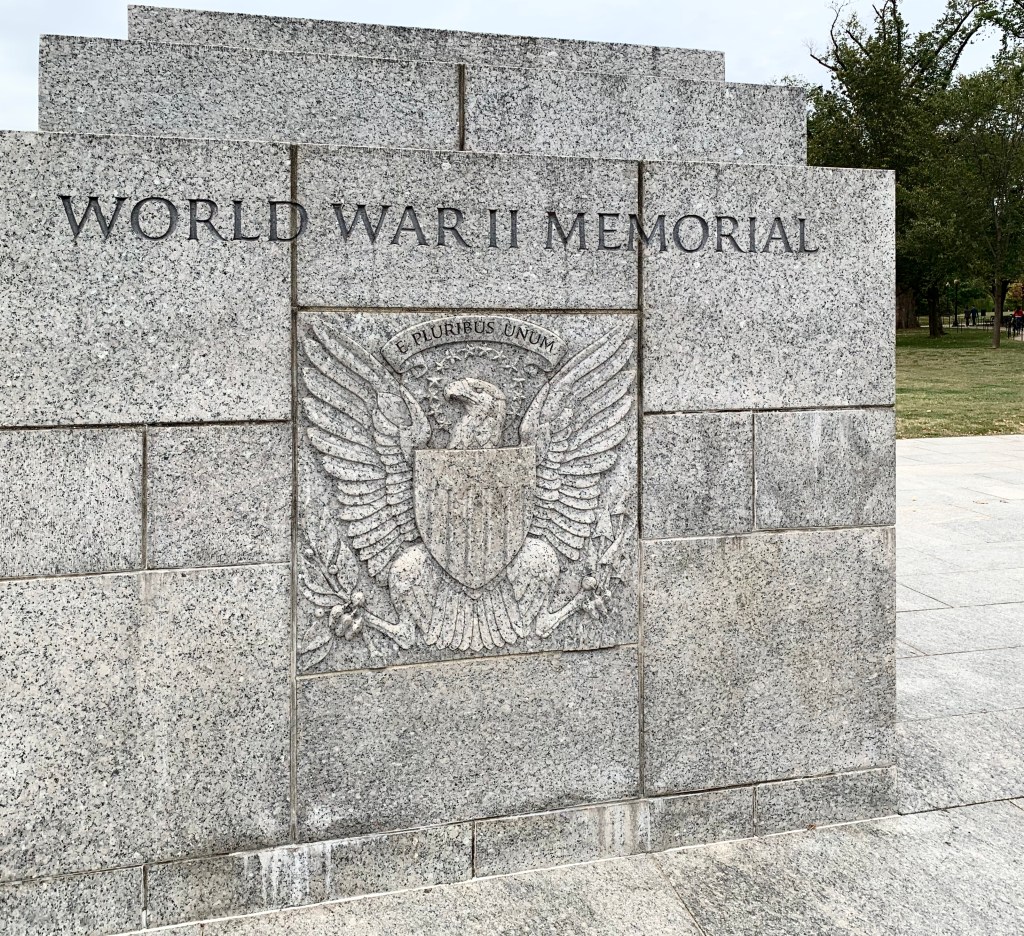
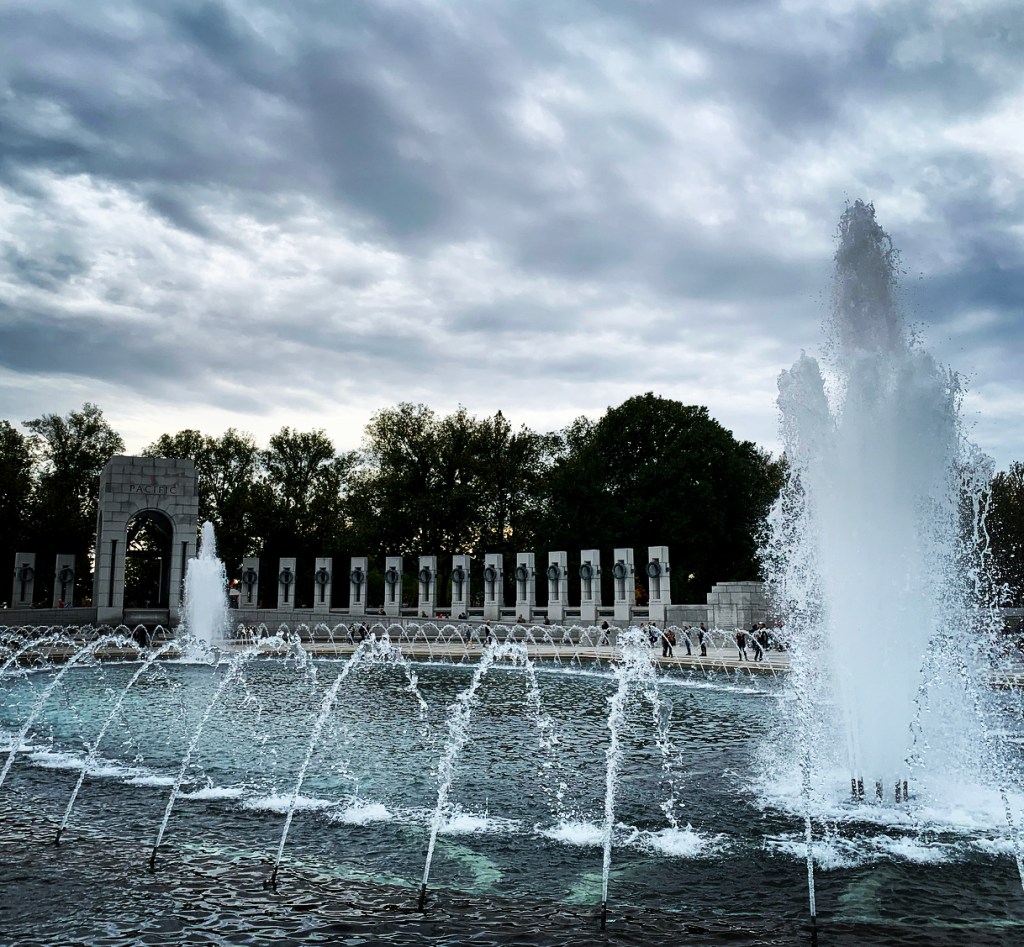
This weekend we visited the World War II Memorial in Washington DC that honors the 16 million who served in the armed forces of the U.S., the more than 400,000 like US Army Staff Sergeant Charles “Chuckie” Melvin Wilson, 36thBomb Squad, 801stBomb Group who died, and all who supported the war effort from home. Stone architecture, bronze sculptures, and a glorious fountain combine to recognize the many ways Americans served in the fight to end tyranny and restore freedom around the globe.
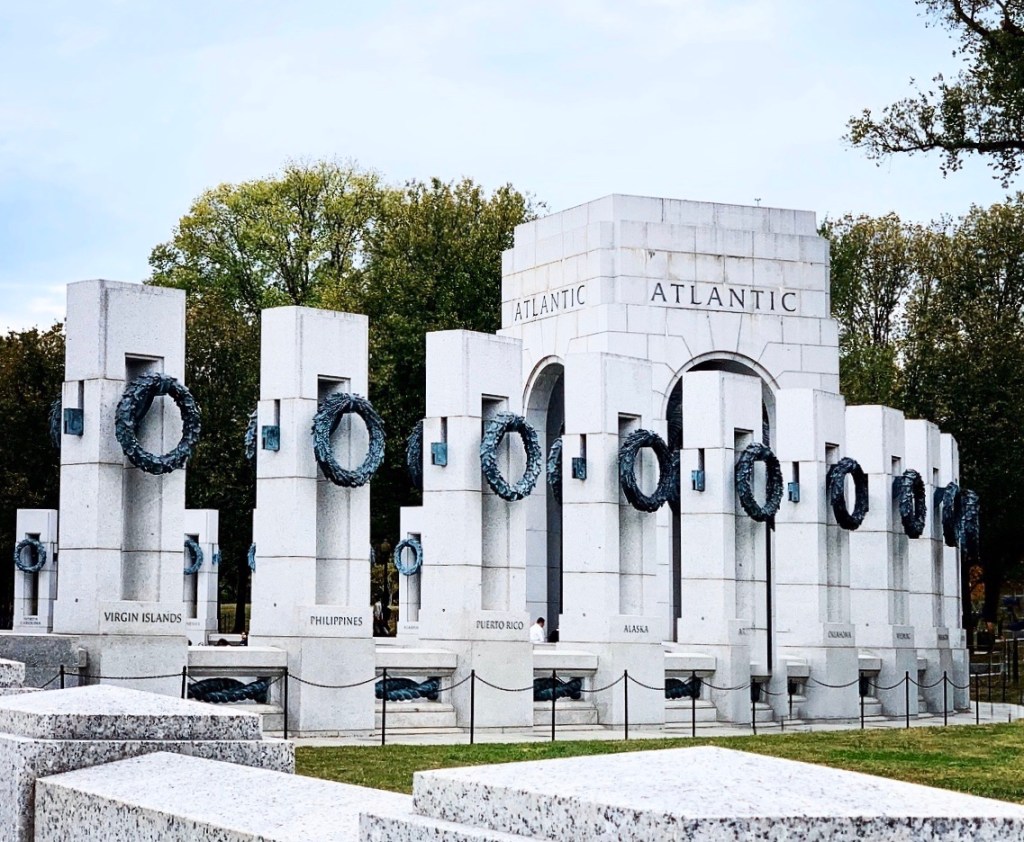
The memorial is a monument to the spirit, sacrifice, and commitment of the American people and is divided into two sides (north and south) that represent the Atlantic and Pacific fronts. They incorporate bronze baldachins, bronze columns bearing American eagles, World War II victory medals, and inscriptions noting the victories in the European and Pacific theatres of operations.
Chuck serviced in the Atlantic
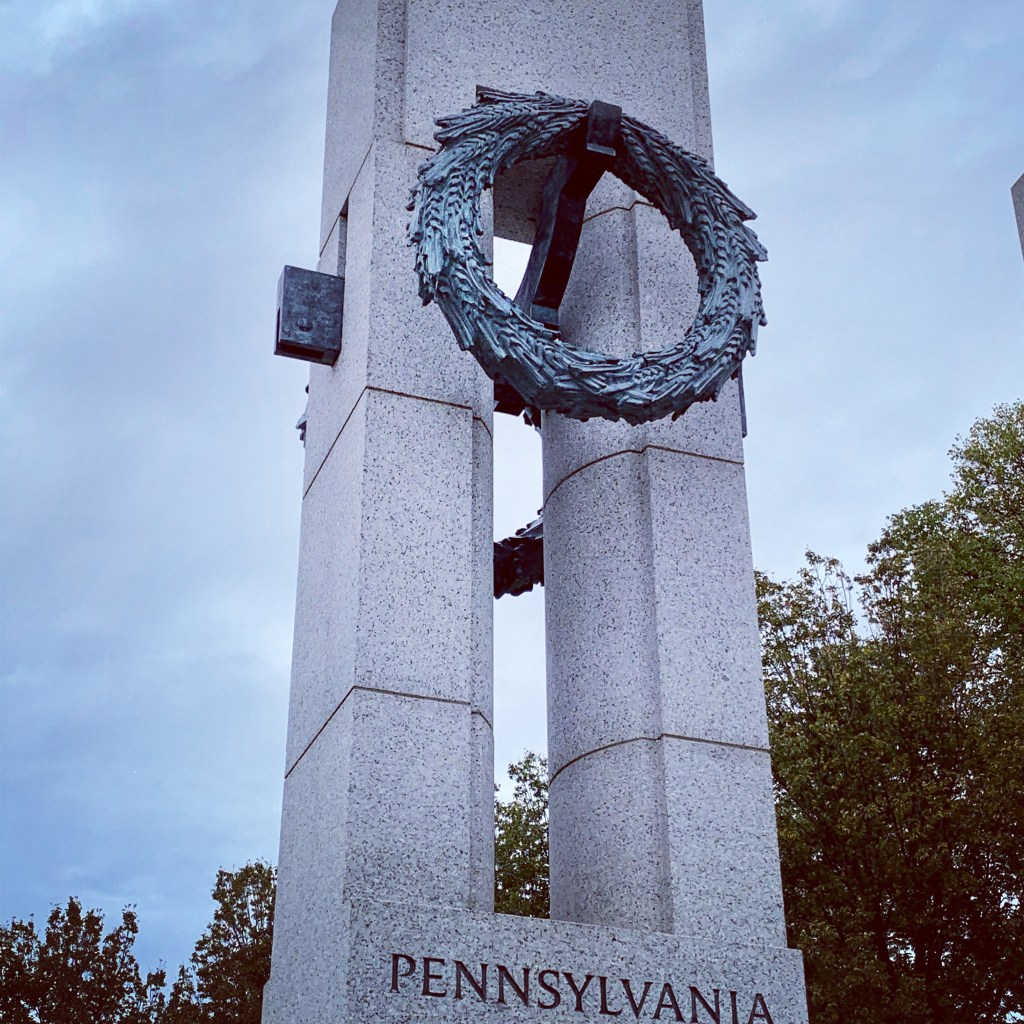
Especially moving to see were 56 triumphal columns surrounding the fountain that list U.S. states, commonwealths, and territories that sent men and women to serve under the U.S. flag during WWII. Chuckie was from Pennsylvania. Each column has two wreaths, one inside and one outside. One wreath consists of oak leaves, representing industrial might. The other consists of wheat, representing the agricultural might of the United States.
Chuckie’s home state
D-Day: A Turning Point in World War II – took years organize
As dawn broke on the French coast at Normandy on 6 June 6 1944, the long-awaited invasion of northwest Europe was, by all accounts, an awe-inspiring sight—the largest amphibious invasion force in history massed in the waters of the English Channel. The giant invasion had taken years to organize, in part because of the need to build up adequate forces in Britain. In the months leading up to the invasion, millions of tons of supplies, ships, planes and weapons were transported across the Atlantic Ocean to Britain in advance of the operation. Hundreds of thousands of troops were assembled in southern England and intensively trained for the complicated amphibious action against Normandy.
Chuckie arrived in Britain five months before in January 1944 with the U.S. Army Air Forces joining the Carpetbaggers who flew hundreds of flights to provide aerial supply of weapons and other matériel to resistance fighters behind enemy lines in France, Italy and the Low Countries in advance of D-Day. Two months before D-Day, Chuckie paid the ultimate sacrifice for freedom when his plane crash landed while on a Top Secret night mission in France to supply the French resistance armies for D-Day.
A mighty endeavor – the hour of great sacrifice
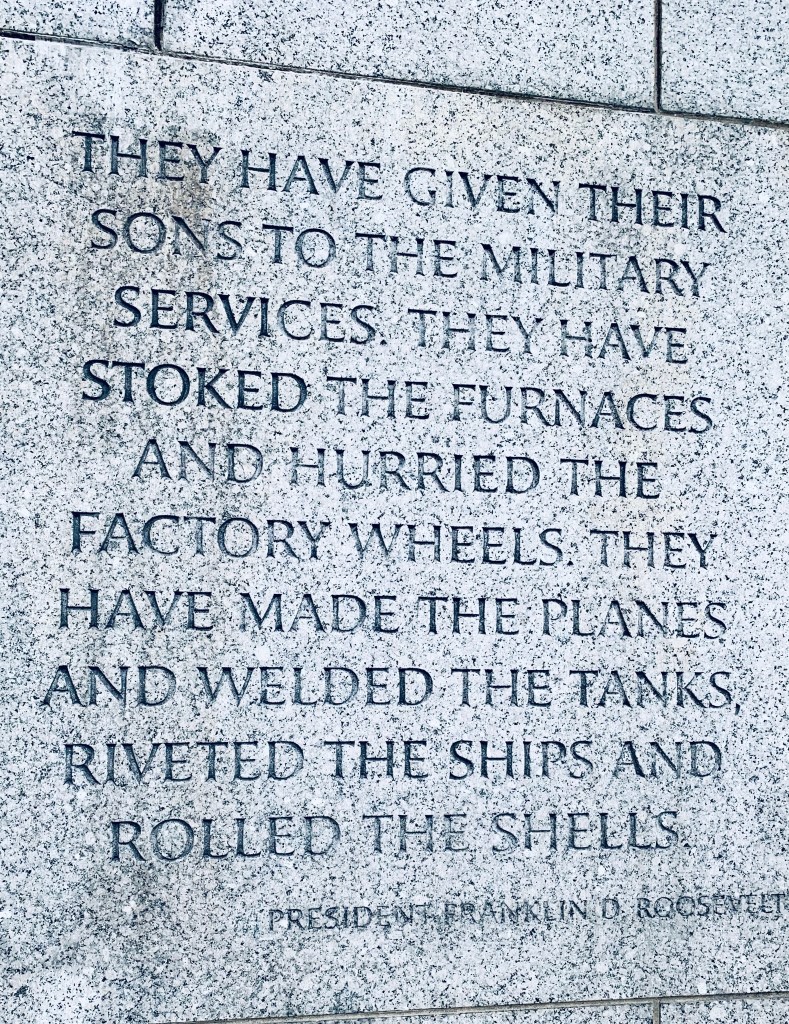
On the night of 6 June 1944, President Roosevelt went on national radio to address the nation for the first time about the Normandy invasion. His speech took the form of a prayer. Chuckie’s parents would have listened with false hope from incorrect information that their their son was ‘over there’ officially classified as Missing in Action. The U.S . Army Air Force had kept from them the truth that one month before his commanding officer had confirmation that Chuckie was Killed In Action. Roosevelt’s radio address that night included a few brief words of comfort to the many American families whose worst fears would come true. Their loved ones – and Chuckie – would not return home alive.
“Some will never return. Embrace these, Father, and receive them, Thy heroic servants, into Thy kingdom. And for us at home — fathers, mothers, children, wives, sisters, and brothers of brave men overseas — whose thoughts and prayers are ever with them–help us, Almighty God, to rededicate ourselves in renewed faith in Thee in this hour of great sacrifice.”
President Franklin D. Roosevelt
The D-Day invasion opened up the long-awaited Second Front against Hitler. The United States and its allies had launched the greatest amphibious invasion in history on the shores of France. Over 150,000 soldiers, sailors, and airmen stormed the beaches of Normandy beginning a campaign that would end with the unconditional surrender of Germany in May 1945. In August, a second Allied invasion force landed on France’s southern coast. Soon Paris was liberated, and by the fall, Allied armies were poised to cross the German border.
The Carpetbagger’s long held secret contribution to paralyzing German infrastructure has now gained widespread recognition for its significant role in helping to defeat the enemy. Dwight D Eisenhower credited the Carpetbaggers and Free French enormous contribution – “Without their assistance, the liberation of France and the defeat of the enemy would have consumed much longer time and meant greater losses to ourselves.“
President Franklin D. Roosevelt
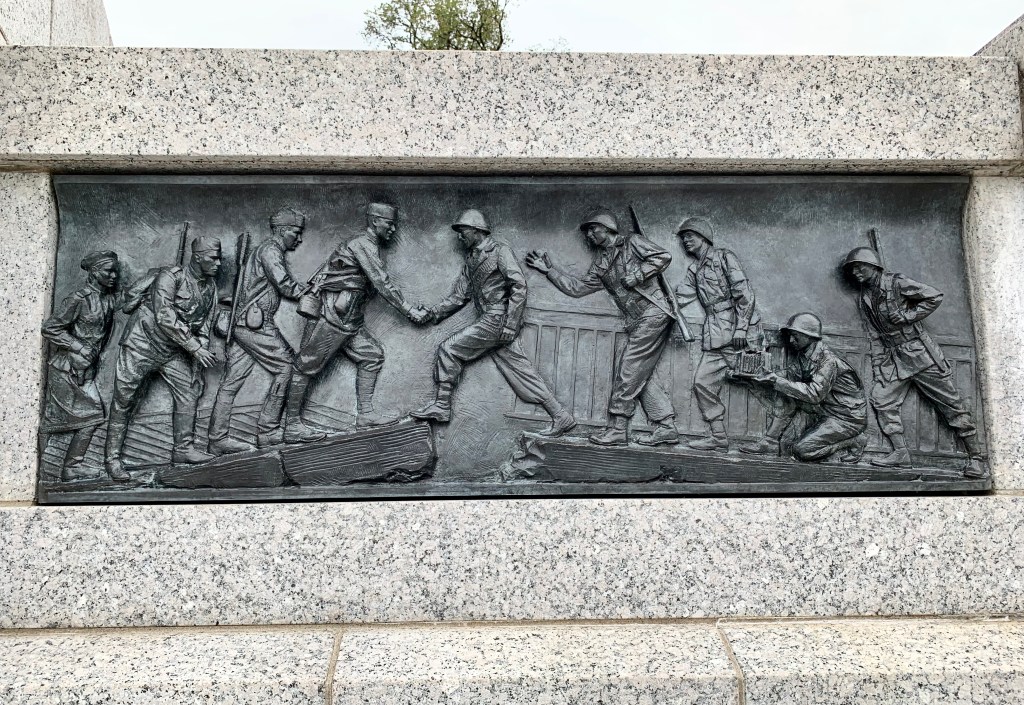
The Memorial it sits on the National Mall in Washington, D.C. between the Lincoln Memorial and the Washington Monument. A series of bas-relief sculpture panels created by sculptor Ray Kaskey is set into the balustrades of the north and south ceremonial entrance walls.
Created by sculptor Ray Kaskey
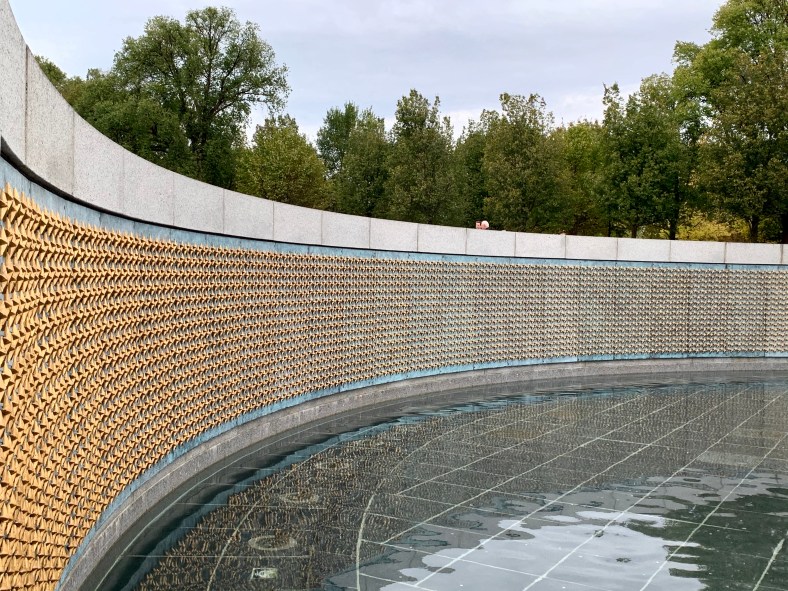
The Freedom Wall – Gold stars mark the price of Freedom
The Freedom Wall, an arched wall containing thousands of gold stars, is where the nation “mark the price of Freedom” and honor the 416,800 American servicemen like Chuckie who died in uniform during WWII. Unlike the Vietnam Veteran’s Memorial, there are no names listed at the WWII Memorial. Instead, those men killed in action are honored with the gold stars. The gold stars come from a military tradition in the USA where military families hang small flags in the windows of their homes to note that a family member was serving in uniform. If that member paid the ultimate sacrifice, then the blue star would be replaced with a gold star.
The Freedom Wall
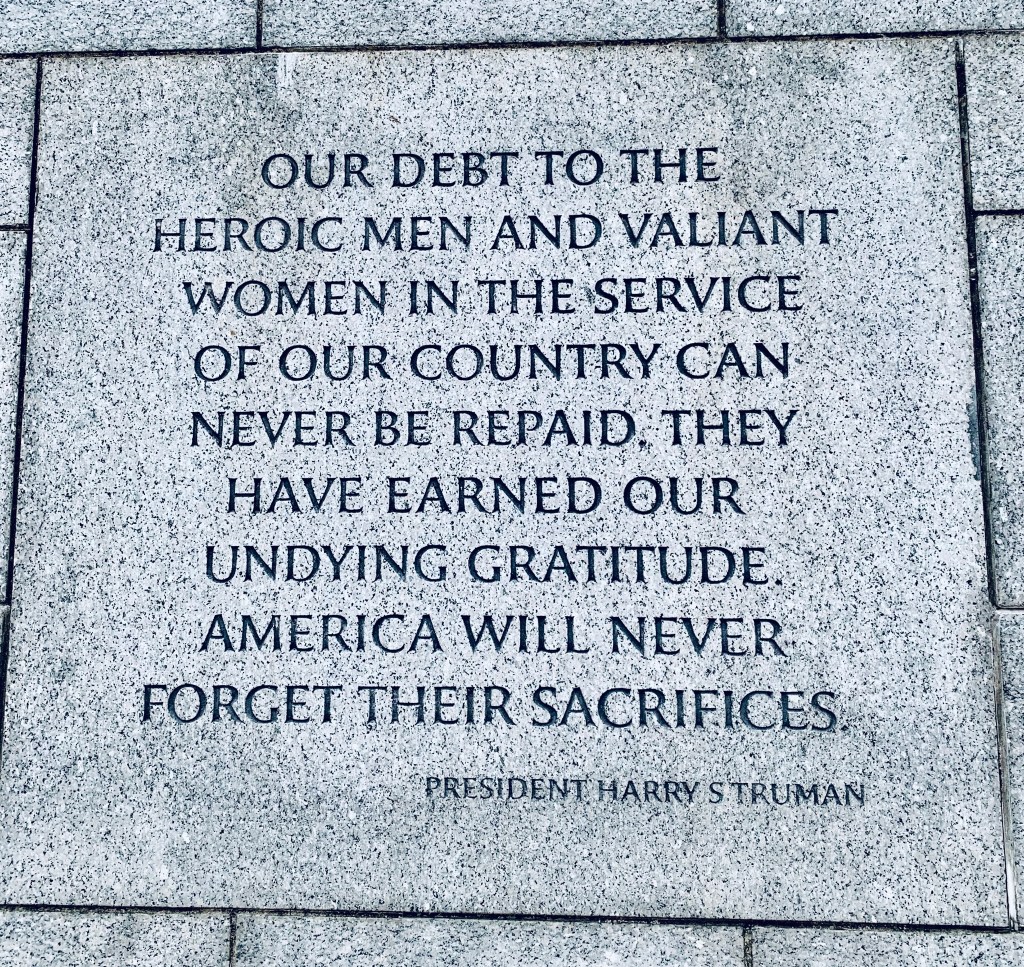
Symbolic of the defining event of the 20th Century, the WWII Memorial is a monument to the spirit, sacrifice, and commitment of the American people to the common defense of the nation and to the broader causes of peace and freedom from tyranny throughout the world. It will inspire future generations of Americans, deepening their appreciation of what the World War II generation accomplished in securing freedom and democracy. Above all, the Memorial stands as an important symbol of American national unity, a timeless reminder of the moral strength and awesome power that can flow when a free people are at once united and bonded together in a common and just cause.
President Harry S. Truman
For more information, see the special online exhibit, D-Day and the Normandy Invasion, hosted by the National Archives and Google Cultural Institute.
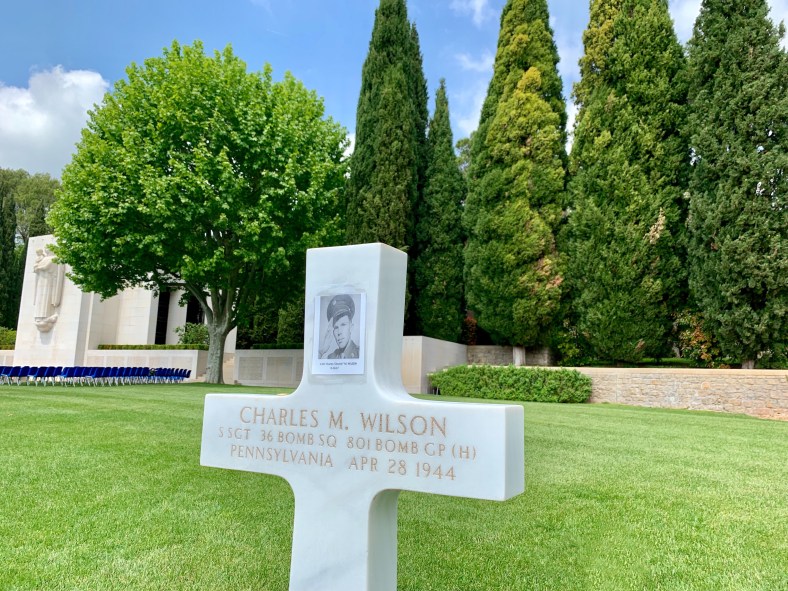
As the world commemorates the 75thanniversary of D-DAY this year, I felt a new sense of urgency and family duty to visit Chuckie’s grave to honor his memory and contribution to freedom. No one from our family had ever visited his grave. They never had passports, didn’t know anyone French and never traveled abroad. On a bright sunny Spring day in May, I journeyed to a beautiful cemetery nestled in the heart of a small village, Draguignan, in Southern France and visited Chuckie’s grave.
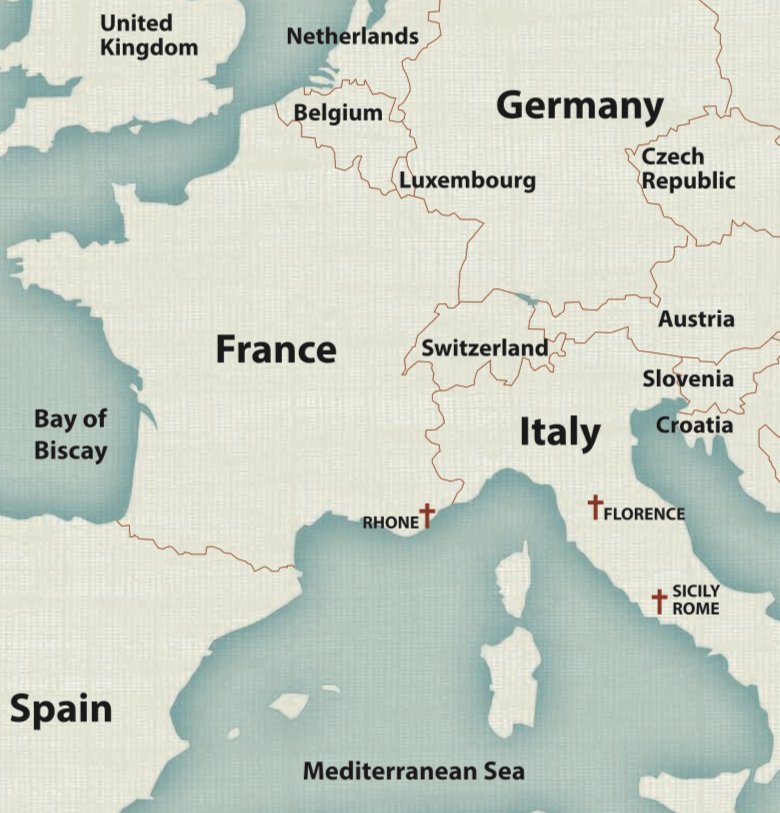
US Army Staff Sergeant Charles “Chuckie” Melvin Wilson, 36thBomb Squad, 801stBomb Group, was killed in action on 28 April 1944 along with four other American aviators when his B-24 ‘Liberator’ Bomber crashed in the French village of Saint-Cyr-de-Valorges on a secret mission to supply the French resistance in advance of D-Day. He is permanently interred in the military war grave cemetery Rhone American Cemetery and Memorial located in Draguignan, France. The site was selected because of its historic location along the route of the U.S. Seventh Army’s drive up the Rhone Valley.
When I arrived the cemetery, staff members we at the gate to greet me. They were so warm and friendly and said how honored they always are when family members visit especially for the first time. The didn’t have any records or photographs of Chuckie on file so were particularly pleased I had made the trip and compiled this blog. It has helped them complete his story and will be included in ongoing educational programs and future memorial commemorative ceremonies. That alone made it all worth it.
For what is remembered lives.
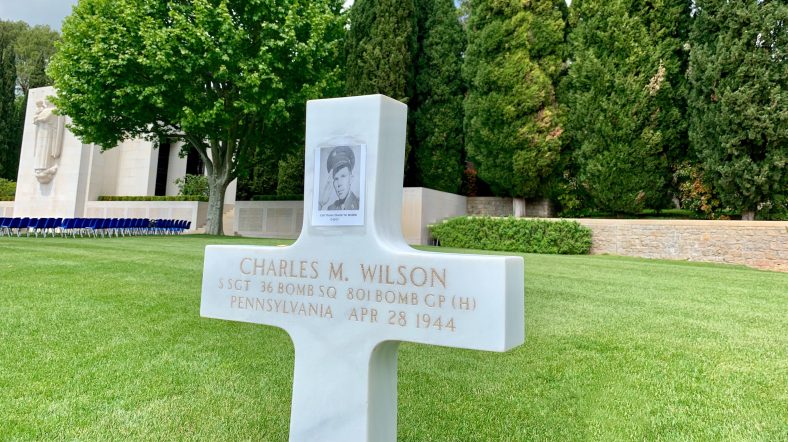
I was given a white lily and taken to the row where Chuckie is laid to rest. Staff told me to walk on up ahead and I would soon came upon his headstone. They gave me a few moments alone to walk the few paces when I soon found him.. I didn’t know what to expect or how I would feel. What began casually a few months before as a simple desk research project to learn about a family member I didn’t know had now become an involved writing project published and shared with thousands of followers around the world on this blog and our Facebook page. Now being at the final resting place of all these young men and Chuckie that day I was filled with emotion that was sadness, gratitude – a but hugely inspired by the meaning of this unexpected journey.
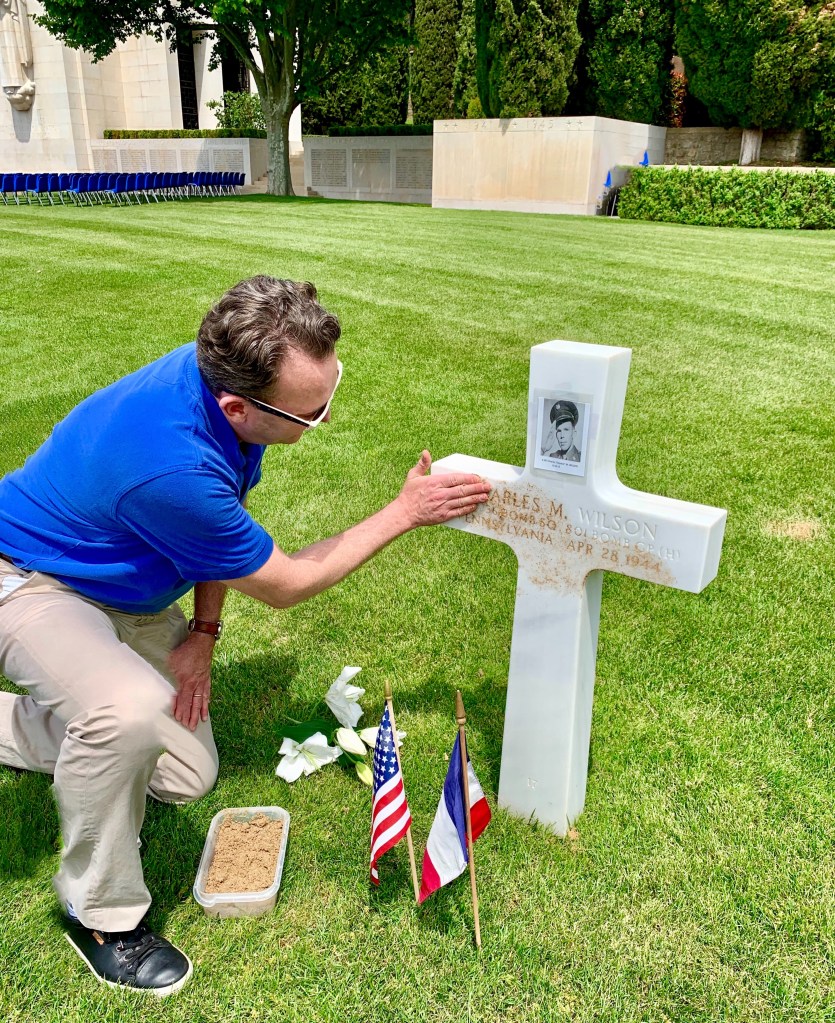
Chuckie’s great nephew rubs sand from Normandy beach on the headstone which makes the letters more readable
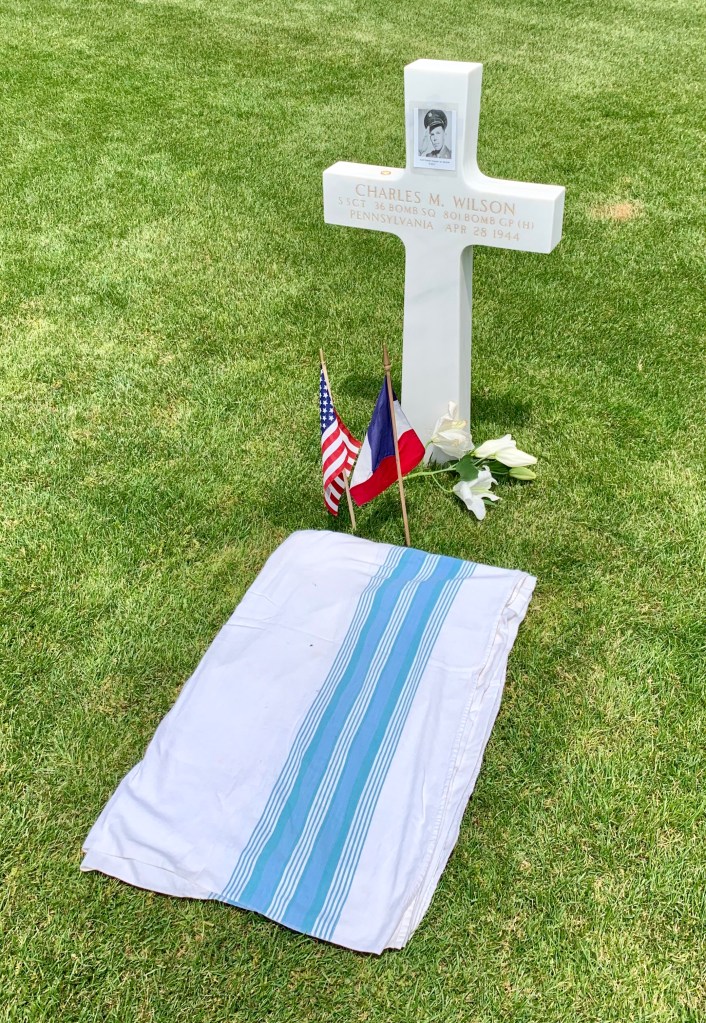
Since neither Chuckie’s parents nor his siblings were ever able in their lifetime to visit his gravesite to say a final goodbye, I brought along a few items that his mother and brother had personally touched. A cotton flannel blanket of his mother Evie was placed over his grave. It was likely in her possession from the 1920s when the family lived at her ancestral home deep in south among the cotton fields of Mississippi. The wedding ring of Chuckie’s brother JB (and the father of this author’s mother) was placed on top of the cross headstone. It was the only personal item I had that he’d touched so seemed appropriate and meant to be.
A blanket of Chuckie’s mother Evie placed over her son’s final place of rest; a gold ring of his brother is placed on the topside of the cross.
I said a silent prayer of gratitude for his service and the ability to symbolically bring Chuckie the warmth of one last hug from his mother that he’d waited 75 years for.
The ultimate sacrifice, the unforgotten glory of their deeds.
The cemetery staff and a few other visitors joined me and gathered around Chuckie’s grave for a brief ceremony. First a moment of silence, then I shared the story of Chuckie, his family and what we came to learn about his brave service. We all reflected upon all the brave young men of the Allied Forces who fought and died in WWII and the glory of their deeds that shall not be forgotten.
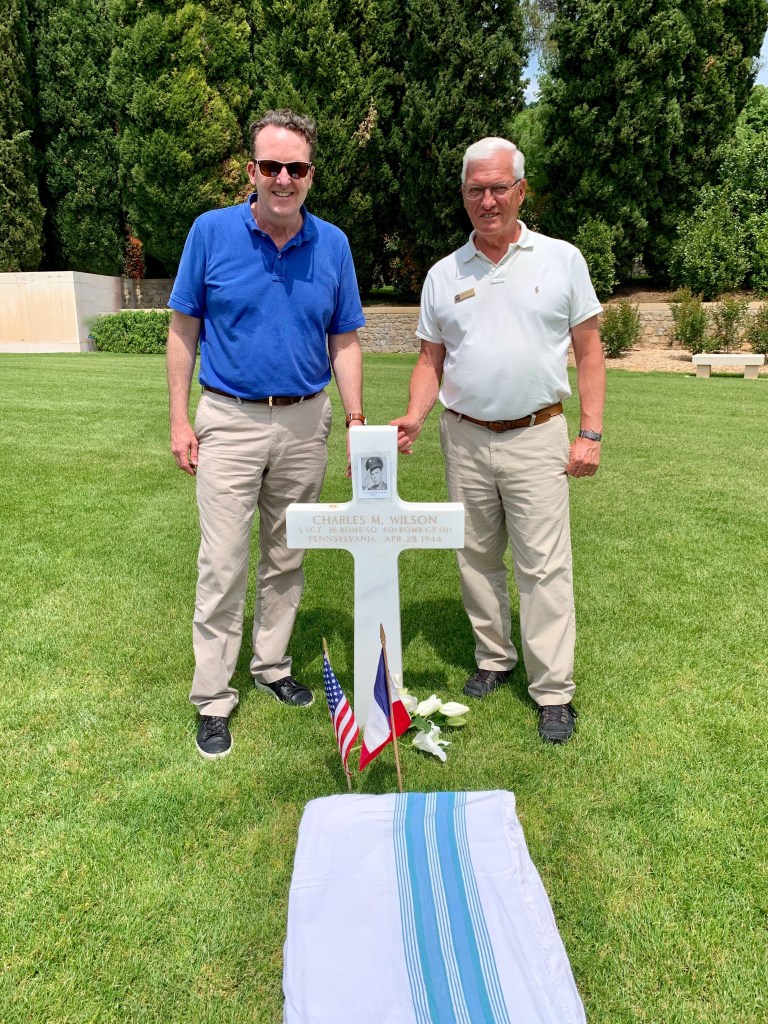
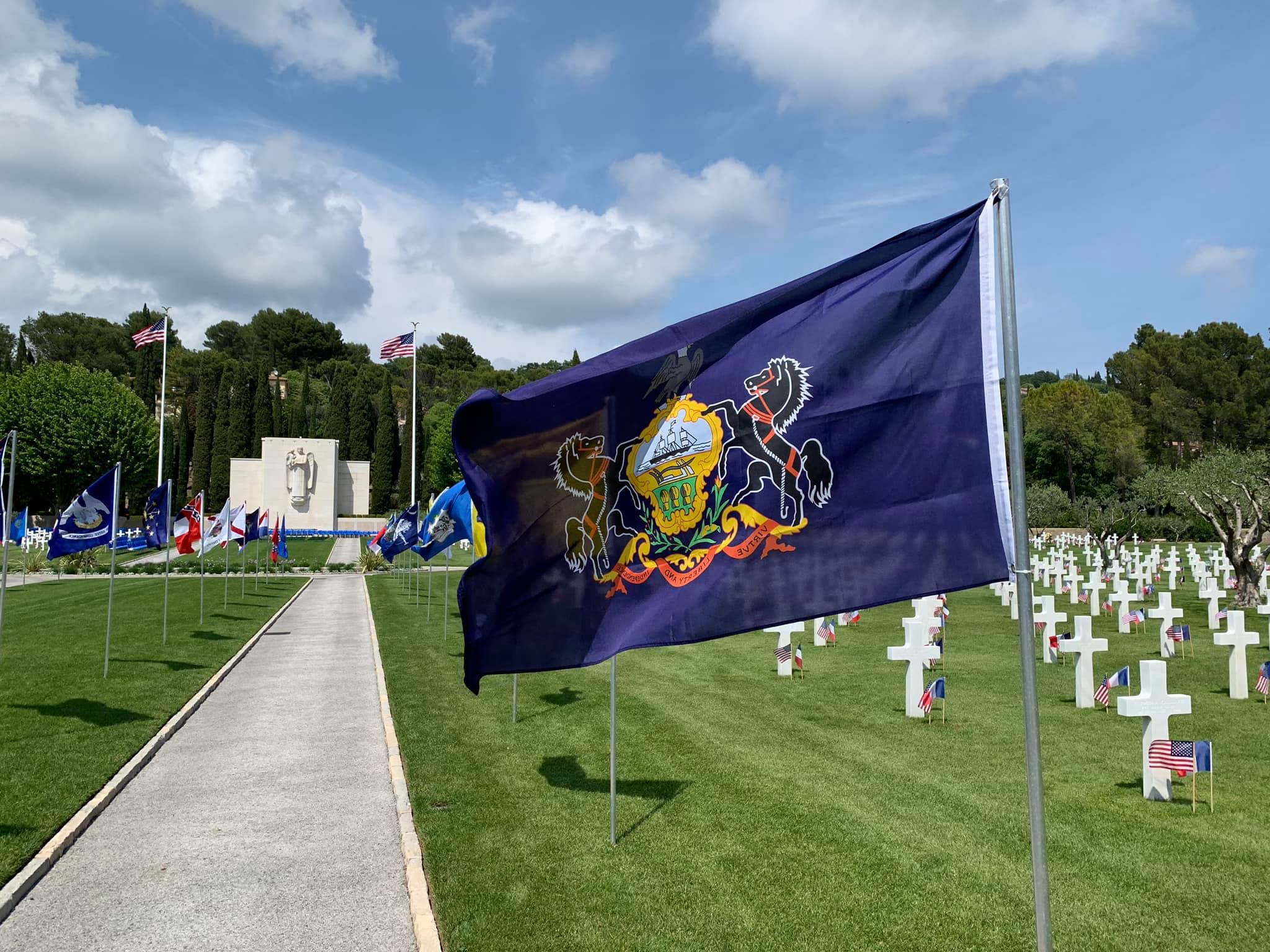
Chuckie,s great nephew is joined by the cemetery Superintendent. The State of a Pennsylvania flag flies as more than 100 men buried there are from Pennsylvania like Chuckie. And 80% buried there were just 20 years old when they died.
Together, we honor all those like Chuckie who fought and died for freedom. #RIP.
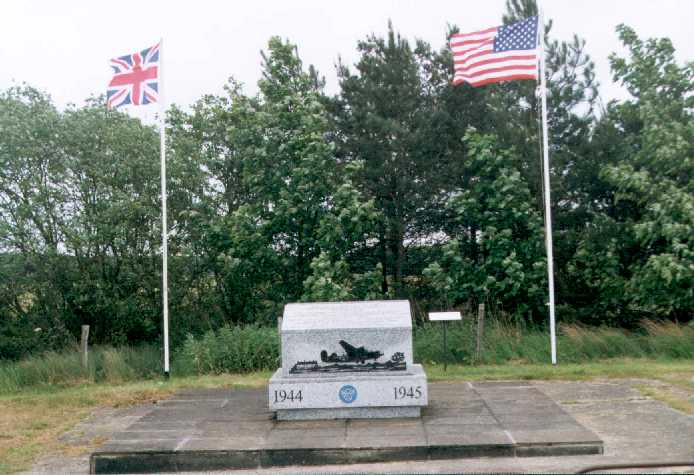
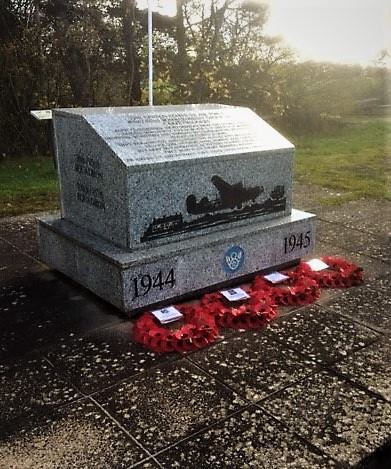
Forty two years after their mission, on 19 September 1987, fifty ex Carpetbaggers returned to Harrington to dedicate a memorial to Chuckie and the other Carpetbagger US Army Air Forces lost during WWII. The memorial is placed in a position overlooking the airfield where the B-24s carried out one of its most effective contributions to the Allied victory.
Chuckie’s family never knew that he was a Carpetbagger, that RAF Harrington was his base, or that this memorial to him existed until earlier this year when a family member and author of this blog began researching facts about about his life and contribution to Freedom. The experience and techniques perfected during Carpetbagger operations were used as the US Central Intelligence Agency (CIA) continued to develop into a worldwide organization. For this reason many records of the 801st / 492nd Bomb Group and the US Army Airmen like Chuckie that Carpetbaggers remained secret or restricted until the 1980s.
A memorial to the Carpetbaggers overlooking the airfield at Harrington RAF The memorial is located on site of Dispersal at side of the Harrington to Lamport Road
The Carpetbagger Aviation Museum was formed in 1993 for the 50th Anniversary reunion of the USAAF’s 801st / 492nd Bomb Group (The Carpetbaggers) at Harrington. It is housed in the Group Operations Building on the Administration Site of the former Station 179 airfield at Harrington, Northamptonshire, England. The Museum is administered by members of the Harrington Aviation Museum Society, a Registered Charity No 1061997
The author of Unforgotten Glory plans to visit Harrington RAF and The Carpetbagger Museum to pay respects at the last place Chuckie and his fellow comrades walked the earth as they prepared and then took off 27 April 1944 into the dark night sky.
Chuckie is is the only member of the 36th Bombardment Squadron and lone Carpetbagger buried at Rhone American Cemetery in the city of Draguignan which is located in Southern France. The squadron conducted special operations and electronic warfare missions over Europe from 1943 until the end of the war. By the end of World War II, several hundred temporary burial grounds had been established by the U.S. Army on battlefields around the world. In 1947, 14 sites overseas were selected to become permanent cemeteries by the Secretary of the Army and ABMC and included Rhone American Cemetery. Chuckie was interred there on 21 December 1948.
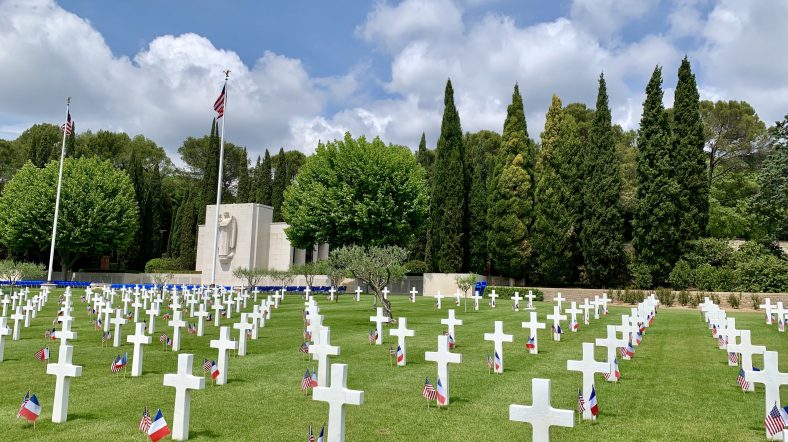
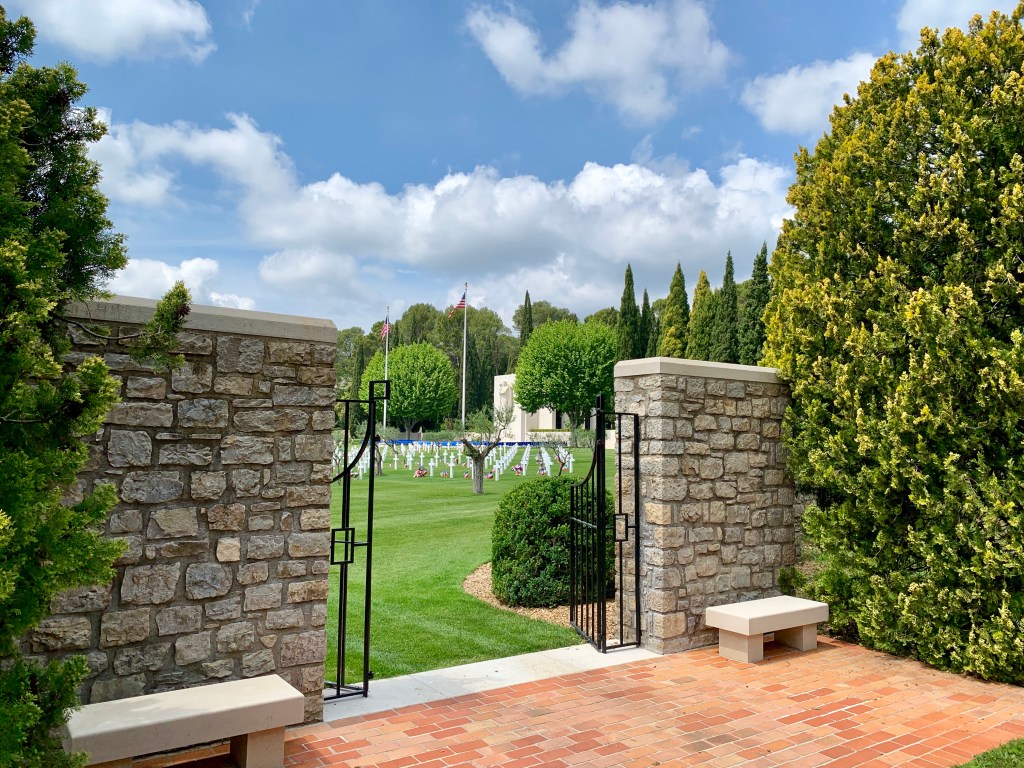
Draguignan, is the final resting place for 860 American war dead, most of whom lost their lives in the liberation of southern France in August 1944. Their headstones are arranged in straight lines, divided into four plots, grouped about an oval pool. At each end of the cemetery is a secluded garden and fountain surrounded by the characteristic cypresses, olive trees, and oleanders of southern France.
The American Battle Monuments Commission, established by Congress in 1923, is an agency of the executive branch of the federal government. ABMC—guardian of America’s overseas commemorative cemeteries and memorials—honors the service, achievements and sacrifice of U.S. Armed Forces. Each grave site in the overseas American World War I and II cemeteries is marked by a headstone of pristine white marble.
The cemetery grounds are not American territory. However, use of the land is granted to the United States in perpetuity, free of any taxes, fees or any other charges. This is done through a treaty between the United States and France. Burial in ABMC cemeteries is limited by the agreements with host countries to members of the U.S. armed forces who died overseas during the wars.
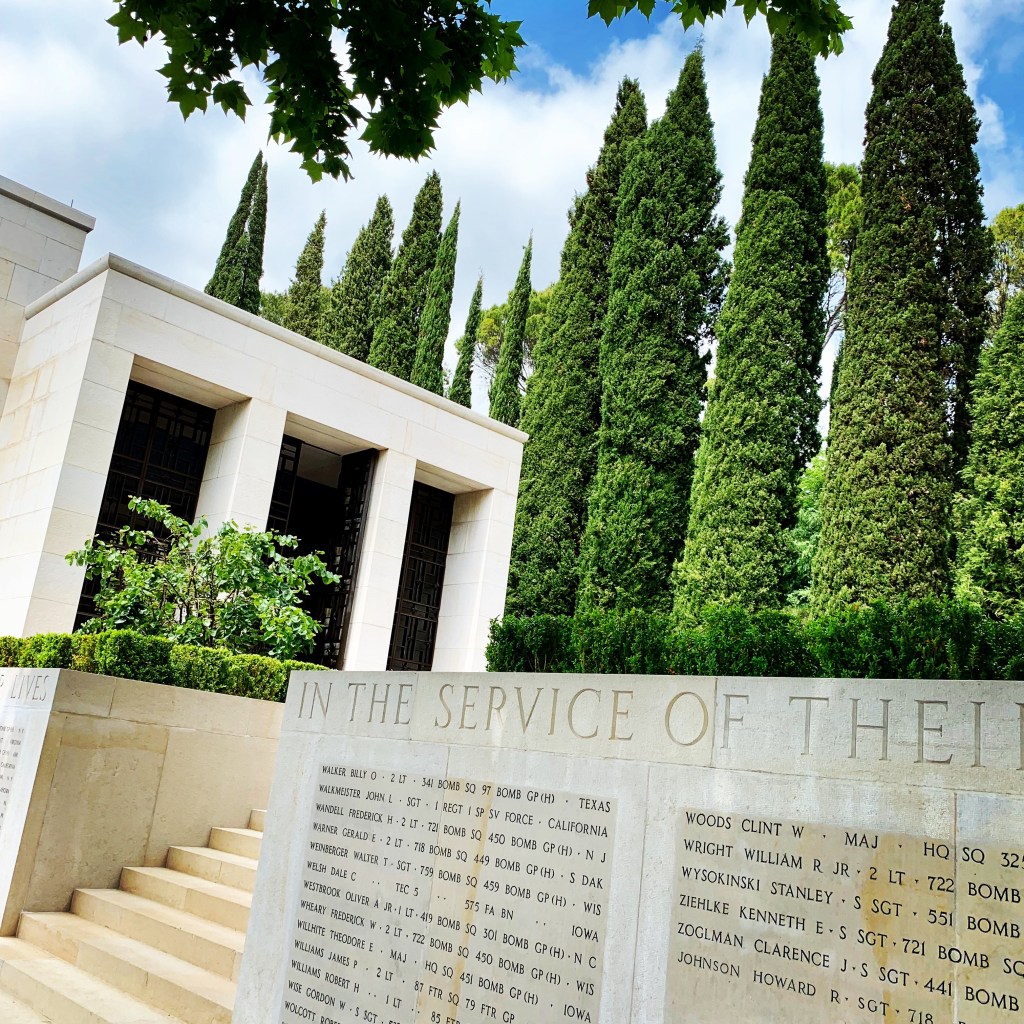
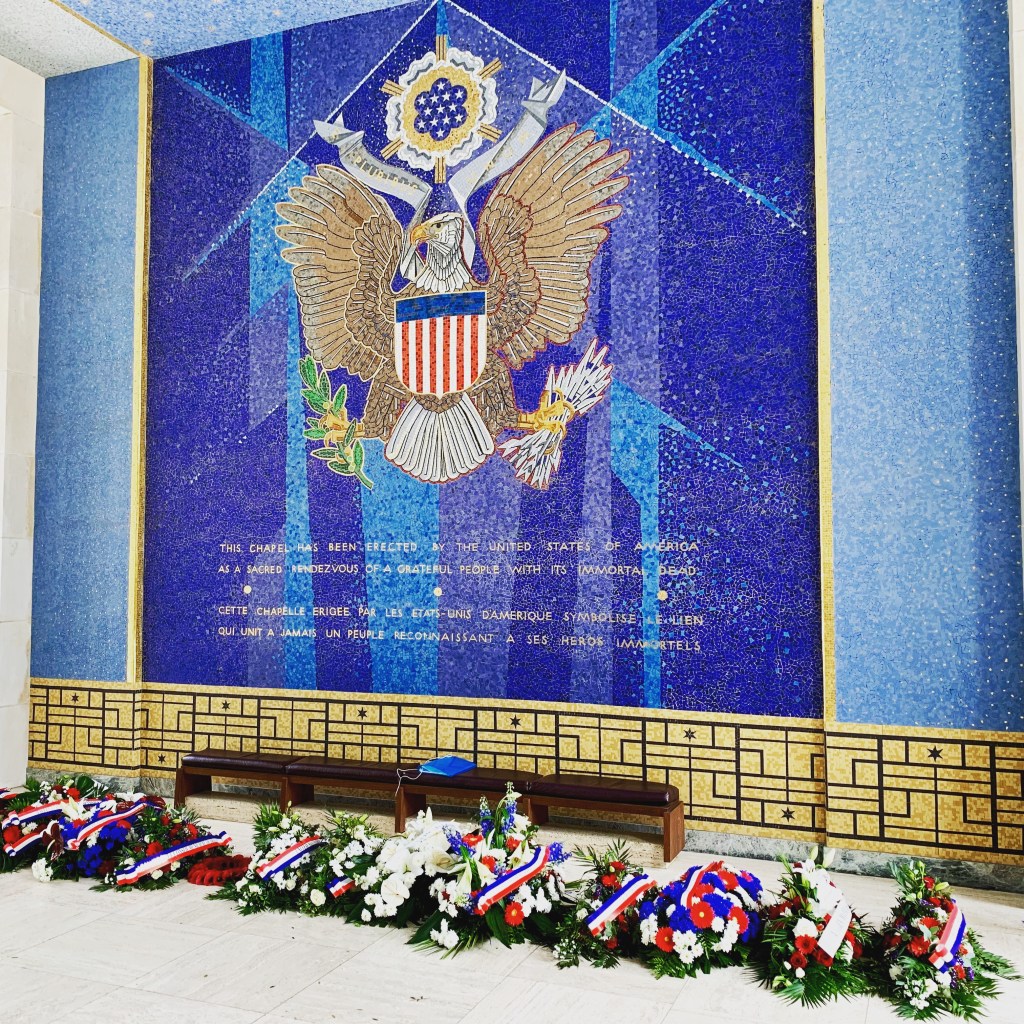
On the hillside overlooking the cemetery stands the magnificent chapel with its beautiful, decorative mosaic. On the retaining wall of the terrace are inscribed the names of 294 of the missing.
The cemetery chapelLooking out into the cemetery from the beautiful secluded garden and fountain The beautiful, decorative mosaic inside the chapel
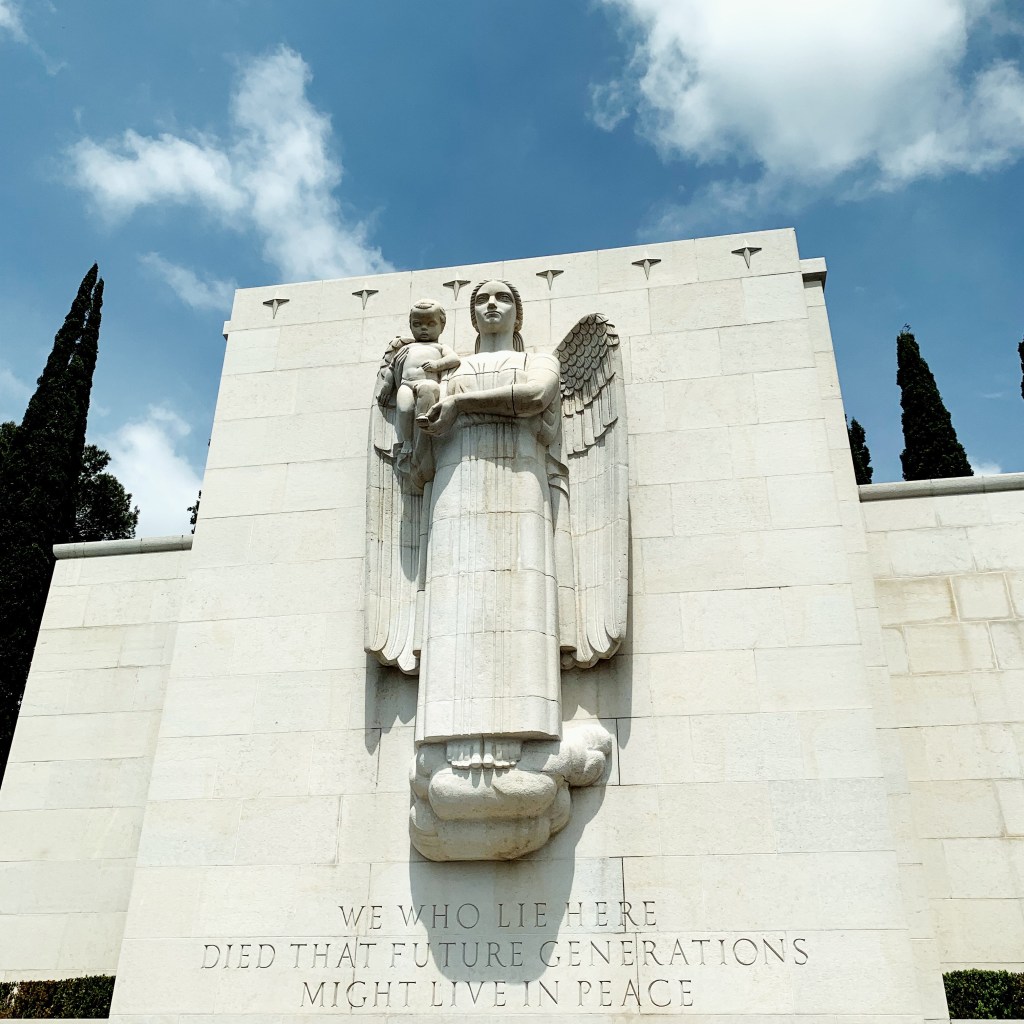
On the façade of the chapel is the sculpture of the Angel of Peace watching over the graves. Beneath the sculpture is the engraving, “Those who lie here died that future generations might live in peace.”
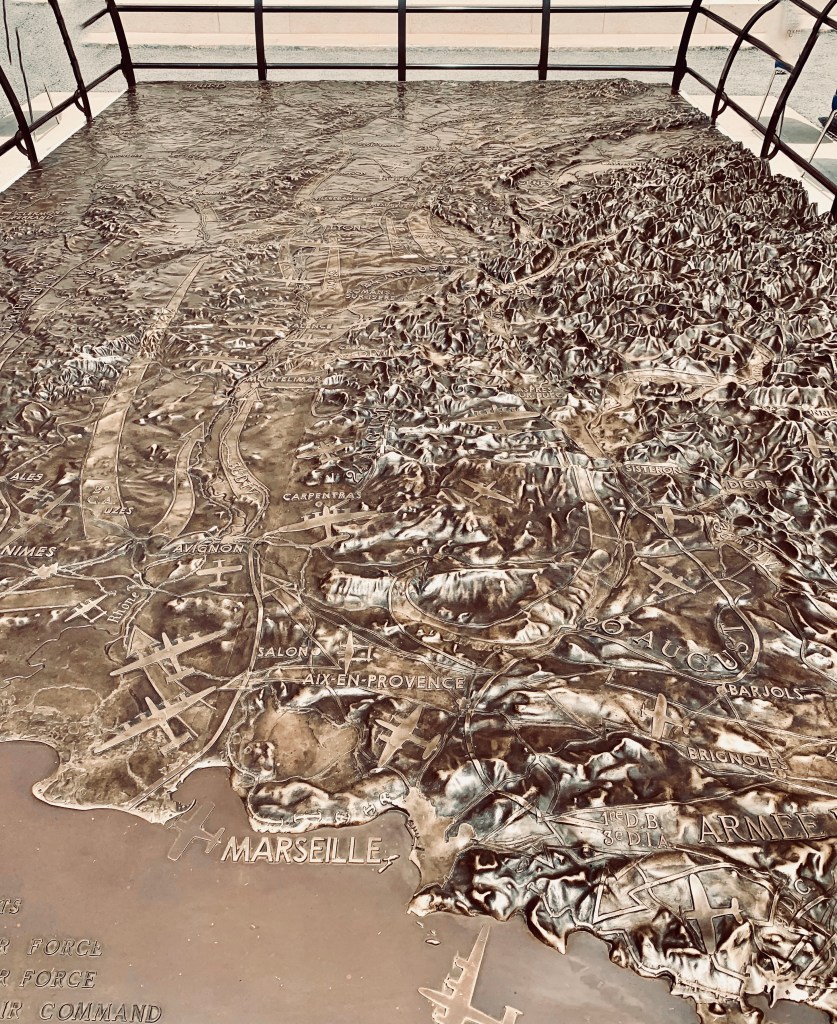
Between the chapel and the burial area, the great bronze relief map recalls the military operations in the region.
Bronze relief map recalls the military operations in the region.
Unlike the national cemeteries administered by the Department of Veterans Affairs, all permanent American military cemeteries on foreign soil are “closed” except for the remains of servicemen and women lost during World War I and World War II that may be found on the battlefields or recently identified by the Defense POW/MIA Accounting Agency.
The 2018 Memorial Day Ceremony at Rhone American Cemetery took place outside the memorial building. Image courtesy of Michel Delannoy.
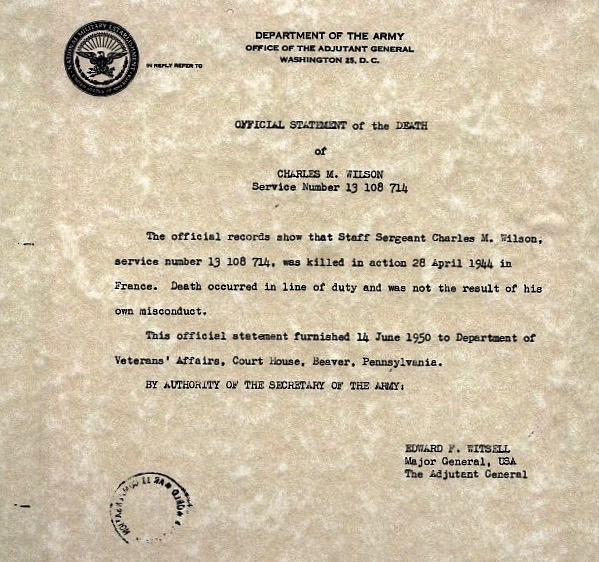
World War II was the deadliest military conflict in history. An estimated total of 70–85 million people perished, which was about 3% of the 1940 world population (est. 2.3 billion). Chuckie was one of the 52,173 U.S. Army Air Force killed in action. On 14 June 1950 an official Statement of Death was furnished by the Department of the Army to the Department of Veteran’s Affairs, Court House, Beaver, Pennsylvania noting Charles M. Wilson was killed in action on 28 April 1944 in the line of duty in France.
Battle deaths of US citizens (including POWs who died in captivity, but does not include those who died of disease and accidents) were 292,131: Army 234,874 (including Army Air Forces 52,173); Navy 36,950; Marine Corps 19,733; and Coast Guard 574. Of those killed, 185,924 deaths occurred in the European/Atlantic theater of operations and 106,207 deaths occurred in Asia/Pacific theater of operations. Source: STATISTICAL AND ACCOUNTING BRANCH OFFICE OF THE ADJUTANT GENERAL (June 1, 1953).
The final resting place of Charles M. Wilson at Rhone American Cemetery in France
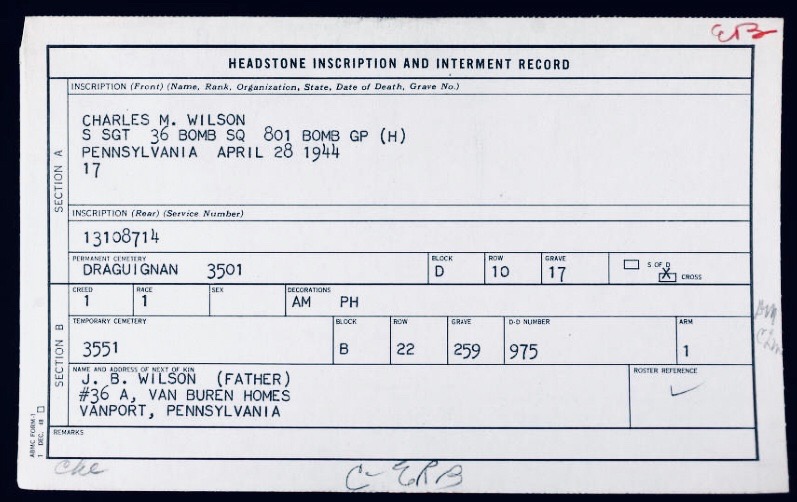
Just before Christmas in 1948 Chuckie’s parents received a letter confirming the final interment of their son Staff Sergeant Charles. M. Wilson per their expressed wishes. Like many who lost loved ones in WWII, the Wilson family chose to honor him by leaving his remains in the region near where he died fighting for what he believed and interred side by side with comrades who also gave their lives for their country rather than having his remains returned to the United States.
The record Chuckie’s father J.B Wilson authorized for Chuckie’s permanent internment in France
At military cemeteries, the decedent’s full name, rank, date of death, unit, and state of entry into military service are inscribed on the grave marker. The individual’s service number is included on white marble headstones at the World War II cemeteries.
The interment of remains of World War I and World War II war dead at permanent overseas American military cemeteries was made by the American Graves Registration Service, Quartermaster General of the War Department. When the interment program was completed the cemeteries were turned over to American Battle Monuments Commission (ABMC) for maintenance and administration.
The interments of World War I and World War II remains at ABMC cemeteries are permanent. It is no longer possible to repatriate the remains of those interred at these American military cemeteries. A provision of the law terminated authority to make further disposition of remains after December 31, 1951, when the decision of the next of kin became final. The program of final disposition of war dead established the moral and legal obligation of the U.S. government to honor the expressed wishes of the next of kin authorized to make the decision regarding the permanent interment of their loved one’s remains.
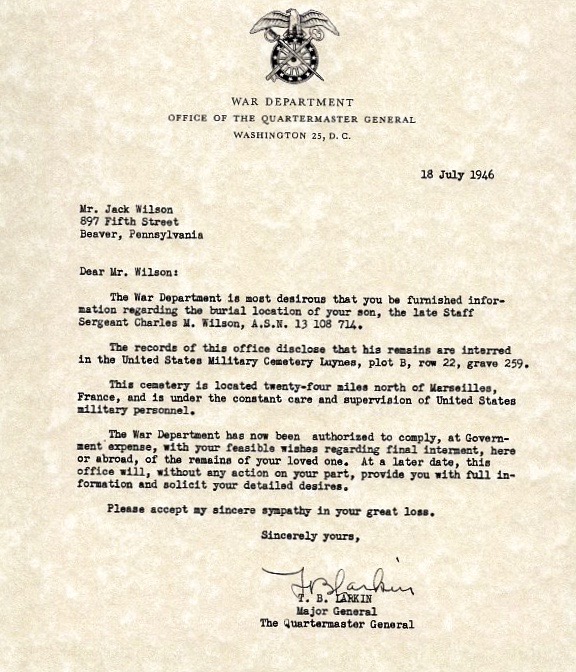
“Dear Mr. Wilson:
This letter is to inform you that the remains of your loved one have been permanently interred, as recorded above, side by side with comrades who also gave their lives for their country. Customary military funeral services were conducted over the grave at the time of burial.
After the Department of the Army has completed all final interments, the cemetery will be transferred, as authorized by the Congress, to the care and supervision of the American Battle Monuments Commission. The commission also will have the responsibility for permanent construction and beautification of the cemetery, including erection of the permanent headstone. The headstone will be inscribed with the name exactly as recorded above, the rank or rating where appropriate, organization, State, and date of death. Any inquiries relative to the type of headstone or the spelling of the name to be inscribed thereon should be addressed to the American Battle Monuments Commission. . . “
While interment activities are in progress, the cemetery will not be open to visitors. However, upon completion thereof, due notice will be carried by the press.
You may rest assured that this final internment was conducted with fitting dignity and solemnity and that the grave-side will be carefully and conscientiously maintained in perpetuity by the United States Government.”
Letter to Chuckie’s parents from Thomas B Larkin, Major General, The Quartermaster General, United States War Department
Chuckie is buried at RHONE AMERICAN CEMETERY in the city of Draguignan which is located in Southern France. More on his final resting place and the recent visit by this author coming up in a future post.
The Carpetbaggers have been recognized with many prestigious awards and citations includng a Presidential Unit Citation by the United States for “extraordinary heroism in action against an armed enemy” and most recently the Congressional Gold Medal.
Chuckie’s Commander was Colonel Clifford Heflin, a decorated member of the Armed Forces, serving in the Air Force for 31 years. Commander Heflin was personally honored with several prestigious awards from the Amy Air Force and from General Charles DeGaulle’s Free French Forces.
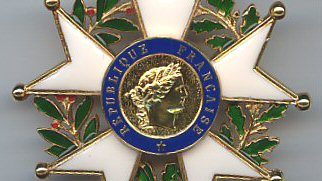
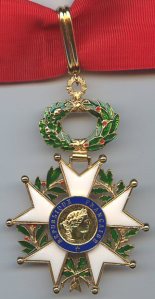
At a ceremony in Paris on 7 Sep. 1945, Heflin received the French Ordre National de la Légion d’honneur (“National Order of the Legion of Honor”), France’s highest award, and the Croix de Guerre (“Cross of War”) from General Marie Pierre Joseph Francois Koenig, Charles DeGaulle’s head of the resistance, and later military governor of Paris.
The Croix de Guerre is awarded either as an individual award or as a unit award to those soldiers who distinguish themselves by acts of heroism involving combat with the enemy.
Due to the S E C R E T classification until 1984 of the Carpetbagger Project, some of the awards are still not yet included in official published lists of honorees.
Sources include Heflin’s personal papers and copies of brief articles in two French newspapers published 10 Sept. 1945.
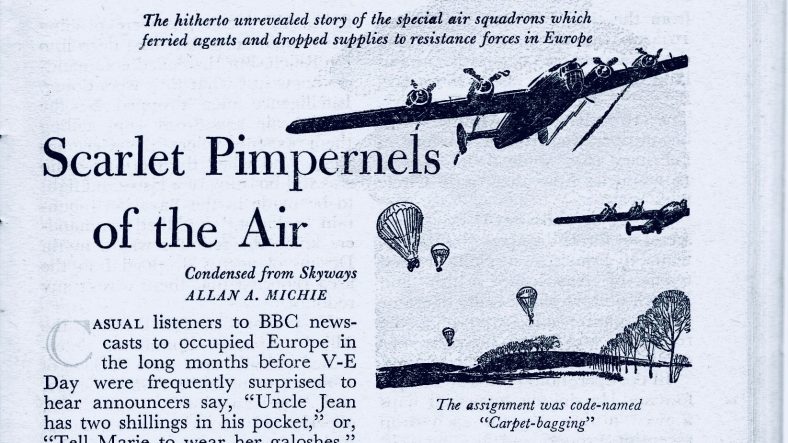
While the secrets of the Carpetbagger Project were closely guarded for fifty years, the American publication Readers Digest was the first to publish “the hitherto unrevealed story of the special air squadrons which ferried agents and dropped supplies to resistance forces in Europe.” I found a reference to the article in the Worry Bird Missing Air Craft Report – so I went on Ebay and quickly and easily bought an actual copy of the November 1945 issue. Chuckie is referenced at the end of the article but, unsurprisingly, not by name nor did the article reveal the full truth about him or his fellow airmen despite all the complete facts well known to many and none made known to his parents yet.
“Scarlet Pimpernels of the Air”
The article is a fascinating read and provides interesting information about RAF Harrington, the B-24 Liberators, the French Marquis and their important role in the War. But it did not reveal the names or that Chuckie was killed in action.
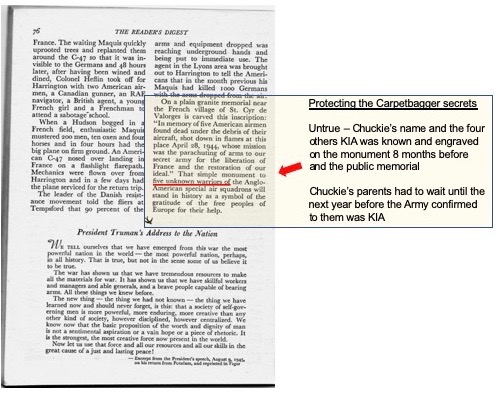
Readers Digest was a popular publication in America at one time with a wide circulation of American readers. Whether Chuckie’s parents read this story is not known and likely. Chuckie’s parents still thought their son was missing in action. If they read this article, the last paragraph would have come as a shock.
“In memory of five American airmen found dead under the debris of their aircraft, shot down in flames at this place April 28, 1944, who’s mission was the parachuting of arms to our secret army for the liberation of France and the restoration of our ideal.“
Sixteen months before this Readers Digest article published, Chuckie’s parents were informed he was reported as Missing in Action on 28 April 1944. Sadly, they would still be made to wait another five months before finally receiving official confirmation that their son was killed in action and as an upcoming post will reveal.
Carpetbaggers from their base at RAF Harington helped build disparate French resistance groups into an effective sabotage and guerrilla force. The objective was to help the French resistance to “harass, disrupt and divert” the German army’s defense against the Allies’ D-Day invasion. Following the Carpetbagger successes early in 1944, Gen. Dwight D. Eisenhower, Supreme Commander of the Allied Expeditionary Force, ordered Lt. Gen. Carl Spaatz, Commanding General of U.S. Strategic Air Forces in Europe, to increase the size of the unit, which quickly grew to a force of 3,000 airmen, sixty-four B–24 bombers and several C–47s.
From January 1944 to May 1945, the Carpetbagger Project completed 1,860 sorties and delivered 20,495 containers and 11,174 packages of vital supplies to the resistance forces in western and northwestern Europe. More than 1,000 parachutists dropped through the B-24 Joe Holes into enemy territory.
Chuckie’s B-24 Liberator The Worry Bird was on one of the twenty-five B-24s lost. Eight more were so badly damaged by enemy action and other causes that they were no longer fit for combat. Personnel losses initially totaled 208 missing and killed and one wounded. Fortunately, many of those listed as missing had parachuted to safety and returned to RAF Harrington with the help of the same resistance forces they had been sent to resupply.
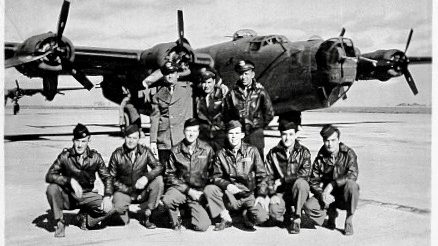
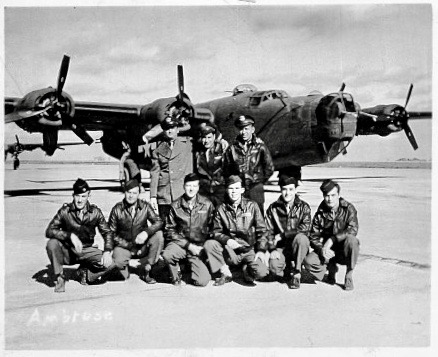
The Ambrose Crew in front of B-24 Liberator The Worry Bird. Charles M. Wilson is 4th from left, front row kneeling.
“The Free French had been of inestimable value in the campaign. Without their assistance, the liberation of France and the defeat of the enemy would have consumed much longer time and meant greater losses to ourselves.”
U.S General Dwight D. Eisenhower
“The French Resistance Movement played a noble part in the liberation of Brittany and the peninsula was quickly overrun.”
British Prime Minister Winston Churchill
On 13 August 1945 the Carpetbaggers were re-designated as the 49nd Bomb Group H and the four Bomb Squadrons. On 7 July 1945, the air echelon of the 492 Bomb Group left Harrington for Kirtland Field, Albuquerque, New Mexico, where they later joined up with the ground echelon who had returned on the ocean liner Queen Elizabeth.
The 492nd Bomb Group deactivated on 17 October 1945.
Staggering losses
World War II proved to be the deadliest international conflict in history directly involving more than 100 million people from over 30 countries. The war took the lives of 60 to 80 million people, including 6 million Jews who died at the hands of the Nazis. Civilians made up an estimated 50-55 million deaths from the war, while military comprised 21 to 25 million of those lost during the war. Millions more were injured, and still more lost their homes and property.











 Unforgotten Glory