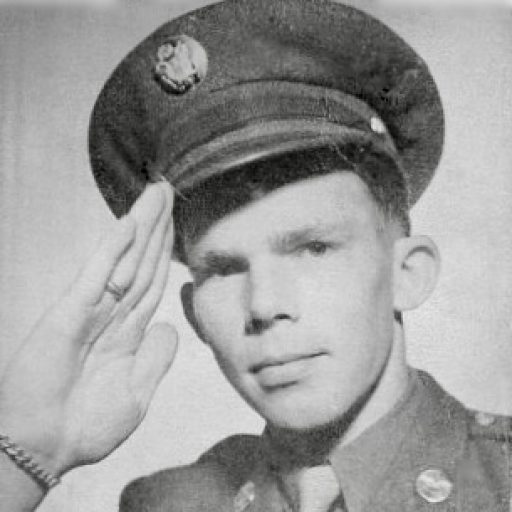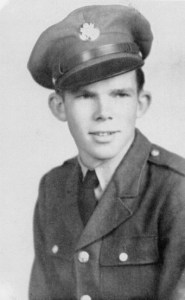
October 1942 – Training Serial #13108715 Army Recruit

Chuckie was one of more than three million who joined the Army in 1942, the year after Pearl Harbor. At the outset of World War II, the United States Army was short of properly trained and prepared Soldier. To answer the call for more combat troopers, the Army built induction centers all over the country. New recruits and draftees had to be inducted into the Army, trained, and shipped to war as quickly and efficiently as possible. 

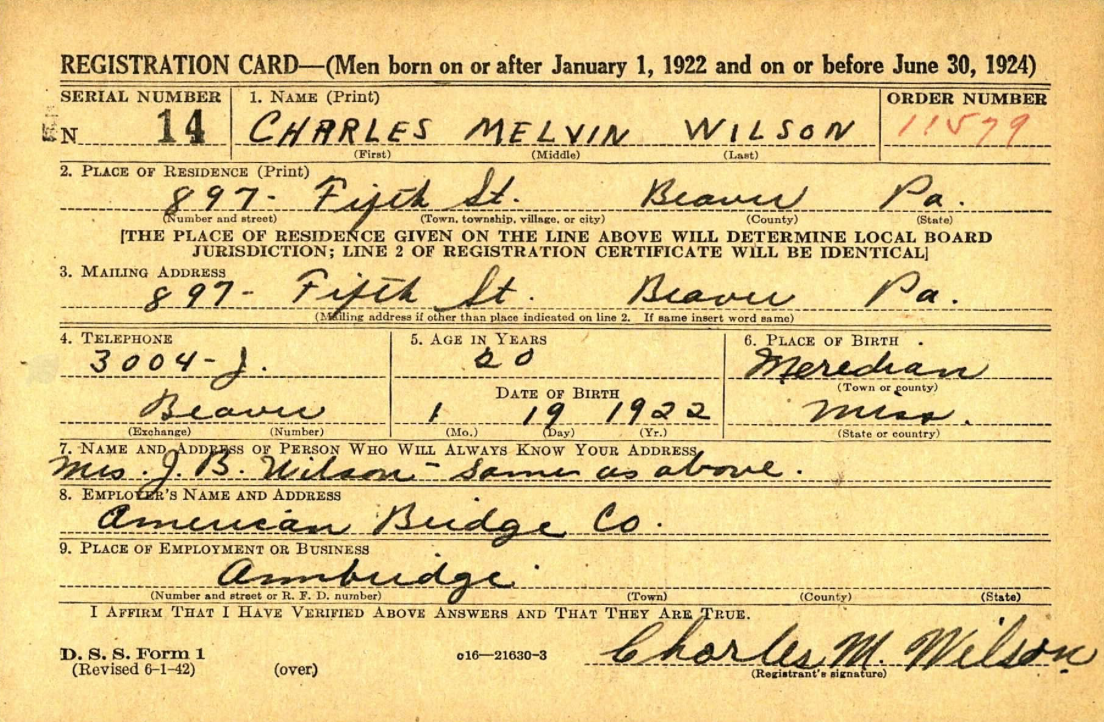
Like Chuckie, the new additions were mostly young Americans who would normally have been pursuing jobs, schooling, and family life, but instead were answering the nation’s call to arms. Each were assigned serial numbers. I found Chuckie’s record in the The National Archives. Many of them had never even traveled outside their home state, let alone Europe, Asia, or the Pacific Islands. Preparing these millions of civilians for war would be one of the military’s most daunting challenges.

All new recruits went through a few weeks of basic training, often called “boot camp.” The goal was to turn the wide variety of individuals who entered the service into teams of fighters who could work seamlessly with one another to achieve their objectives. 

Soldiers who needed training to perform specialized jobs, such as mechanics or radio operators, shipped off to special schools to learn their new trade. Soldiers serving as infantry, paratroopers, or artillery went to basic training to learn to be a soldier in their specific branch.

Camp personnel shaved the heads of the recruits and assigned them serial numbers. Platoons of recruits slept, ate, and learned together, and even did hours upon hours of physical fitness training as a unit. Following commands, they practiced the same basic skills over and over— marching, loading, unloading, and cleaning their weapons. Drill instructors used tough methods to force the newcomers to become attentive to detail and protocol. Even the smallest mistakes could result in extra kitchen duty or a challenging physical punishment—sometimes for the entire group.
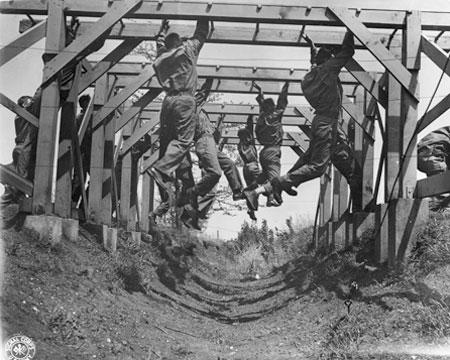
Physical therapy on overhead bars.
Photo credit: U.S Army Heritage and Education Center

The Library of Congress holds thousands of images from World War II in its collections — from sources as diverse as the soldiers themselves, civilians, government agencies, professional photographers, and more.  information can be found on the The National WWII Museum’s website.

Soldiers tackle part of an obstacle course at Camp Edwards, Massachusetts, 1942. 
(Image: Library Of Congress, LC-USW33-000257-ZC.)


9 September 1942 – Enlistment in US Army

Chuckie was 20 years old when he was enlisted to serve in United States Army during World War II. The terms were for the duration of the War or other emergency, plus six months, subject to the discretion of the President or otherwise according to law. Chuckie’s official enlistment record notes he is single with no dependents and is semi-skilled welder and flame cutter.

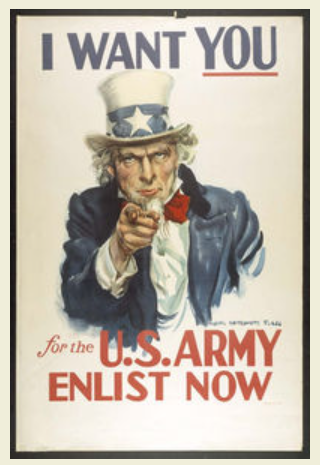
During American involvement in World War II from 1941–45, the government used propaganda through a diverse set of posters to increase loyalty to war efforts and commitment to victory. I do not know why Chuckie enlisted that day. There is no one alive anymore who remembers him for me to ask.

Who me? Yes, You!

Posters were widely used by the United States for propaganda during World War II, so much that there were over 200,000 poster designs created and printed during the war. The posters mostly had a positive message, which differed from other countries. With a stern look and bony finger pointing out, the “I Want YOU” poster was the embodiment of America that pushed all young men to enlist for their moral responsibility. Of all World War II propaganda posters with explanation, Uncle Sam sticks out as one of the most famous. Actually, this poster was first published in 1916 for the First World War recruiting efforts. It proved to be so popular, the U.S. Army revamped it and pushed it out again for the Second World War. With its proliferation and its incorporation into satire throughout the 20th-century, this image continues to reverberate strongly in American cultural memory.

30 June 1942 – Draft Registration

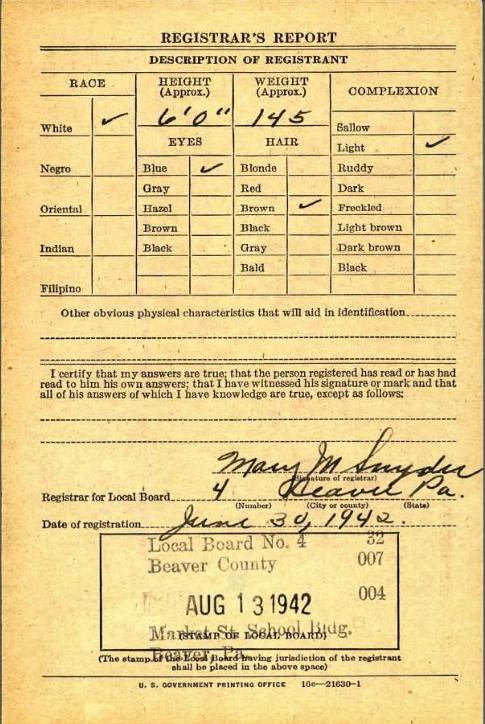
Six months after Pearl Harbor, Chuckie was 20 years old when he registered for the draft as required under the 1940 Selective Training and Service Act. Between 1941 and 1943, there were five draft registrations for WWII as the ages changed to 18-44. I found his draft card on the National Archies. It is the only known record of Chuckie’s signature. He’s listed as being 6 Feet tall and 145 lbs. which sounds about right for an active, healthy 20 year old.

Employer: American Bridge Company in Ambridge, Pennsylvania

At that time Chuckie was working at American Bridge Company, a legendary heavy/civil construction company founded in 1900. A modern fabricating and manufacturing facility in Western Pennsylvania was completed in 1903 and became the largest such facility in the world. It was the place where steel was fashioned into the skeletal framework of many of the nation’s ships, bridges and buildings.

A entire town grew around the plant and became known as Ambridge, a conjunction of “American” and “Bridge”. Many of our family, friends and neighbors worked at that plant.

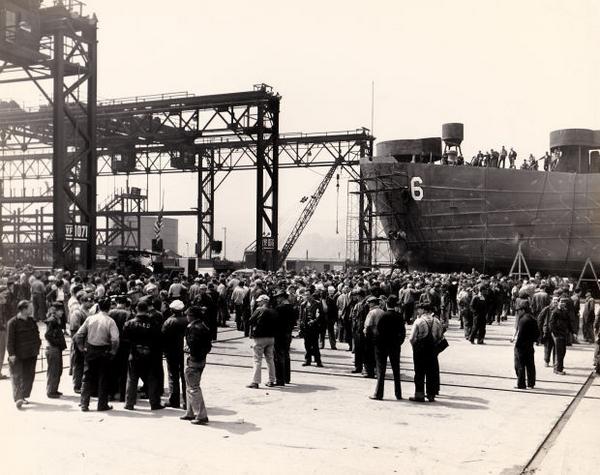
A crowd gathers as workers at American Bridge Co. of Ambridge launch a landing ship tank that was produced in 1943 for the war effort.
Photo Credit: Elwood City Ledger

American Bridge’s entire capacity was utilized for National Defense projects from 1941-1945. American Bridge manufactured 199 LST’s as well as four Aviation Repair Vessels, major components for 11 Essex Class Aircraft Carriers, one Super-aircraft Carrier, and 31 Auxiliary Converted Aircraft Carriers, 77 C Type Cargo Ships, four Tankers, 20 Cargo Lighters, and 348 Knock-down Barges.

Everyone leaves behind a legacy when they die.

US Army Staff Sergeant Charles “Chuckie” Melvin Wilson, 36thBomb Squad, 801stBomb Group, was killed in action on 28 April 1944 along with four other American aviators when his B-24 ‘Liberator’ Bomber crashed in the French village of Saint-Cyr-de-Valorges. He is permanently interred in the military war grave cemetery Rhone American Cemetery and Memorial located in Draguignan, France. 

US Army Staff Sergeant Charles “Chuckie” Melvin Wilson
Born: January 19, 1922 – Died: April 28, 1944

These few details are all his family had about the fate of their son, their brother, their nephew, their cousin or the uncle they never knew.  The ‘good guys won’; Chuckie was ‘killed in action’ and he’s ‘buried over there’ were the only memories spoken of or shared as the years went on. Little information was known. No one from his family had visited his grave. They never had passports, knew anyone French or traveled abroad.

The journey begins.

I had always been curious to know more about Chuckie, other family members too. Surely there was more to know about Chuckie now available on the internet? The lives of those in the Allied Forces who fought and died in WWII are recorded in hundreds of thousands of films, photographs, letters and history books. Monuments recognize the victory they achieved to restore freedom and end tyranny around the globe.  These offer us a lasting record of their hopes, dreams, talents and ambitions, the countless lives they impacted, and the loved ones they left behind. But that record is incomplete and quickly disappearing for many. 

One of those is US Army Staff Sergeant Charles “Chuckie” M. Wilson.  When his mother (my great grandmother) died in the late 1970s, my family found a shoe box with a purple heart, a few undated photographs and just six official letters she received from the War Department over a 15 year period from the date of his death.  These were all the memories that remained of Chuckie. 

As the world commemorates the 75thanniversary of D-DAY this year, I felt a new sense of urgency and family duty to create a more complete digital record of Chuckie’s life so that his memory and contribution to freedom will not be forgotten.  With only a basic timeline of key events known from those six letters, I dove into the internet to see what more I could find. The internet has made it possible for anyone with a computer and curiosity to search hundreds of thousands of websites, indexed data bases and social media to uncover a wealth of facts, images and uncover the truth of personal human stories.  

The ultimate sacrifice, the unforgotten glory of their deeds.

What quickly emerged in my searches is a fascinating and remarkable story of heroism and bravery of a 22 year old man who enlisted in the Army to do his part in the fight for freedom for people in countries oceans away from his small town in Western Pennsylvania who soon found himself in England as part of the build up to the Allied invasion in France, details of his top secret air mission on that fateful day in advance of D-Day to supply the French resistance behind enemy lines, images of Chuckie and his fellow airman with their-24 ‘Liberator’ Bomber, a first-hand account of human tragedy as he and four fellow American airmen gave the ultimate sacrifice of their life for the liberation of France and the restoration of freedom, and a previously unknown monument to them erected with gratitude by the French villagers on the spot where they found his body under the plane wreckage after their fiery crash in Saint-Cyr-de-Valorges, France and the compassion they showed him as they quickly buried him in gratitude in a temporary grave so that his remains would be safe and could be returned with honor and dignity. 

It is my hope that by sharing some history, personal family stories and facts of Chuckie and his mission on this blog over the coming months, readers will gain an interesting snapshot into an important period in history. Together we honor those like Chuckie who fought and died for freedom. In late May, I will be the first family member to visit Chuckie’s grave in France and I will share that experience here too.  When I write my last post on this blog in a few months time there will finally be a more complete record of the life of Charles M. Wilson so that future generations can remember him, better understand the price of freedom and be inspired by what they learn.

Thank you for your interest. You can follow by signing up or liking UnforgottenGlory Facebook page.

For all of us, may it evoke a small comfort to know that once we are gone, we will not be erased from the memories of others.

Tim B.

Processing…
Success! You're on the list.