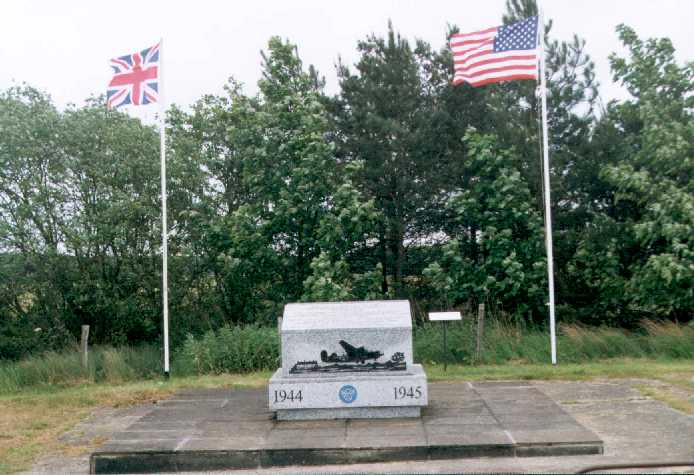
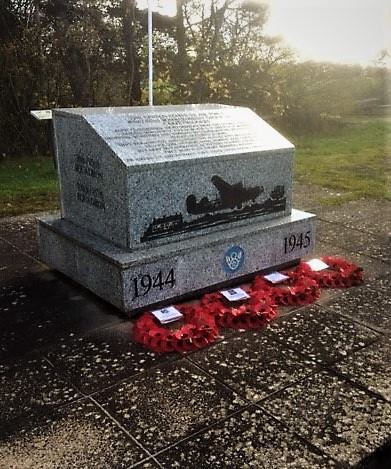
Forty two years after their mission, on 19 September 1987, fifty ex Carpetbaggers returned to Harrington to dedicate a memorial to Chuckie and the other Carpetbagger US Army Air Forces lost during WWII. The memorial is placed in a position overlooking the airfield where the B-24s carried out one of its most effective contributions to the Allied victory.
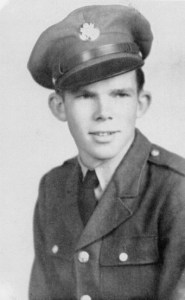
Chuckie’s family never knew that he was a Carpetbagger, that RAF Harrington was his base, or that this memorial to him existed until earlier this year when a family member and author of this blog began researching facts about about his life and contribution to Freedom. The experience and techniques perfected during Carpetbagger operations were used as the US Central Intelligence Agency (CIA) continued to develop into a worldwide organization. For this reason many records of the 801st / 492nd Bomb Group and the US Army Airmen like Chuckie that Carpetbaggers remained secret or restricted until the 1980s.
A memorial to the Carpetbaggers overlooking the airfield at Harrington RAF The memorial is located on site of Dispersal at side of the Harrington to Lamport Road
The Carpetbagger Aviation Museum was formed in 1993 for the 50th Anniversary reunion of the USAAF’s 801st / 492nd Bomb Group (The Carpetbaggers) at Harrington. It is housed in the Group Operations Building on the Administration Site of the former Station 179 airfield at Harrington, Northamptonshire, England. The Museum is administered by members of the Harrington Aviation Museum Society, a Registered Charity No 1061997
The author of Unforgotten Glory plans to visit Harrington RAF and The Carpetbagger Museum to pay respects at the last place Chuckie and his fellow comrades walked the earth as they prepared and then took off 27 April 1944 into the dark night sky.
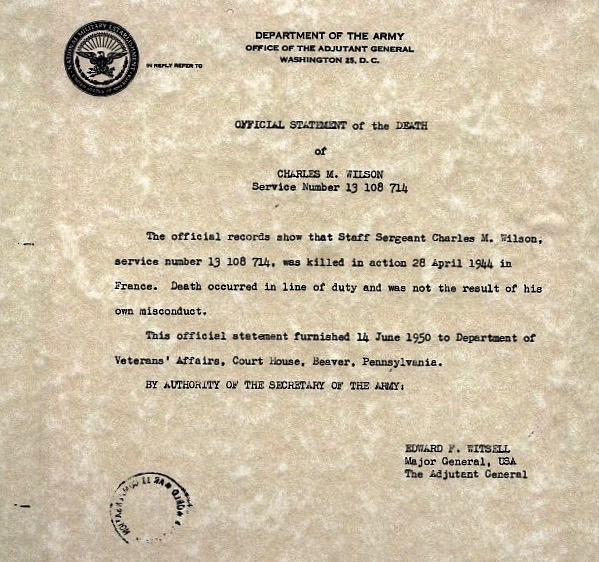
World War II was the deadliest military conflict in history. An estimated total of 70–85 million people perished, which was about 3% of the 1940 world population (est. 2.3 billion). Chuckie was one of the 52,173 U.S. Army Air Force killed in action. On 14 June 1950 an official Statement of Death was furnished by the Department of the Army to the Department of Veteran’s Affairs, Court House, Beaver, Pennsylvania noting Charles M. Wilson was killed in action on 28 April 1944 in the line of duty in France.
Battle deaths of US citizens (including POWs who died in captivity, but does not include those who died of disease and accidents) were 292,131: Army 234,874 (including Army Air Forces 52,173); Navy 36,950; Marine Corps 19,733; and Coast Guard 574. Of those killed, 185,924 deaths occurred in the European/Atlantic theater of operations and 106,207 deaths occurred in Asia/Pacific theater of operations. Source: STATISTICAL AND ACCOUNTING BRANCH OFFICE OF THE ADJUTANT GENERAL (June 1, 1953).
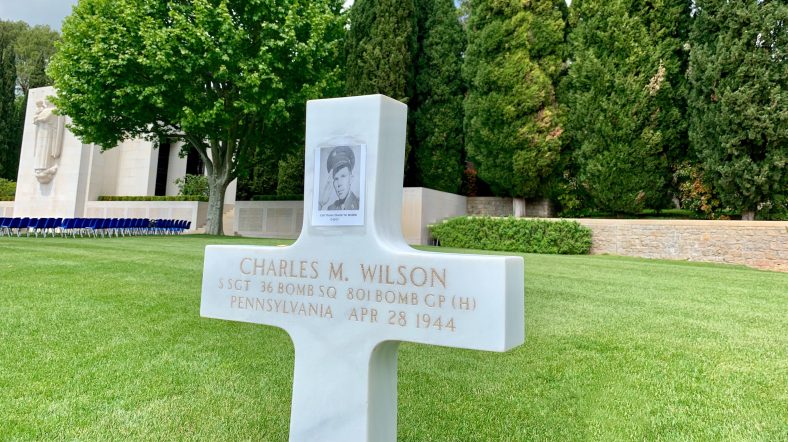
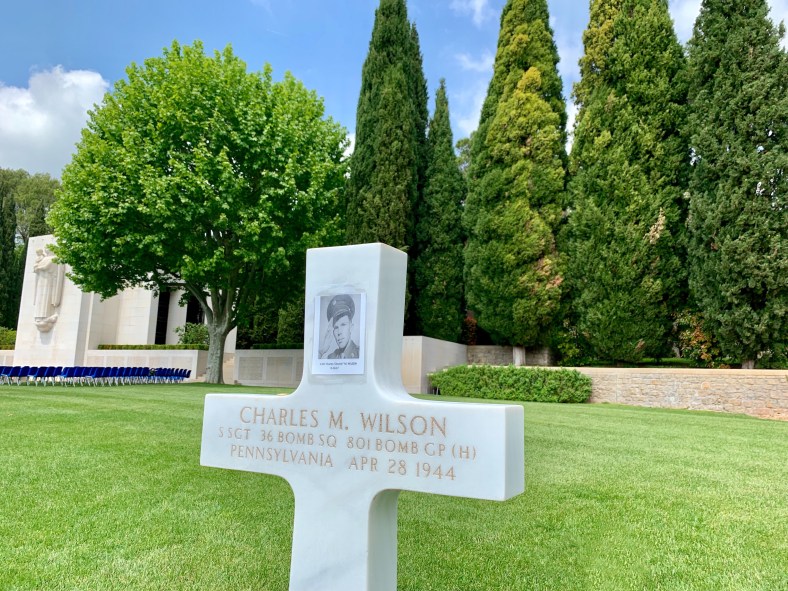
The final resting place of Charles M. Wilson at Rhone American Cemetery in France
Carpetbaggers from their base at RAF Harington helped build disparate French resistance groups into an effective sabotage and guerrilla force. The objective was to help the French resistance to “harass, disrupt and divert” the German army’s defense against the Allies’ D-Day invasion. Following the Carpetbagger successes early in 1944, Gen. Dwight D. Eisenhower, Supreme Commander of the Allied Expeditionary Force, ordered Lt. Gen. Carl Spaatz, Commanding General of U.S. Strategic Air Forces in Europe, to increase the size of the unit, which quickly grew to a force of 3,000 airmen, sixty-four B–24 bombers and several C–47s.
From January 1944 to May 1945, the Carpetbagger Project completed 1,860 sorties and delivered 20,495 containers and 11,174 packages of vital supplies to the resistance forces in western and northwestern Europe. More than 1,000 parachutists dropped through the B-24 Joe Holes into enemy territory.
Chuckie’s B-24 Liberator The Worry Bird was on one of the twenty-five B-24s lost. Eight more were so badly damaged by enemy action and other causes that they were no longer fit for combat. Personnel losses initially totaled 208 missing and killed and one wounded. Fortunately, many of those listed as missing had parachuted to safety and returned to RAF Harrington with the help of the same resistance forces they had been sent to resupply.
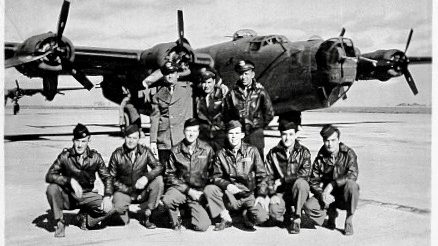
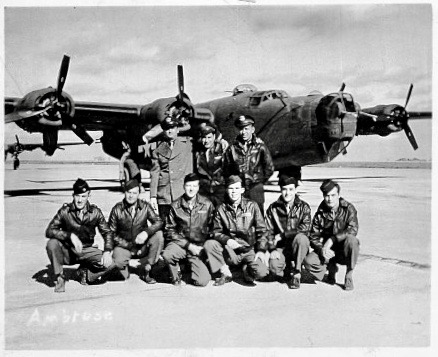
The Ambrose Crew in front of B-24 Liberator The Worry Bird. Charles M. Wilson is 4th from left, front row kneeling.
“The Free French had been of inestimable value in the campaign. Without their assistance, the liberation of France and the defeat of the enemy would have consumed much longer time and meant greater losses to ourselves.”
U.S General Dwight D. Eisenhower
“The French Resistance Movement played a noble part in the liberation of Brittany and the peninsula was quickly overrun.”
British Prime Minister Winston Churchill
On 13 August 1945 the Carpetbaggers were re-designated as the 49nd Bomb Group H and the four Bomb Squadrons. On 7 July 1945, the air echelon of the 492 Bomb Group left Harrington for Kirtland Field, Albuquerque, New Mexico, where they later joined up with the ground echelon who had returned on the ocean liner Queen Elizabeth.
The 492nd Bomb Group deactivated on 17 October 1945.
Staggering losses
World War II proved to be the deadliest international conflict in history directly involving more than 100 million people from over 30 countries. The war took the lives of 60 to 80 million people, including 6 million Jews who died at the hands of the Nazis. Civilians made up an estimated 50-55 million deaths from the war, while military comprised 21 to 25 million of those lost during the war. Millions more were injured, and still more lost their homes and property.
This was a difficult post to write. On 22 April 1945, hundreds of people, including Chuckie’s squadron commander, from two villages in France paid tribute to Chuckie that day in a public memorial. Yet sadly, due to the need to keep the secrets of the Carpetbagger Project, Chuckie’s parents sat in a small apartment in a small American town unaware with hope still alive that he would return home safely. All they still knew from the US Government was that he was still Missing in Action. It would be another year before they knew what what everyone else involved in the public memorial knew that day – Chuckie was killed in action one year before.
The villagers of St. Cyr de Valorge and Tarare built a monument to honor these men. The held a public memorial to the five American airmen who died there in a crash one year before in a very large public ceremony that included Chuckie’s squadron commander. It was to be the first of a series of memorials to honor Allied Forces airmen who had died delivering supplied and agents to the French resistance forces.
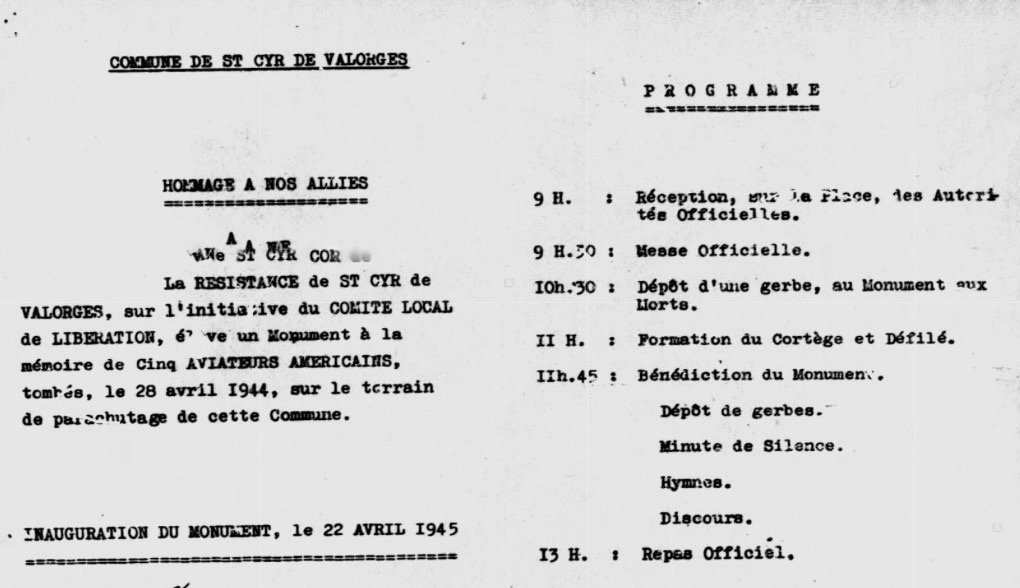
An actual copy of the official Memorial Program from that day.
Translation – Left side: 28 April 1944 “Five American aviators were killed in the process of air-dropping weapons.“ Right Side:: 22 April 1945 “Tribute from the French resistance to th five victims” The Official Program from the Memorial
English Translation
Left Hand side – Title: Tribute to our allies Main text: The Resistance of St Cyr de Valorges, upon the initiative of the local committee of Liberation, dedicates a memorial to the five American aviators fallen on 28thApril 1944 on the air-dropping field of this municipality. Bottom left: Unveiling of the memorial on 22ndApril 1945
Right-hand side – Title: Program Main text: 9:00 am: Welcome of the official public authorities on the square 9:30 am: Official mass 10:30 am: First wreath laying at the memorial 11:30 am: Cortege preparation to march 11:45 am: Blessing of the memorial Further wreath laying A minute of silence Anthem Speeches 1:00 pm: Official meal
Lt. Col Robert Boone was invited to be present at the days celebration and memorial dedication as a representative of the American Carpetbagger units.
Lt. Col Robert Boone
Boone was one of Chuckie’s squadron commanders at Harrington and in command of the 801st Bomb Group. He was responsible for the working up of the air and ground echelons in preparation for the first Carpetbagger missions. On 13 August 1944 the Carpetbaggers at Harrington were redesignated to the 492nd Bomb Group (H) and the four squadrons became the 856th, 857th, 858th and 859th Bomb Squadrons under Col Clifford Heflin, the first commander of the 801st/492nd Bombardment Group, nicknamed the Carpetbaggers.
Public Memorial Program
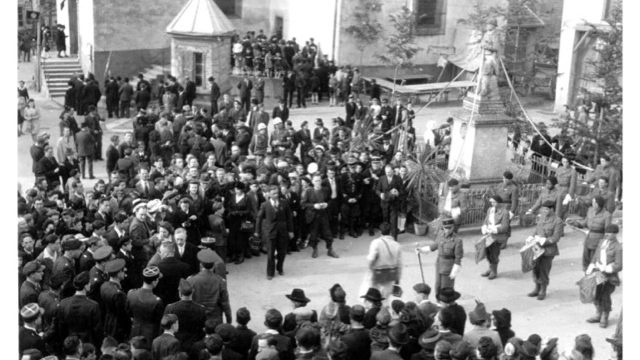
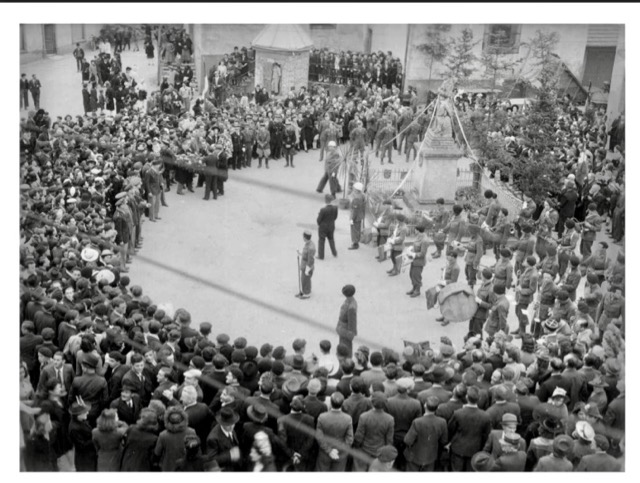
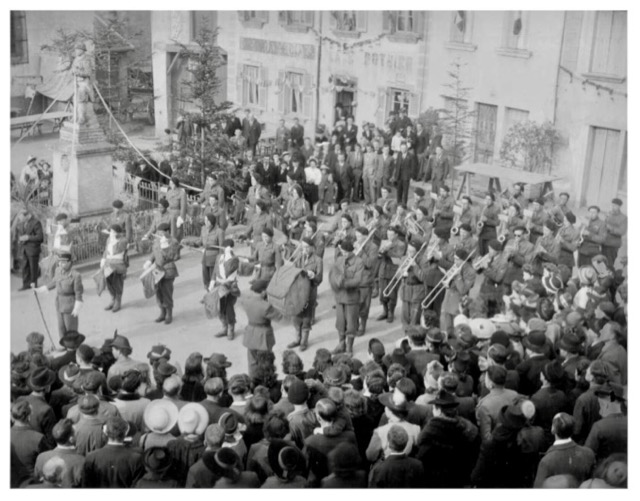
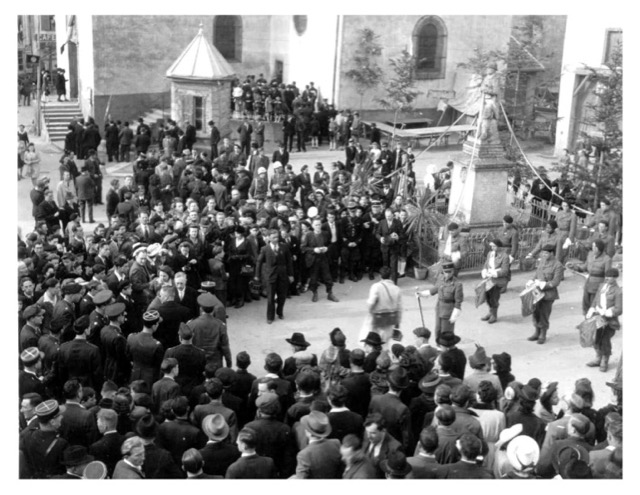
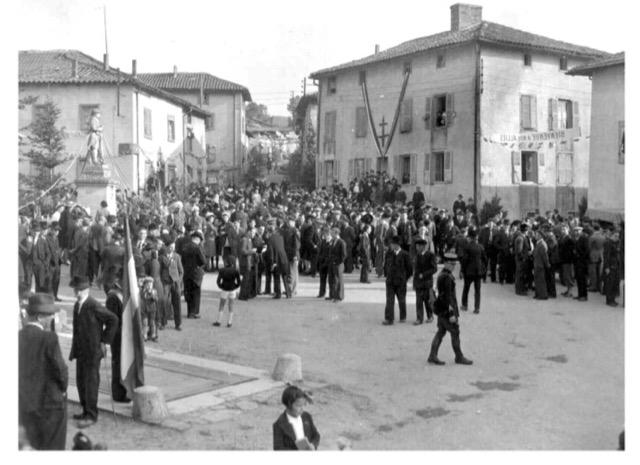
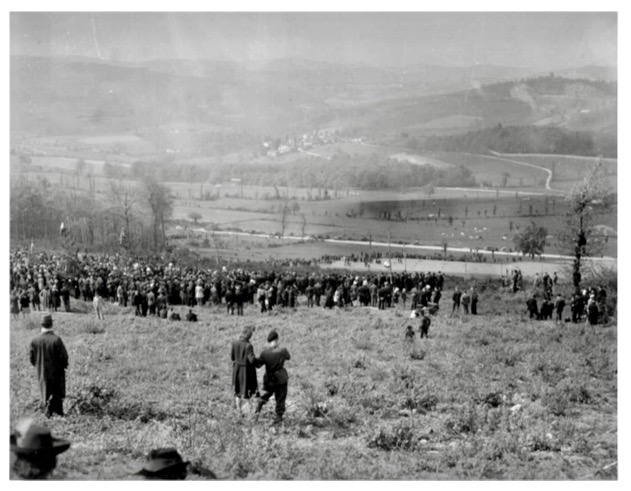
9AM Welcome – The public square at St. Cyr de Valorge, near where the crash had occurred, was packed with people from the two villages. Flags of France, the United Stated, and Great Britain were flying, while bands played the national anthems of the three countries. There was much cheering, and hundreds were in tears as speakers told of the stirring days of the resistance.
The village square at St. Cyr de Valorge, France
9:30 Official Mass – The official party and the villagers gathered in the village church, where a priest spoke, eulogizing Chuckie and the fliers. After the mass, the villagers moved to the monument for dedication.
This picture shows the village church in the background.
This is the hill and site where Chuckie’s plane crashed. The memorial still stands today.
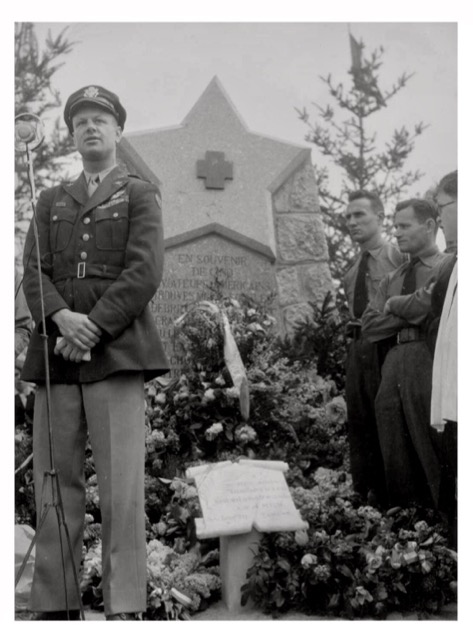
11:45 AM Memorial Dedication Boone gave his address, which was translated into French by an interpreter, He said that he was happy to be on the ground in daytime to see the beauty of the country – something that was impossible to see at night – and to feel the warmth of the French people – impossible to feel in a Liberator airplane. He said that the men in his outfit remembered the dead men well, and to him the ceremony was evidence that the men fought not only for, but with, France in the war of Liberation.
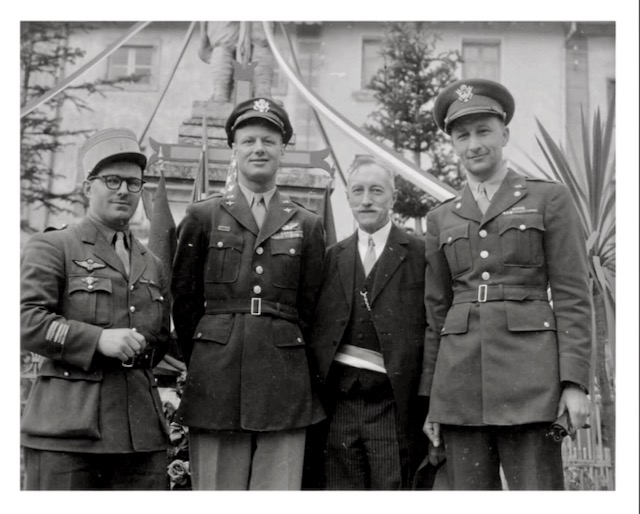
Boone and French officials
Photos Above: The memorial from 22 April 1945 above.
1:00 PM Official Meal – After the ceremony, the party moved to a banquet hall for lunch. Colonel Boone was given Lieutenant Ambrose’s identification tags and part of his bracelet, which he promised to send to the lieutenant’s relatives in the United States.
The villagers walk back down the hill to an Official luncheon.
Sadly, Chuckie’s parents, brother and sister went to their graves thirty and forty years later never knowing any of this.
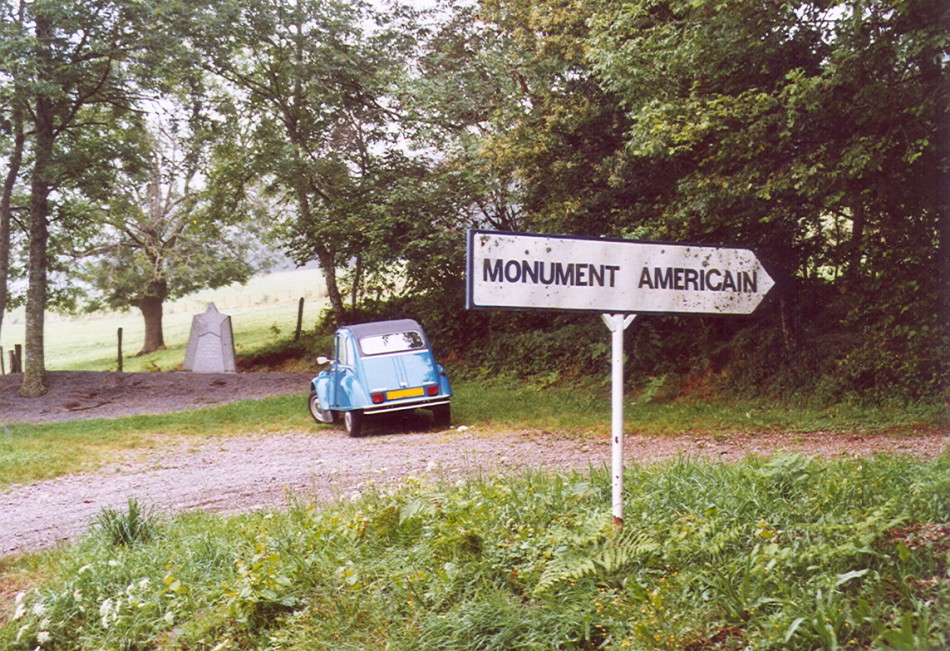
Here is that monument as it stands today, 74 years later.
The memorial as it stands today.
TRANSLATION: “In memory of five American aviators found dead in their plane debris, that crashed into flames in this place on 28th April 1944; whose mission was to airdrop weapons to our secret army for the liberation of France and the restoration of our ideals.” Lieutenant C.W. Ambrose Charles M. Wilson Robert H. Redhair A.B. Pope Lieutenant Peter Roccia”
Left hand side little black stone: “Frenchy to his friends”
It speaks to the service and sacrifices of all the Carpetbaggers.
Pilot 1st Lt George W Ambrose; is buried at Long Island National Cemetery, Farmingdale, New York, USA
Co-pilot, 2nd Lt. Robert Harry Redhair; is buried in Akhard Cemetery, Polk Co, Missouri
Navigator, 2nd Lt. Arthur Bozeman Pope; is buried in National Cemetery Marietta, GA
Bombardier, 2nd Lt. Peter Roccia; is buried in Arlington National Cemetery
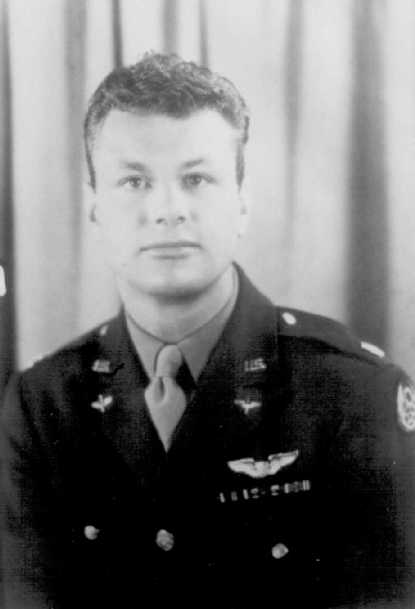
Flight Engineer, Staff Sargeant Charles M Wilson; is buried at Rhone American Cemetery, Draguignan, France
Right hand side white stone: “Loved comrade-in-arms on 28 April 1944 James Heddleson”
There were three crash survivors, their stories told in previous posts.
James Joseph Heddelman
George Willam Henderson
James Cryl Mooney
A small clearing on the way to the monument. Photo credit.
It was now morning daylight. Sometime in the morning hours, members of the French resistance army removed the remains of Chuckie and his four fellow comrades from the wreckage of the plane in a field near Saint-Cyr-de-Valorges, France and buried them in an unmarked temporary grave. They also worked very hard to quickly retrieve all the container canisters and packages of supplies strewn about and to hide them.
The Nazi’s would soon arrive at the crash site to retrieve any intelligence they could find.
Quickly burying the dead while under threat of the imminent danger of the arrival of the Nazi’s was a humane act of enormous compassion and respect by the French people. They protected Chuckie and the other fallen from any potential further desecration by the Nazi’s. It also allowed for Chuckie’s body to be identified and, at a later point, safely moved to a temporary cemetery and his subsequent permanent interment in December 1948 at his final resting place at Rhone American Cemetery in Draguignon, France.
Chuckie’s parents were never given many facts about how he died because on his “S E C R E T” Carpetbagger mission. They did have the comfort of knowing that their their son’s body was always treated with the dignity and respect he deserved for paying the ultimate sacrifice for Freedom.
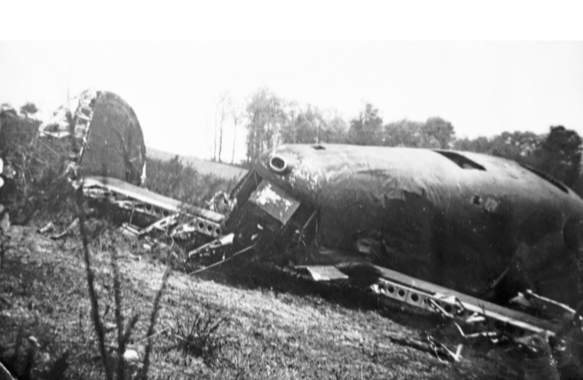
Chuckie’s family never saw these photos of his crashed plane. Today, they are easily findable by anyone on the internet.
April 1944 B-24 Liberator “The Worry Bird” wrecked upside down in a field west of Lyon, France, after striking a hill near the town of Saint-Cyr-de-Valorges during a night mission.Note the square ‘Joe Hole’ which canisters and packages exited during an airdrop. A second photo of B-24 Liberator “The Worry Bird” April 1944 This is the underside of the bombay compartment in the center of the aircraft and the tail section section.
Killed In Action – 28 April 1944 Lieut. George W Ambrose, Pilot; of Springdale, PA Lieut. Robert H Redhair , Co-Pilot; of Bartlesville, OK S Sgt. Charles M Wilson, Engineer; of Beaver, PA Lieut. Arthur B Pope, Navigator; of Fulton, GA Lieut. Peter Roccia, Bombardier; of Washington, D.C.
“It was the next day that they (the French) realized that two more Americans survived (in addition to Mooney). They found the chutes, 1st one and then another, which they immediately buried.“
Survivors of the crash included: Sgt. James J Heddleson, Radio Operator; of Louisville, OH Sgt. George W Henderson, Tail Gunner; of Santa Monica, CA Sgt. James C Mooney, Dispatcher; of Englewood, NJ – He volunteered for this mission (his first) – the rest of the crew only met him shortly before take-off, as regular crew member Sgt. W. Bollinger had reported off sick that day.
“We assumed everyone was killed except Sgt. Mooney. His condition was such, I found out later, that the man whose house he was taken to, had to turn him over to the Germans. He told me personally how sorry he was for having to do this. But I tried to assure him that in Sgt Mooney’s case (broken back) he probably saved his life as I heard the Germans took him to a hospital.“
Heddelson and Henderson were now on the move to evade the enemy, as trained
“We moved only at night as we traveled quite a way for the shape we were in. The French started to look for us they said in every direction possible. We skirted villages and main roads, avoiding everyone we saw, especially the Germans. Having no idea where we were, we headed South.”
Edited from transcribed copy of letter by crash survivor James Heddelson in the archives at the Air Force Academy June – 1998
A French secret agent on the ground that day also took the piece of the plane with the serial number.
It would soon be returned back to the Office of Strategic Services (OSS) headquarters at Baker Street in London as part of his field report to the Allied Forces command that the plane had crashed and USAAF men had died.
Chuckie and his fellow crew onboard B-24D serial no. 42-40997 The Worry Bird (formerly Screamin’ Mimi of the 565th Bomb Squadron, 389th Bomb Group) clipped a hill near its drop zone in Saint-Cyr-de-Valorges, Loire, and crashed killing him and four other crew; three airmen survived.
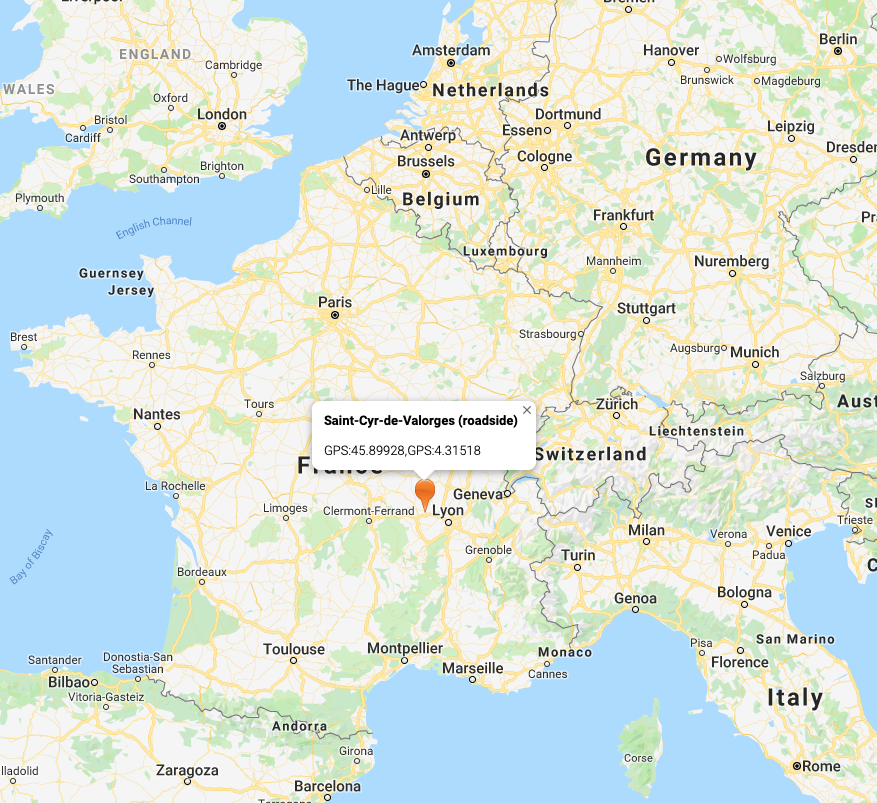
The GPS location of the plane crash
When it struck the ground on the third downward circle, the B-24 divided into four distinct compartments as it crash landed.
Chuckie and the four other airmen in the first to sections were killed; the three airmen in the back two sections survived after being able to parachute out and away from the plane to safety just before the crash landing.
bombardier-navigator’s compartment in the nose of the aircraft which contained the navigational equipment, bomb-sight, bomb controls, and nose guns or nose turret; where navigator Lieut. Arthur B Pope, Navigator; and bombardier Lieut. Peter Roccia, Bombardier were located
flight deck which included the pilot’s compartment, radio operator’s station, and top gun turret; where flight engineer Chuckie along with pilot Lieut. George W Ambrose and co-pilot Lieut. Robert H Redhair were located
bomb bay compartment in the center of the aircraft under the center wing section (half deck is located above the rear bomb bay); where survivor Sgt. James C. Mooney was located
rear fuselage compartment which contains the lower gun turret, waist guns, bottom camera hatch, photographic equipment, and the tail gun turret; where survivors Staff Sgt. James Heddleson and Sgt. George Henderson were located
Radio operator James Heddleson and gunners George Henderson and James C. Mooney survived. Heddelsman wrote a first person account of the crash in a letter to author Ben Parnell for his 1987 book Carpetbaggers: America’s Secret War in Europe. A transcription is in the archives at the Air Force Academy. A portion is reprinted here.
1st I hit my forehead, partly falling out and then I was thrown backwards toward the “Joe Hole” area, with the back of my head slamming into something in the plane. Sgt. Mooney is gone, he apparently fell out of the “Joe Hole.” I found out later he held onto the chutes (packages). Luckily he wasn’t killed, although the poor man must have suffered terribly. His back was broken, this I was told later. Sgt. Henderson was immediately out of the tail section.
We found each other. Henderson and I were apparently fairly close to each other … as each of us made our way back to the plane.
The plane seemed to be everywhere Our plane could be seen like a beacon for miles like a beacon.. . . the ammunition exploding and whatever was in the canisters also going off. . . and the noise it made in the still of the night with everything exploding certainly would attract a lot of attention.
The canisters were scattered everywhere. The French worked very hard throughout the night, very hard, trying to retrieve them. Sgt. Henderson and I were apparently fairly close to each other and as each of us made our way back to the plane, we found each other.
We assumed everyone was killed except Sgt. Mooney. Mooney, we tried to find him, hoping he was alright, but it was night and in the mountain area and after a while we gave up. We were not only hurting physically, but also emotionally, myself being only 20 years old at the time.
We could hear noises like cars or truck engines or so we thought. My left leg was hurt and was getting worse as it was swelling around the knee. We had no idea where we were, but the 1st thing we thought of was it could be the Germans.
We started down the hills toward the valley, Not knowing anything about the territory, we just decided to slip away in the night, the best way we could.
Edited from transcribed copy of letter by crash survivor James Heddelson in the archives at the Air Force Academy June – 1998
His back broken, Mooney was helped from the crash area by a French women from the village but was soon handed over to the Germans for urgent care when the seriousness of his injuries became clear. He survived as a POW in a Lyon hospital recovering from his injuries. Heddleson and Henderson successfully evaded the enemy by first hiding under cover, then being taken in by the French Resistance Army the Maquis, living with them for three months and even going along one night to help blow up a railway trestle. In early August an RAF Lockheed Hudson picked them up safely and on 27 August 1944 they returned to Harrington.
Coming up The Crash (Part four): What happened the next day when then sun came up and photos of the crashed plane.
Not only was the B-24 demanding to fly, even for a fully-qualified pilot, it operated at such high weights that takeoffs became dicey even with full power on all engines. Flight stability was marginal, and escape from a stricken machine was extremely difficult once the pilot and copilot had let go of the controls. I imagine these were some of contributing factors on the night Chuckie’s plane crashed.
To better ensure accurate drops, pilots tried to get down to within 400 to 600 feet off the ground and to reduce their flying speed to 130 miles per hour or less. The low speed reduced the chances of damage to parachutes, as the shock of opening is much less at the slower speed. Personnel were normally dropped from a height of 600 ft with containers and packages being dropped from 300 – 500 ft.
Chuckie’s plane made two passes over the target and on the third pass, “we hit or clipped something”
Once again the flaps start down and the bomb-doors open and we are starting our approach. I can look out and see the hills, or mountains on our left side. Suddenly the plane shakes violently, apparently we hit or clipped something.”
The engines were racing and the plane was climbing, seemingly straight up. He yells for us to get out. . . .We no sooner cleared the plane when it starts down again, only this time it is too late, because it is burning when it crashes.”
Transcribed from copy of letter by crash survivor James Heddelson in the archives at the Air Force Academy June – 1998
At 02:10 hrs local Chuckie’s aircraft landed in a fiery crash in Saint-Cyr-de-Valorges, Loire, near Lyon France.
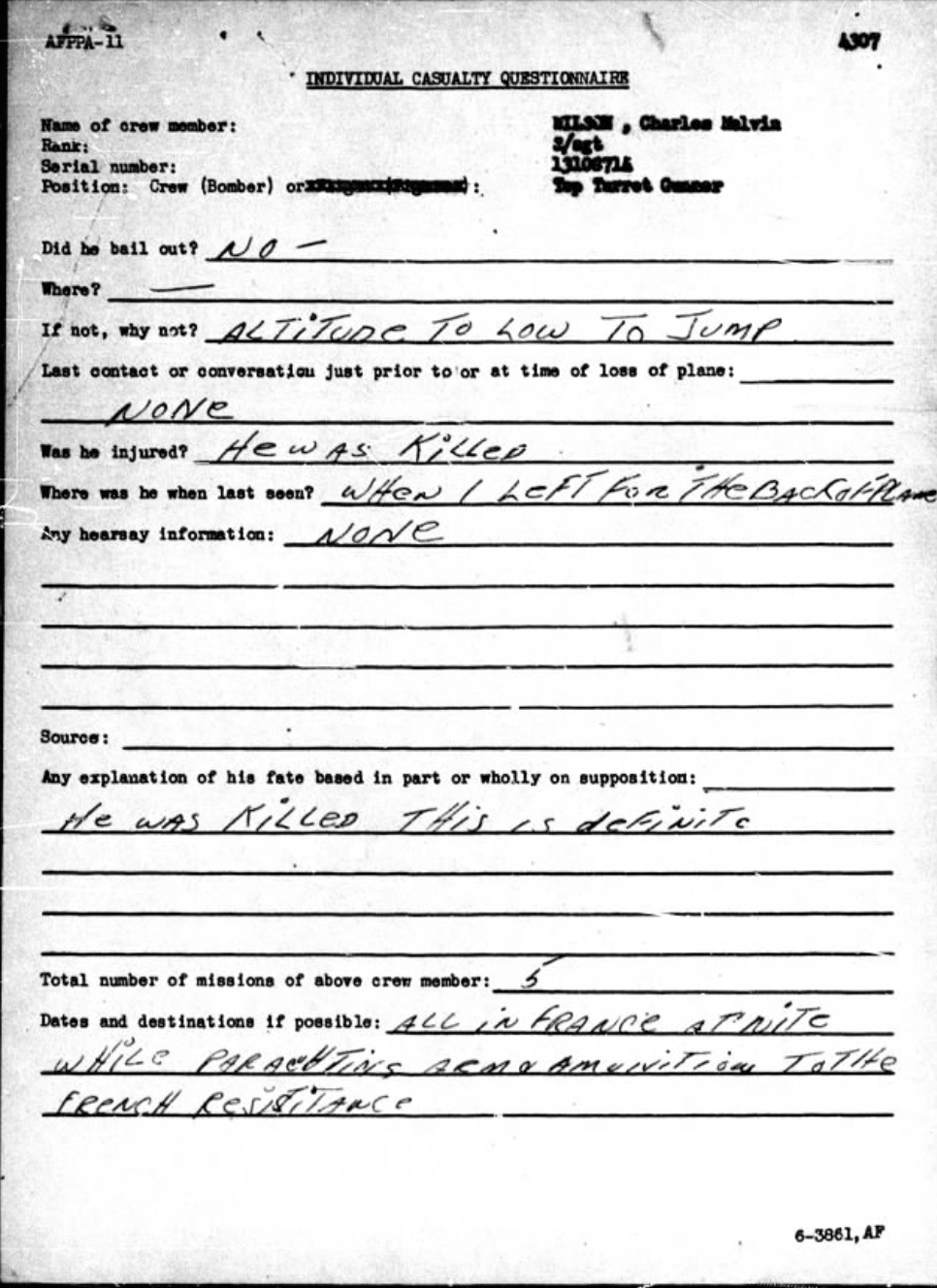
“He was killed. This is a definite.”
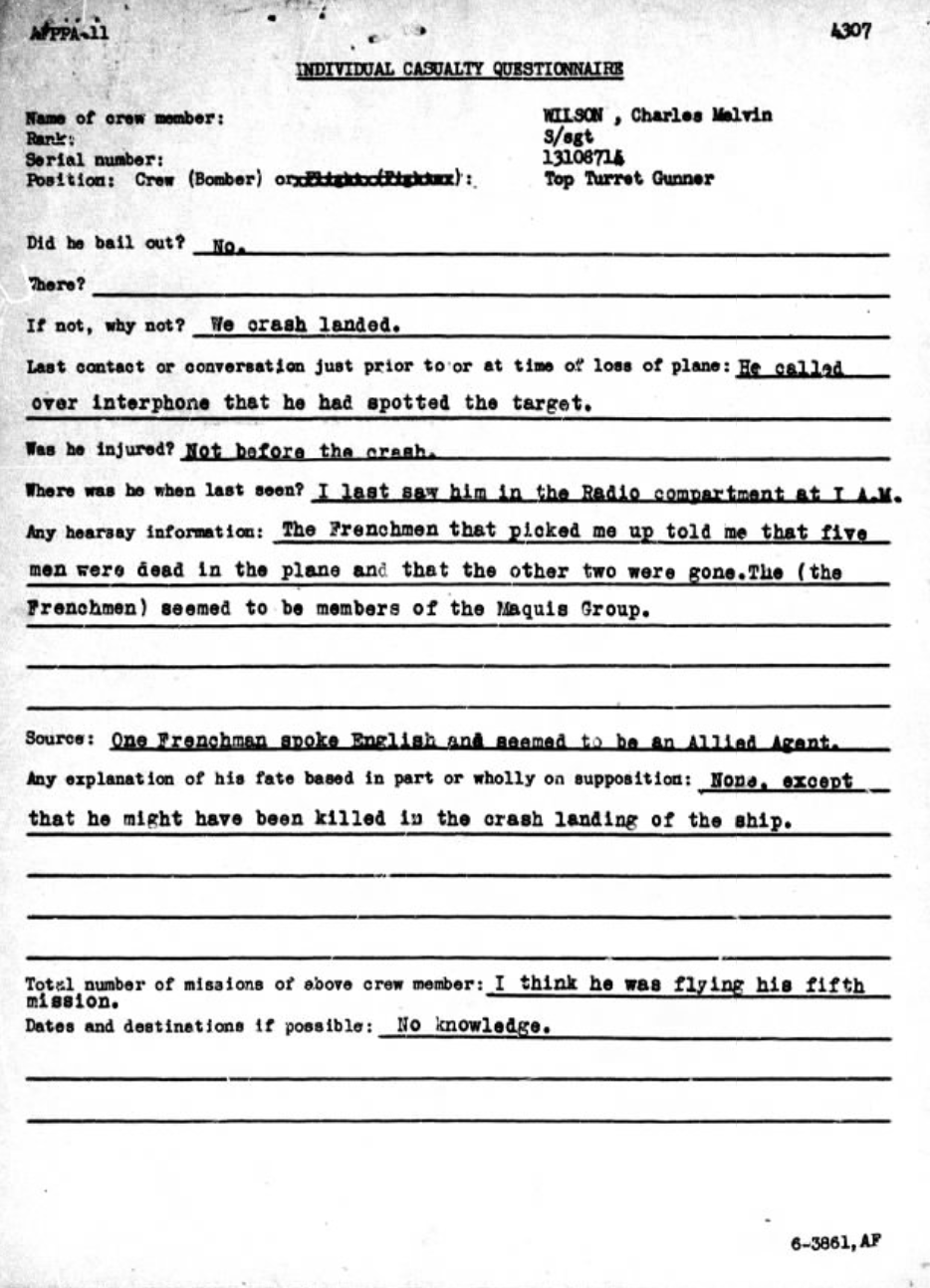
Chuckie was killed on impact. Individual Casualty Questionnaire‘s were completed by two of the three crash survivors when they eventually returned back to Harrington three months later after successfully evading the enemy with the help of the French resistance. Both confirm Staff Sgt Charles. M. Wilson was killed in action when his plane crashed. Copies of the actual questionnaires likely completely sometime in August 1944 were found in the MACR and posted below.
By survivor Sgt. George Henderson
By survivor Sgt. James Heddelson
Next up: The Crash (part three) – seen like a beacon
Part one of four posts capturing the story of what actually happened that night of the fiery crash that killed Chuckie compiled from two first person survivor accounts, historical documents filed in the Missing Aircraft Report and WWII archival material.
Chuckie’s Carpetbagger mission the night he was killed was Operation Lackey 3A over the Timdale drop zone detailed in an earlier post. When his aircraft reached a position a few miles from the drop zone near Lyon, France the ‘S’ Phone was used. The system permitted direct two-way voice communication with an aircraft up to a range of 30 miles and the agents on the ground working behind enemy lines to communicate and coordinate landings and the dropping of agents and supplies. It was composed of a “Ground” transceiver and an “Air” transceiver and required the ground operator to face the path of the aircraft. It had the useful trait of transmitting signals that could not be picked up by enemy ground monitoring stations more than one mile away.
“He called over the interphone that he spotted the target.”
It was around 1:00AM in the morning when Chuckie and crew reached the target area. According to the first person account from survivor Sgt James Heddelson, they made the 1st pass over the pinpoint and members of the Resistance on the farmland below for identification. While the S-Phone provided directional information to the pilot it gave no range information for the drop. This could only be done by visual sightings of lights on the ground.
A few miles from the target area all available eyes began searching for the drop area, which would usually be identified by three high powered flashlights placed in a row, with a fourth at a 90 degree angle to indicate the direction of the drop. The recognition torches were placed in the pre-arranged pattern and the light codes were exchanged between the ground and the plane. The aircraft was most vulnerable to enemy fire over the drop zone. The pilot 1st Liet. George Ambrose wasted no time lining up the twinkling markers.
“We circled around for position to make the drop.”
Pilot Ambrose selected half flaps and made the run in at 135 mph – not much above stalling speed. He was guided by the bombardier, who would be releasing the containers over the drop zone. Speed was all important on the ground – the man sized containers were to be quickly taken away into the cover of trees.
(2nd pass) . . . the wing flaps start to come down and the bomb bay doors are starting to open. Suddenly they start back up, we don’t drop and it is like we were practicing and we climb back up.”
“As we start to circle around again, I can still see the lights on the ground in the distance on our drop area.We start in for the 3rd pass.“
“Sgt James Mooney is over the “Joe Hole.” He volunteered for this mission (his first) we only met him shortly before take-off, as a regular crew member Sgt. W. Bollinger reported off sick. I am over the smaller hole behind Sgt. Geo. Henderson, who is in the tailgunners position, getting ready to throw some packages out. Once again the flaps start down and the bomb-doors open and we are starting our approach. I can look out and see the hills, or mountains on our left side.“
“Suddenly the plane shakes violently. Apparently we hit or clipped something.”
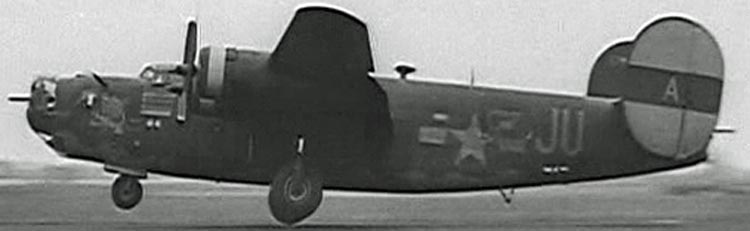
The Worry Bird B-24 Liberator
Coming Next: The Crash (Part Two) – The plane hits high ground
Credits: Edited quotes compiled from crash survivor Sgt. Geo. Henderson and Sgt. James Heddelson Interrogation Reports detailing when they last had contact with Chuckie; and a first-person account transcribed from copy of letter from crash survivor Sgt. James Heddelson in the archives at the Air Force Academy.
A simple line of text, one sentence, is all that was noted in the official record of Mission 324 for 27 April 1944:
“21 B-24s are dispatched on CARPETBAGGER operations; 1 B-24 is lost”
Chuckie and his fellow crewman took off from Harrington at 22:26 hours on their 5th mission assigned to the 801st. They flew on a secret course to the South West France on an Operational Mission code named Operation Lackey 3A for drop site Timdale. They were one of the 1st crews to fly at night without benefit of the full moon.
The plane never returned to home base.
Specially modified B-24Ds were used in classified missions. In a joint venture between the Army Air Forces and the Office of Strategic Services (OSS) code named Operation Carpetbagger. Pilots and crews flew specially modified B-24Ds painted with a glossy black anti-searchlight paint to supply friendly underground forces throughout German occupied Europe. Being some 500 ft above sea level and located not too far away from the supply bases of Cheddington and Holme as well as the British SOE based at Tempsford, Harrington was chosen for the Carpetbagger Operations by the Eighth Air Force’s Special Operation Group in which Chuckie served.
Like all Allied forces who operated behind Nazi lines, Chuckie and the Carpetbaggers were subject to torture and execution in the event of capture, under Hitler‘s notorious Commando Order. Because the teams normally operated in uniform, to apply this order to them was a war crime.
Report 262 noted the result of the Operation as MIA. The Air Forces Organization was required to file a Missing Air Crew Report (MACR) within 48 hours.
Records show the secret code name for the Carpetbagger mission Chuckie was flying the night he was killed was Operation Lackey over the Timdale drop zone near Lyon, France –“TIMBALE DZ 45deg 57’N, 04deg 22’E”. The exact location of the planned drop is still a farm today and can be seen on Google maps is here.
On its final approach to make the drop “on lights” where members of the resistance were waiting on the ground, the plane hit a hill at 02:00AM and separated into four parts when crashing at nearby Saint Cyr de Valorges (Loire), France, killing five of the eight crew members including Chuckie.
Curious to see pictures of the village where Chuckie died on that hill, I did a Google search. Right there as I’d imagined. Beautiful, green rolling farmland, high wooded hills, peaceful, wide open expansive views. So familiar. It’s the same topography of Western Pennsylvania where Chuckie and this author grew up.
A very dangerous place to be flying a huge B-24 bomber in the dark of night just 130 feet above the ground at an airspeed of near stalling. The heroism, their bravery now even more clear. God bless them all.
One important lesson taught to the Carpetbaggers was the need to memorize the route to the drop zone. Pilots learned to literally map read their way by moonlight, memorizing landmarks – the most successful pilot sometimes spent hours studying the route. However, the B-24s were fitted with the best possible flying and navigational instruments. The most important flying instrument was a radio altimeter giving an accurate height readout on the low level flights.
The route to the drop zone was achieved by a team effort, the bombardier sat in the glazed nose on a swivel seat reading off landmarks to the navigator sitting at his table behind the blackout curtains. The pilot was provided with large blister windows giving a good downward view of the ground.
First radio navigation aid to be used on a mission was the Gee set, this recorded directional signals which were marked on a special chart – accurate within a quarter of a mile over England, but prone to jamming over enemy territory. The Rebecca / Eureka directional system explained on an earlier post consisted of a ground beacon (Eureka) set up on the drop zone, this was triggered by a signal from Rebecca set in the aircraft. Eureka then automatically sent out signals which were picked up by a calibrated receiver, this indicated the aircraft’s position in relation to the drop zone.
Chuckie and his crew flew at night from Great Britain to deep into German occupied France to drop supplies to the French resistance. They crash landed at the red dot pinpointing Saint-Cyr-de-Valorges.
Coming up over the next 10 days are daily posts with details of that last mission, monuments to Chuckie and fellow Carpetbaggers by the grateful people of France and, for the first time, a family visits Chuckie’s grave in France for Memorial Day.












 Unforgotten Glory
