In memoriam: Charles M. Wilson, Killed in Action April 28, 1944
Category Family
The Wilson Family
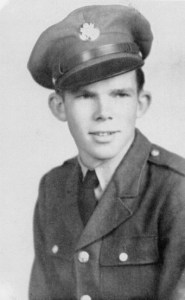
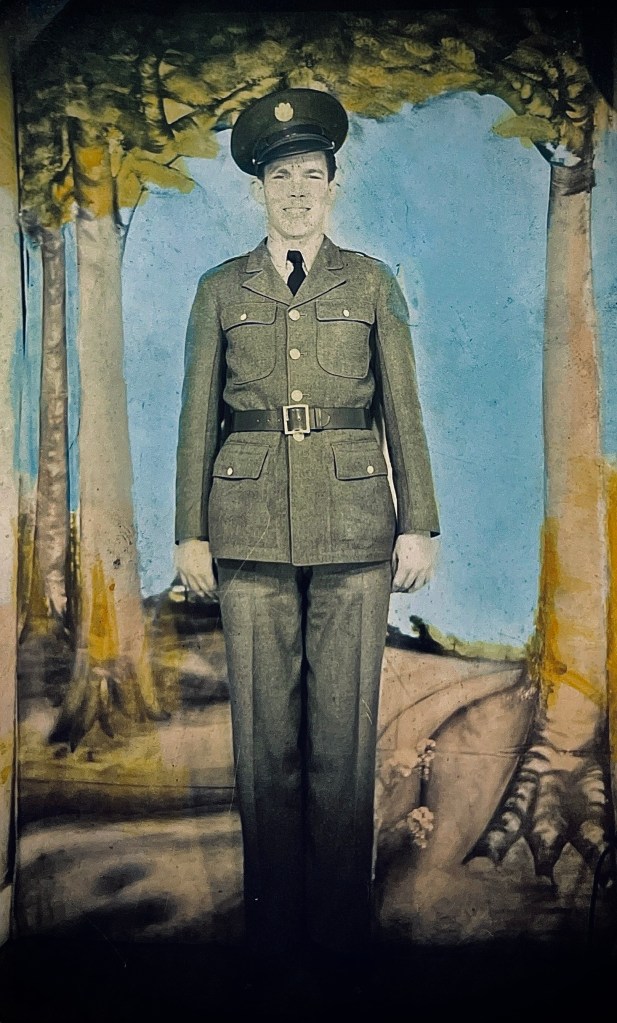
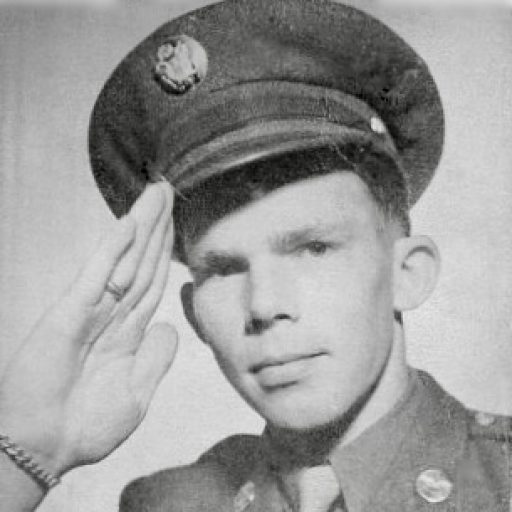
Chuckie as a toddler sitting in frontwith his older brother behindChuckie in adolecenceColorized photo of Chuckle in uniform
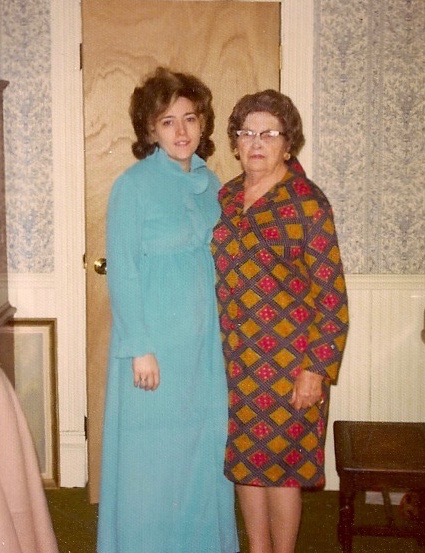
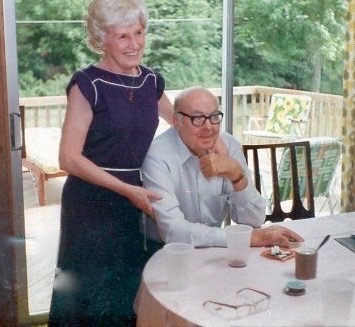
There are very few photographs of US Army Staff Sergeant Charles “Chuckie” Melvin Wilson, 36th Bomb Squad, 801st Bomb Group. He was killed in action on 28 April 1944 along with four other American aviators when his B-24 ‘Liberator’ Bomber crashed in the French village of Saint-Cyr-de-Valorges on a secret mission to supply the French resistance in advance of D-Day. Just ten days before he was killed, his brother and sister-in-law had a baby girl, his first niece, and the mother of Unforgotten Glory’s author. She recently passed away; found among her possessions were these new, previously unseen photos of Chuckle.
May these images evoke a small comfort to know that once we are gone, we will not be erased from the memories of others.
US Army Staff Sergeant Charles “Chuckie” Melvin Wilson, 36thBomb Squad, 801stBomb Group, was killed in action on 28 April 1944 along with four other American aviators when his B-24 ‘Liberator’ Bomber crashed in the French village of Saint-Cyr-de-Valorges. He is permanently interred in the military war grave cemetery Rhone American Cemetery and Memorial located in Draguignan, France.
US Army Staff Sergeant Charles “Chuckie” Melvin Wilson Born: January 19, 1922 – Died: April 28, 1944
These few details are all his family had about the fate of their son, their brother, their nephew, their cousin or the uncle they never knew. The ‘good guys won’; Chuckie was ‘killed in action’ and he’s ‘buried over there’ were the only memories spoken of or shared as the years went on. Little information was known. No one from his family had visited his grave. They never had passports, knew anyone French or traveled abroad.
The journey begins.
I had always been curious to know more about Chuckie, other family members too. Surely there was more to know about Chuckie now available on the internet? The lives of those in the Allied Forces who fought and died in WWII are recorded in hundreds of thousands of films, photographs, letters and history books. Monuments recognize the victory they achieved to restore freedom and end tyranny around the globe. These offer us a lasting record of their hopes, dreams, talents and ambitions, the countless lives they impacted, and the loved ones they left behind. But that record is incomplete and quickly disappearing for many.
One of those is US Army Staff Sergeant Charles “Chuckie” M. Wilson. When his mother (my great grandmother) died in the late 1970s, my family found a shoe box with a purple heart, a few undated photographs and just six official letters she received from the War Department over a 15 year period from the date of his death. These were all the memories that remained of Chuckie.
As the world commemorates the 75thanniversary of D-DAY this year, I felt a new sense of urgency and family duty to create a more complete digital record of Chuckie’s life so that his memory and contribution to freedom will not be forgotten. With only a basic timeline of key events known from those six letters, I dove into the internet to see what more I could find. The internet has made it possible for anyone with a computer and curiosity to search hundreds of thousands of websites, indexed data bases and social media to uncover a wealth of facts, images and uncover the truth of personal human stories.
The ultimate sacrifice, the unforgotten glory of their deeds.
What quickly emerged in my searches is a fascinating and remarkable story of heroism and bravery of a 22 year old man who enlisted in the Army to do his part in the fight for freedom for people in countries oceans away from his small town in Western Pennsylvania who soon found himself in England as part of the build up to the Allied invasion in France, details of his top secret air mission on that fateful day in advance of D-Day to supply the French resistance behind enemy lines, images of Chuckie and his fellow airman with their-24 ‘Liberator’ Bomber, a first-hand account of human tragedy as he and four fellow American airmen gave the ultimate sacrifice of their life for the liberation of France and the restoration of freedom, and a previously unknown monument to them erected with gratitude by the French villagers on the spot where they found his body under the plane wreckage after their fiery crash in Saint-Cyr-de-Valorges, France and the compassion they showed him as they quickly buried him in gratitude in a temporary grave so that his remains would be safe and could be returned with honor and dignity.
It is my hope that by sharing some history, personal family stories and facts of Chuckie and his mission on this blog over the coming months, readers will gain an interesting snapshot into an important period in history. Together we honor those like Chuckie who fought and died for freedom. In late May, I will be the first family member to visit Chuckie’s grave in France and I will share that experience here too. When I write my last post on this blog in a few months time there will finally be a more complete record of the life of Charles M. Wilson so that future generations can remember him, better understand the price of freedom and be inspired by what they learn.
Thank you for your interest.
For all of us, may it evoke a small comfort to know that once we are gone, we will not be erased from the memories of others.
Tim B.
Processing…
Success! You're on the list.
Whoops! There was an error and we couldn't process your subscription. Please reload the page and try again.
The war and its aftermath changed many American families forever. More than 292,000 American servicemen were killed in action in WWII. Families on the home front were profoundly affected. Another gruesome statistic in the arithmetic of war is the number of soldiers missing in action, lost at sea, or interred as unknowns. To this day, the remains of over 70,000 American G.I.s from World War II have never been officially recovered or identified. For the families of these veterans, the war, in some ways, is not over.
For Chuckie’s immediately family, life went on without him but was never the same. The pain of their loss was ever present for the rest of their days. In the 1950s, Chuckie’s sister Mary married a military man living the majority of her adult life where military duty called. They had three children – Donna, Mike and Link.
Chuckies parents in the 1950s
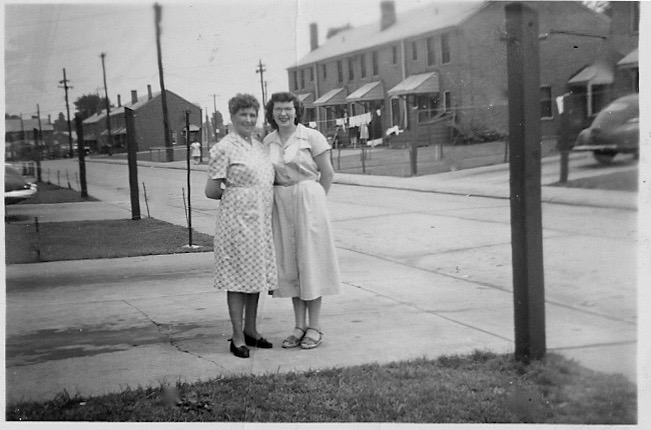
Chuckie’s mother Evie and sister Mary
Chuckie’s brother Jack and his wife Geri remained near his parents in Beaver, Pennsylvania for the rest of their marriage in the 1950s and early 60s raising their only child, a daughter Lynn. She’s was the baby in the V-MAIL photo of his niece that Chuckie likely never saw.
Brother Jack in the 50s
Brother Jack and Sister-in law Geri
Niece Lynn Kay in the 50s
Chuckie’s niece marries in 1963
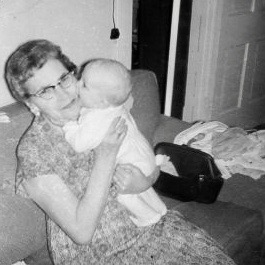
Chuckie’s mother with her first great grandson, the author of this blog
Niece Lynn in the 60s
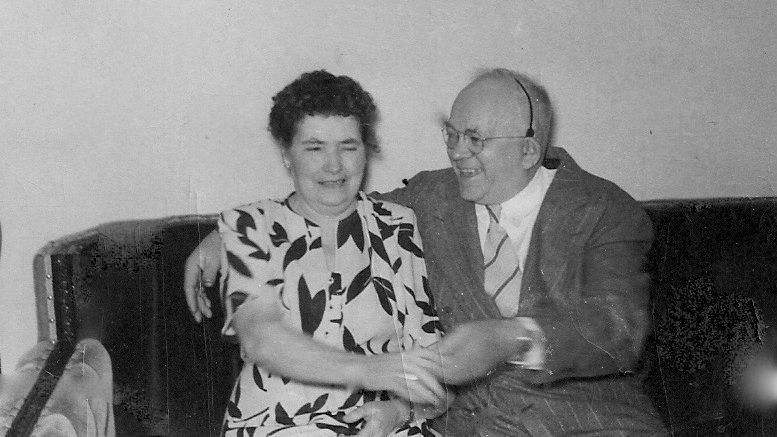
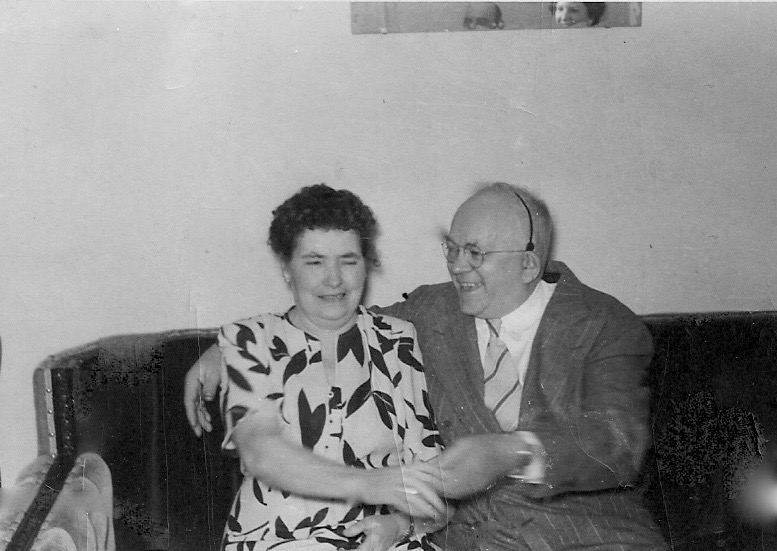
Chuckie’s parents had been married 47 years in 1964 at the time this photo was taken, twenty years after Chuckie was killed in action. His father “J.B.” was nearly deaf; he’s seen wearing hearing aids of the time. Notice the mirror reflection of their friends at the top of the wall sharing the joy of this moment too. It’s a wonderful story photo capturing a human moment of the author of Unforgotten Glory‘s great-grandparents. Enormous affection between them remains; having survived a long, difficult life journey together on a road well travelled yet still possessing an abiding love.
Chuckie’s parents in 1963.
Jack “J.B.” – Chuckie’s father, passed away on 15 June 1964 in Beaver, Pennsylvania at the age of 74 year old. In 1966, Chuckie’s brother became a grandfather for a second time with this birth of another boy making Evie a great grandmother for the second time.
Chuckie’s mother Evie, his sister-in-law Geri and now two great nephews in 1968
Evie and Lynn in 1977
Chuckie’s brother Jack divorced and remarried. In the 1970s, family time was spent with him in Ohio each summer on his boat, at Kings Island amusement park, the movies and fun restaurants.
Chuckie’s mother in the late 1970s
Evie – Chuckie’s mother moved to Virginia in the last years of her life and was well cared for by her daughter Mary. Thankfully, both of Evie’s remaining children would outlive her; she would never again have to suffer the pain of losing a child during her lifetime. She died peacefully on 30 March 1977 at the age of 82.
Chuckie’s brother Jack and wife Jean in the 1980s
Jack – Chuckie’s brother, lived the last two decades of his life happily with his wife Jean.
He died on 10 May 1991 at the age of 71.
Mary- Chuckie’s sister, returned in the 1980s to the land of the Wilson family roots – deep in the American South – following her husband’s retirement from military service. She passed away on 24 Feb 1998 Shreveport, Louisiana at the age of 73 years old.
Chuckie’s family was always proud of him, what he did for his country and the ultimate sacrifice made for freedom. Over the years since his death, each drew strength and comfort from the knowledge that he’d played a small part in protecting the freedom of others and winning the war.
Together, we honor those like Chuckie who fought and died for freedom. Connecting with a loved one’s WWII experience becomes tougher with each passing day—as conversations, old documents, and photos fade. Thanks everyone for joining in commemorating the 75th anniversary of D-DAY by following this storytelling of the life of US Army Staff Sergeant Charles “Chuckie” Melvin Wilson and his fellow Operation Carpetbagger crew of the 36thBomb Squad, 801st Bomb Group so that their contribution to freedom will not be forgotten.
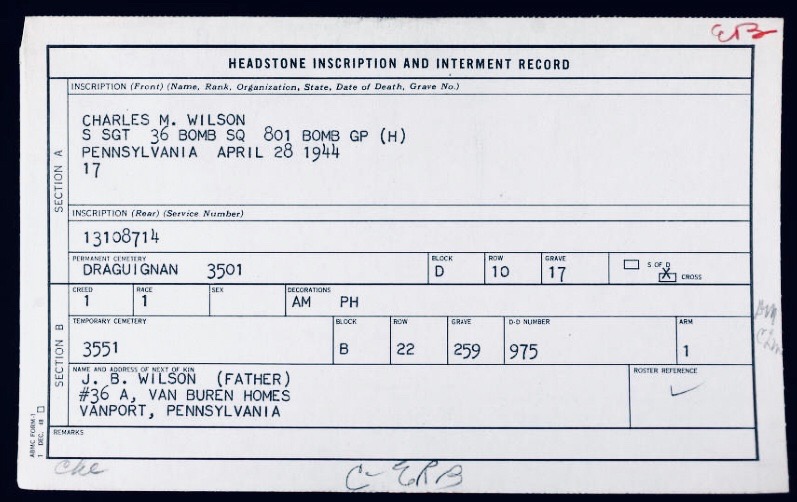
Just before Christmas in 1948 Chuckie’s parents received a letter confirming the final interment of their son Staff Sergeant Charles. M. Wilson per their expressed wishes. Like many who lost loved ones in WWII, the Wilson family chose to honor him by leaving his remains in the region near where he died fighting for what he believed and interred side by side with comrades who also gave their lives for their country rather than having his remains returned to the United States.
The record Chuckie’s father J.B Wilson authorized for Chuckie’s permanent internment in France
At military cemeteries, the decedent’s full name, rank, date of death, unit, and state of entry into military service are inscribed on the grave marker. The individual’s service number is included on white marble headstones at the World War II cemeteries.
The interment of remains of World War I and World War II war dead at permanent overseas American military cemeteries was made by the American Graves Registration Service, Quartermaster General of the War Department. When the interment program was completed the cemeteries were turned over to American Battle Monuments Commission (ABMC) for maintenance and administration.
The interments of World War I and World War II remains at ABMC cemeteries are permanent. It is no longer possible to repatriate the remains of those interred at these American military cemeteries. A provision of the law terminated authority to make further disposition of remains after December 31, 1951, when the decision of the next of kin became final. The program of final disposition of war dead established the moral and legal obligation of the U.S. government to honor the expressed wishes of the next of kin authorized to make the decision regarding the permanent interment of their loved one’s remains.
“Dear Mr. Wilson:
This letter is to inform you that the remains of your loved one have been permanently interred, as recorded above, side by side with comrades who also gave their lives for their country. Customary military funeral services were conducted over the grave at the time of burial.
After the Department of the Army has completed all final interments, the cemetery will be transferred, as authorized by the Congress, to the care and supervision of the American Battle Monuments Commission. The commission also will have the responsibility for permanent construction and beautification of the cemetery, including erection of the permanent headstone. The headstone will be inscribed with the name exactly as recorded above, the rank or rating where appropriate, organization, State, and date of death. Any inquiries relative to the type of headstone or the spelling of the name to be inscribed thereon should be addressed to the American Battle Monuments Commission. . . “
While interment activities are in progress, the cemetery will not be open to visitors. However, upon completion thereof, due notice will be carried by the press.
You may rest assured that this final internment was conducted with fitting dignity and solemnity and that the grave-side will be carefully and conscientiously maintained in perpetuity by the United States Government.”
Letter to Chuckie’s parents from Thomas B Larkin, Major General, The Quartermaster General, United States War Department
Chuckie is buried at RHONE AMERICAN CEMETERY in the city of Draguignan which is located in Southern France. More on his final resting place and the recent visit by this author coming up in a future post.
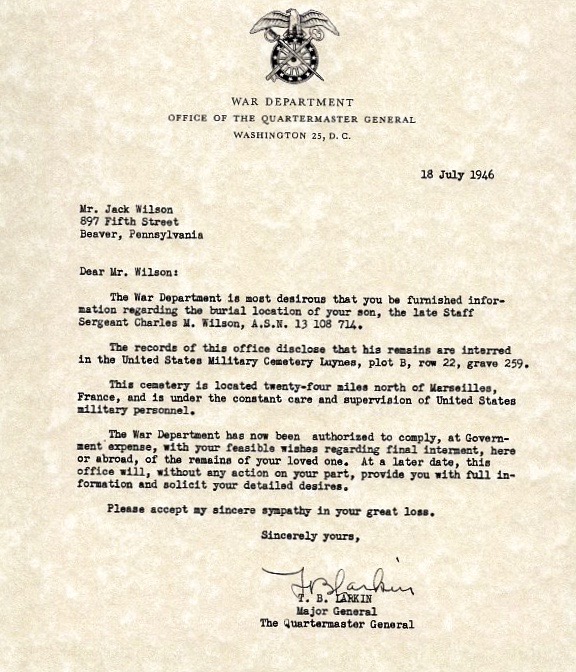
Chuckie’s parents received a letter from the War Department providing them with the temporary burial location of their son in a US military cemetary located twenty-four miles north of Marseilles, France. It also references information will be provided at a later date for making arrangements for his final interment. At that time the next of kin, authorized to make the decision regarding their loved one’s interment, was given the option of having the remains returned to the United States for permanent interment at a national or private cemetery, or permanently interred at the overseas American military cemetery in the region where the death occurred.
Dear Mr. Wilson,
The War Department is most desirous that you be furnished information regarding the burial location of your son, the late Staff Sergeant Charles. M. Wilson, A.S.N. 13 108 714.
The records of this office disclose that his remains are interred in the United Statement Military Cemetery Luynes, Plot B, row 22, grace 259.
This cemetery is located twenty-four miles north of Marseilles, France, and is under the constant care and supervision of Unites States military personnel.
The War Department has now been authorized to comply, at Government expense, with your feasible wishes regarding final interment, here or abroad, of the remains of your loved one. At a later date, this office will, without any action on your part, provide you with full information and solicit your detailed desires.
Please accept my sincere sympathy in your great loss.
Thomas B. Larkin Major General – The 32nd Quartermaster General February 1946-March 1949
As Quartermaster General, Larkin launched the program for return and final burial of American service personnel and civilians who died overseas during World War II. In January 1946, he was named by President Truman as Quartermaster General of the Army. He served in that capacity until March 1949.
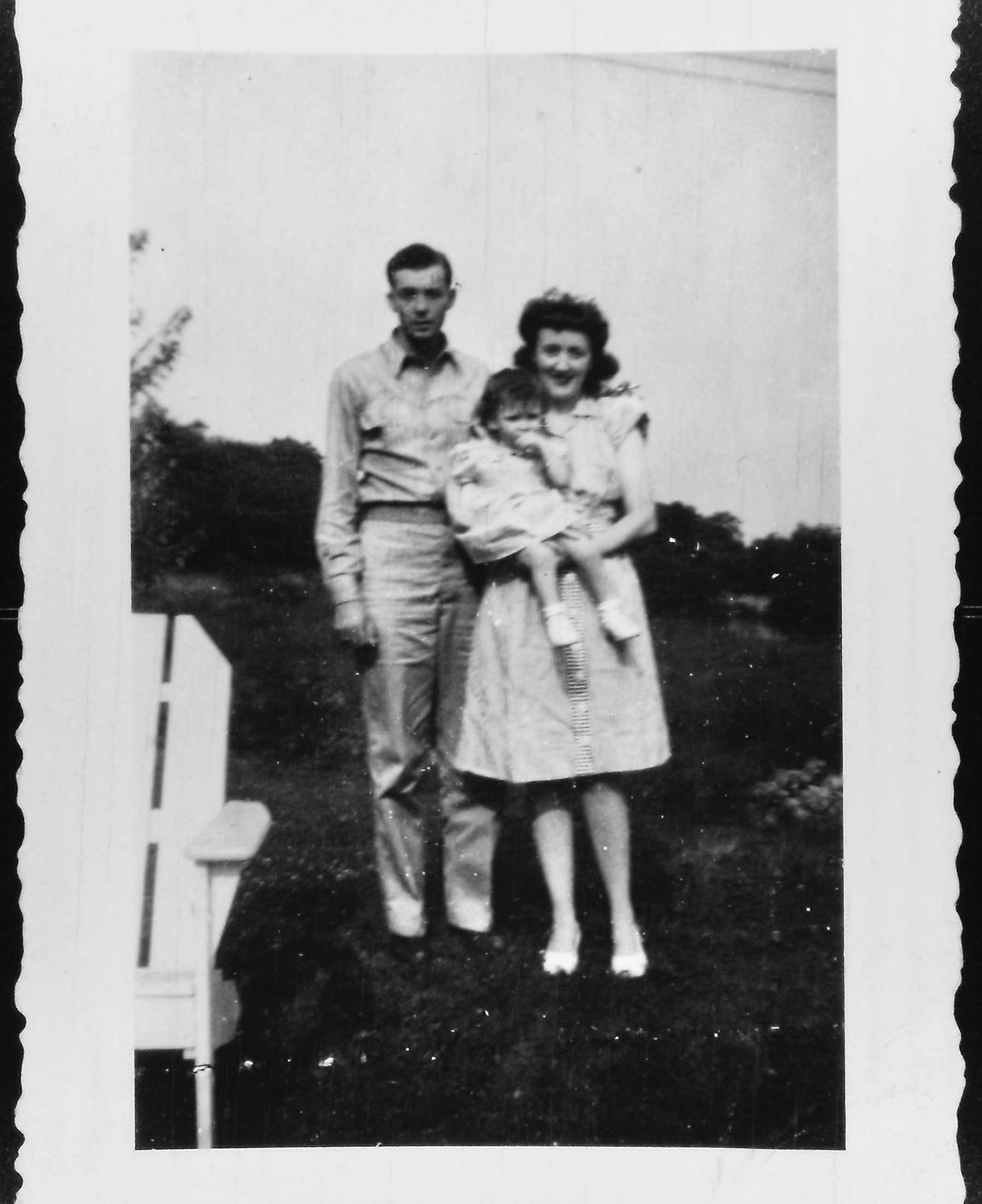
Nearly a year after Chuckie was killed in France in World War II, his older brother enlisted in the Army. The reason now is unknown but possibly out of a sense of duty to his country, honor the memory of his late brother – or both. Jack Wilson was 24 years old, married with a one year old daughter he left at home when he entered the Army on 3 April 1945.
Chuckie’s brother Jack, sister-in-law and niece on the day he left for the Army
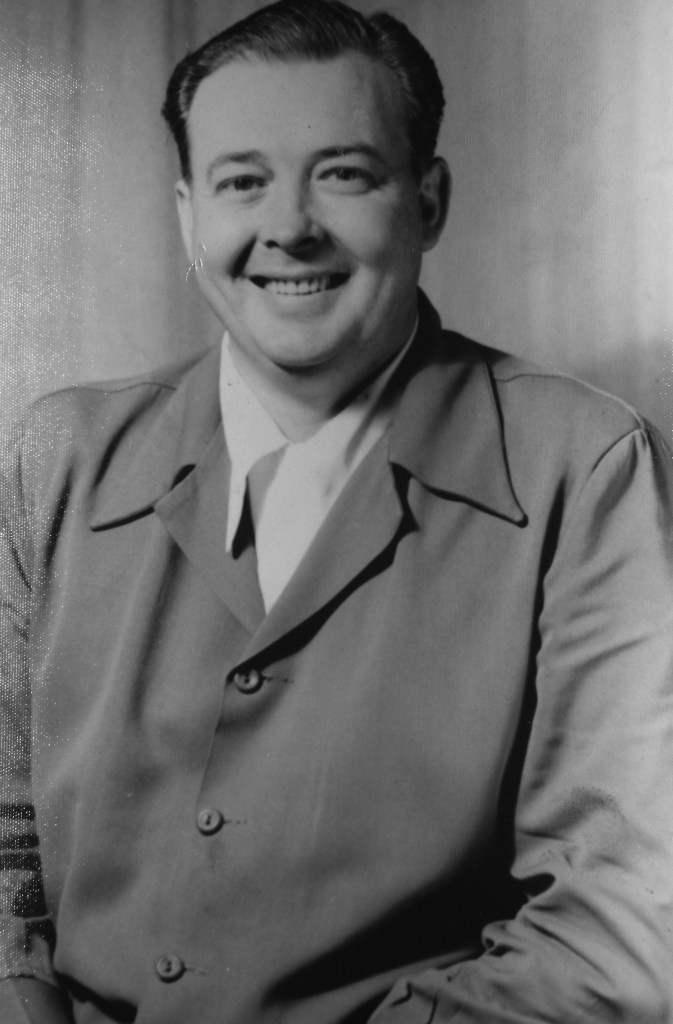
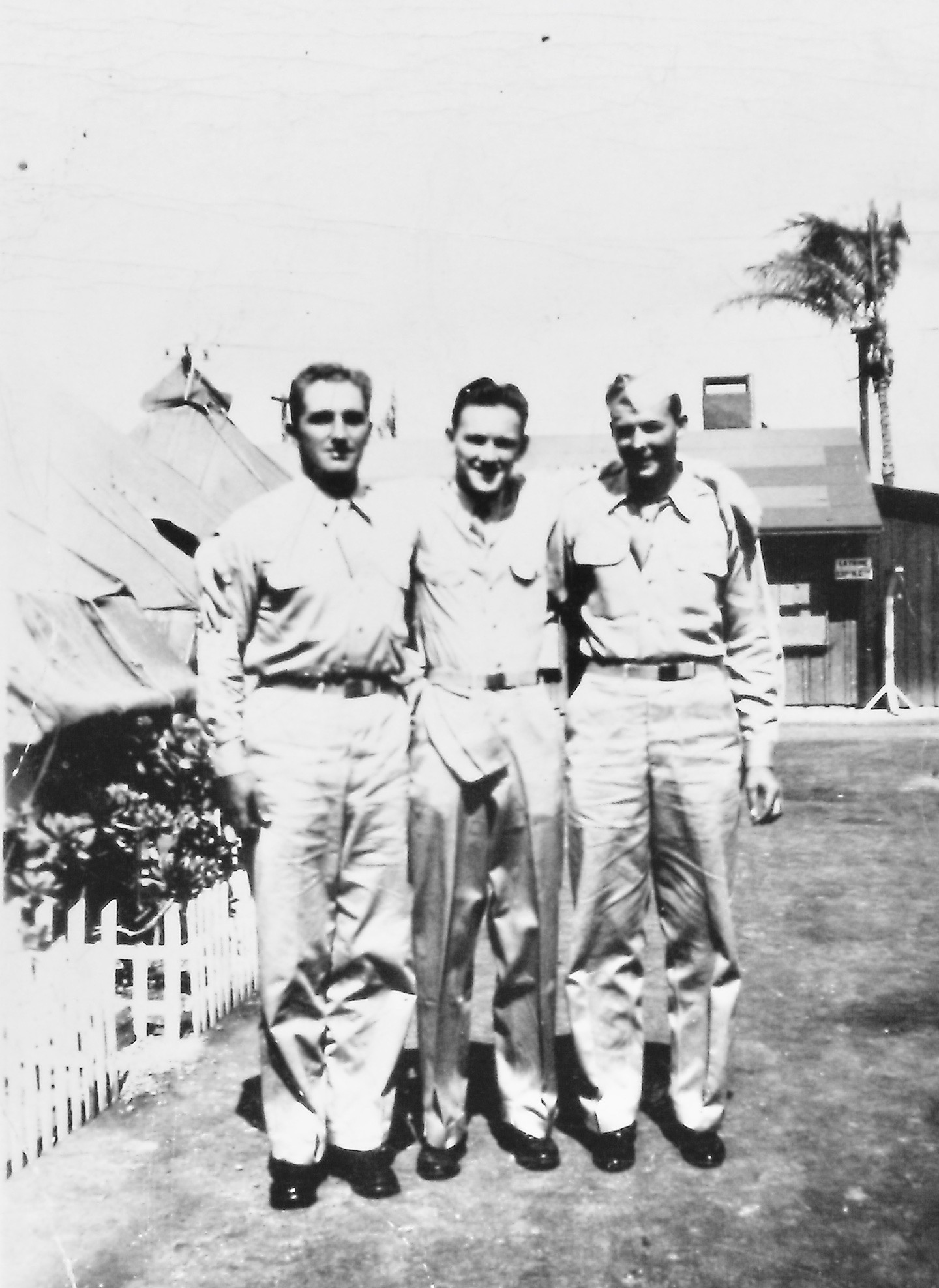
Jack served somewhere in the Pacific. This picture of Chuckie’s brother was taken on the day he was discharged from the Army on 23 Sept 1945 just five months after entering service. The war had ended.
Chuckie’s older brother on right on the day he was release from service.
After the war Jack returned to his hometown Beaver, Pennsylvania where he worked as a salesman the rest of his life. He had two grandsons one of whom is the author of this blog. Jack died at the age of 71 years old never knowing the true story of his brother Chuckie’s Carpetbagger mission or the glory of his deeds now captured In Memoriam on Unforgotten Glory.
Two months after Chuckie’s parents first received news that he was missing in action, they received a second letter from the Government. This one from the United States Senate Finance Committee dated 21 June 1944 extending their sympathy. It contained no new information but now addressed as “my dear Mrs. Wilson.”
My dear Mrs. Wilson
I wish to extend to you my heartfelt sympathy because of the report that your son, Staff Sergeant Charles M. Wilson, has been reported as missing in action in the European Area.
If he has not been found or has not returned to his outfit by the time this letter reaches you, I sincerely hope that will occur in the very near future, and that when he does return he will be safe and sound.
With my kindest regards and best wishes, I am Sincerely yours,
Letter to Chuckie’s mother, dated 21 June 1944, from US Senate Finance Committee
Chuckie’s parents in the 1940s
I was curious to know why the Senate Finance Committee would send such a letter so Googled it. The Finance Committee had the responsibility to raise revenue to pay for the buildup to WWII. They also had responsibility for funding and administering pension and benefits programs to veterans, widows and their children.
By 1941, Germany had conquered most of Europe and had begun its bombing campaign against Britain. And the Japanese had joined the Axis powers. Meanwhile, in the United States, the boom in the defense industry had helped bring the country out of the Great Depression.
The Finance Committee had the responsibility to raise revenue to pay for the buildup. The result was some of the largest revenue measures in the nation’s history, affecting all Americans. By early 1942, the Federal Government was spending $150 million a day, or roughly $5 billion a month, with nearly half of this total going towards the war effort.
The letter was signed by two individuals.
Senator Walter F. George (Georgia) Chairman of the United States Senate Committee on Finance In the 1940s George supported President Roosevelt’s efforts at military preparedness and American defensive buildup in response to the threat posed. Once the United States entered World War II after the Japanese attack on Pearl Harbor, George embraced the president’s vigorous prosecution of the war.
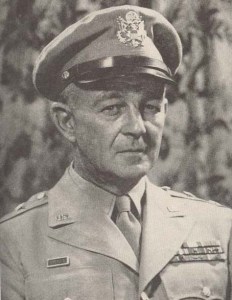
Major General Hugh J. Gaffey At this time, he was chief of staff of the Third Army, serving again under Lieutenant General George Patton. Gaffey served in this capacity through the campaign in Western Europe, from the time the Third Army landed in France in July 1944 and played a major role in Operation Cobra and the Battle of the Falaise Gap, followed by the Allied advance from Paris to the Rhine and the Battle of Metz.
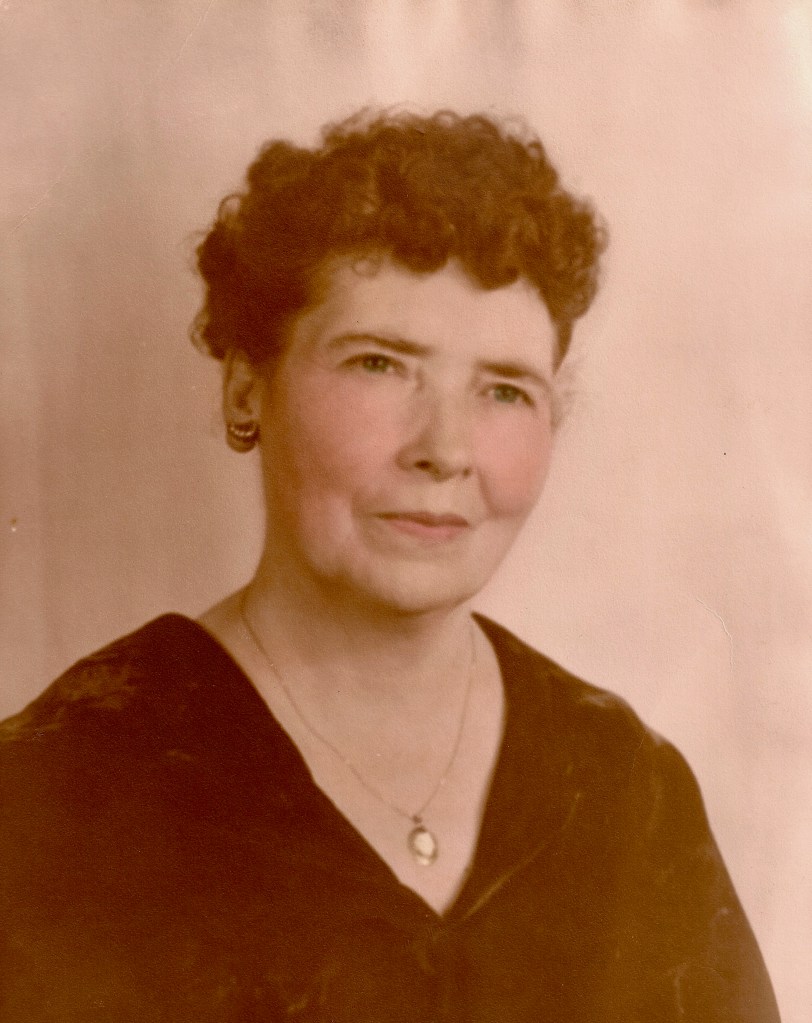
Chuckie’s mother (the author’s great-grandmother) in the 1940s.
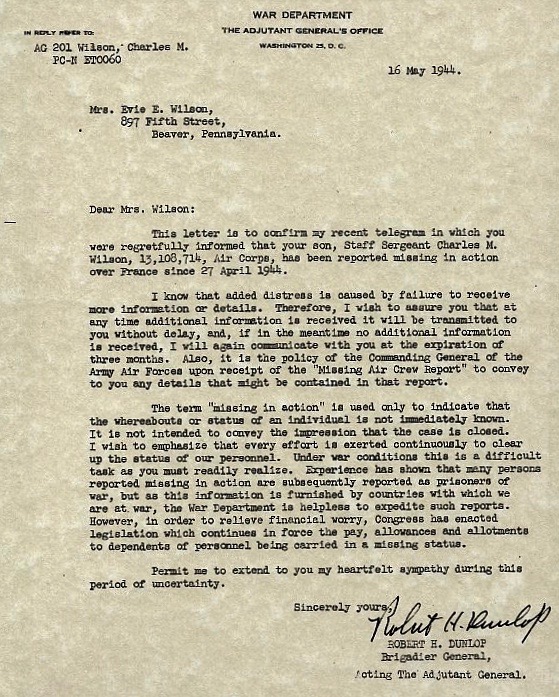
Chuckie’s parents first received a telegram sometime shortly before receiving an official letter from the Brigadier General at the War Department notifying her that “regrettably” her son has been reported missing in action. I cannot begin to imagine the heartache my great-grandparents and family members felt in the days, weeks and months following receiving this news. How painful for any family to have to live every day with such uncertainty, no answers and not knowing if Chuckie was dead, alive or a POW.
Dear Mrs. Wilson:
This letter is to confirm my recent telegram in which you were regrettably informed that your son, Staff Sergeant Charles M. Wilson 13,108,714, Air Corps, has been reported as missing in action over France since 27 April 2944.
I know that added distress is cause by failure to recieve more information or details. Therefore, I wish to assure you that at any time additional information is received it will be transmitted to you without delay, and, if in the meantime no additional information is received, I will again communicate with you at the expiration of three months. Also it is the policy of the Commanding General of the Army Air Forces upon receipt of the “Missing Air Crew Report” to convey to you any details that might be contained in that report.
The term “missing in action” is used only to indicate that the whereabouts or status if an individual is not immediately known. It is not intended to convey the impression that the case is closed. I wish to emphasise that every effort is exerted continuously to clear up the status of our personnel. Under war conditions this is a difficult task as you must realize. Experience has shown that many persons reported missing in action are subsequently reported as prisoners of way, but as this information is furnished by countries with which we are at war, the War Department is helpless to expedite such reports. However, in order to relieve financial worry, Congress has enacted legislation which continues in force the pay, allowances and allotments to dependents of personnel being carried in a missing status.
Permit me to extend to you my heartfelt sympathy during this period of uncertainty.
Letter to Chuckie’s mother from Brifadier General Robert H. Dunlap, 16 May 1944
A copy of the letter Chuckie’s mother received.
Sadly, it would be two more years before Chuckie’s parents would recieve confirmation of his death and official change in status to Killed in Action. And many more years after that before any further details emerged. This remarkable story and details will be shared on upcoming posts.
Chuckie’s mother (the author’s great-grandmother) in the 1940s.
Chuckie’s parents first received a telegram sometime shortly before receiving an official letter from the Brigadier General at the War Department notifying her that “regrettably” her son has been reported missing in action. I cannot begin to imagine the heartache my great-grandparents and family members felt in the days, weeks and months following receiving this news. How painful for any family to have to live every day with such uncertainty, no answers and not knowing if Chuckie was dead, alive or a POW.
Dear Mrs. Wilson:
This letter is to confirm my recent telegram in which you were regrettably informed that your son, Staff Sergeant Charles M. Wilson 13,108,714, Air Corps, has been reported as missing in action over France since 27 April 2944.
I know that added distress is cause by failure to recieve more information or details. Therefore, I wish to assure you that at any time additional information is received it will be transmitted to you without delay, and, if in the meantime no additional information is received, I will again communicate with you at the expiration of three months. Also it is the policy of the Commanding General of the Army Air Forces upon receipt of the “Missing Air Crew Report” to convey to you any details that might be contained in that report.
The term “missing in action” is used only to indicate that the whereabouts or status if an individual is not immediately known. It is not intended to convey the impression that the case is closed. I wish to emphasise that every effort is exerted continuously to clear up the status of our personnel. Under war conditions this is a difficult task as you must realize. Experience has shown that many persons reported missing in action are subsequently reported as prisoners of way, but as this information is furnished by countries with which we are at war, the War Department is helpless to expedite such reports. However, in order to relieve financial worry, Congress has enacted legislation which continues in force the pay, allowances and allotments to dependents of personnel being carried in a missing status.
Permit me to extend to you my heartfelt sympathy during this period of uncertainty.
Letter to Chuckie’s mother from Brifadier General Robert H. Dunlap, 16 May 1944
A copy of the letter Chuckie’s mother received.
Sadly, it would be two more years before Chuckie’s parents would recieve confirmation of his death and official change in status to Killed in Action. And many more years after that before any further details emerged. This remarkable story and details will be shared on upcoming posts.
Sometime shortly after 14 April 1944, Chuckie received news that his brother and his wife had a baby girl, his first niece. It was most likely sent by V-Mail.
During WWII many babies were born while their fathers, brothers, cousins and uncles were away at the battlefront. Letters served as a vital link between loved ones and friends. V-Mail became extremely popular. It was a quick way to deliver a lot of mail to troops, boost moral and for the troops to get caught up on what was going on at home.
The emotional power of letters was heightened by the fear of loss and the need for communication during times of separation. The Post Office, War, and Navy Departments worked together to ensure V-Mail for civilians and service members around the world. The Postal Museum has an interesting and informative Victory Mail online exhibit.
“Here’s a photo of your new niece.”
Because V-Mail stationery served as a letter and envelope in one, enclosed objects and photographs were prohibited. In 1943 the War Department amended the restriction on sending photographs allow photos of “infants born after a soldier departed for overseas or those under 1 year of age” and it could include the mother. The photographs were transposed onto the regulation forms “without altering, treating, or sensitizing the form in any manner.”
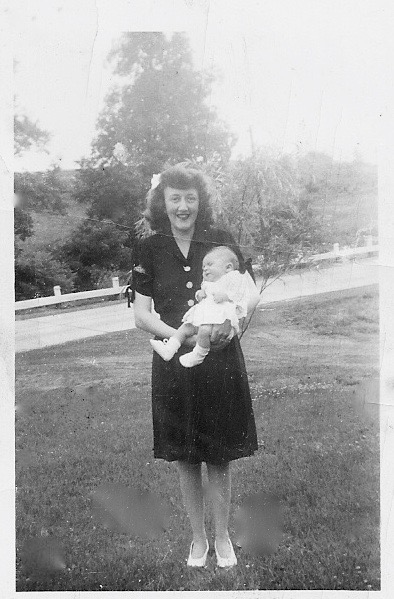
Here is the regulation standard photo taken by Chuckie’s brother to be sent V-Mail to Chuckie on the battlefront – his newborn infant niece, born after Chuckie departed for overseas, held by her mother. It is unlikely that Chuckie ever saw this photo.
Chuckie would never meet his neice. He never came home.
Chuckie’s sister-in-law holding his newborn niece
Chuckie's niece is the Unforgotten Glory blog author.
















 Unforgotten Glory