4 May 1944 – French agents report back, plane crashed

For eight long days back at Harrington, Chuckie’s Squadron Command didn’t hear anything from the Ambrose Crew or those on the ground about the fate of the Carpetbagger mission or their friends and colleagues of The Worry Bird crew.

Finally on 4 May 1944 Allied Forces Operations at Baker Street London received a message from French agents in the field that Chuckie was killed, along with a part of Chuckie’s airplane with the aircraft number.

French witnesses on the scene reported the aircraft had arrived over the target and made three descending circles. It struck the ground on the third circle, crashed and burned, killing all crew members except George W. Henderson, S Sgt. James J Hedddleson and St. James C. Mooney.

This is copy of the actual report dated 6 May 1944 which can be found in the National Archives.
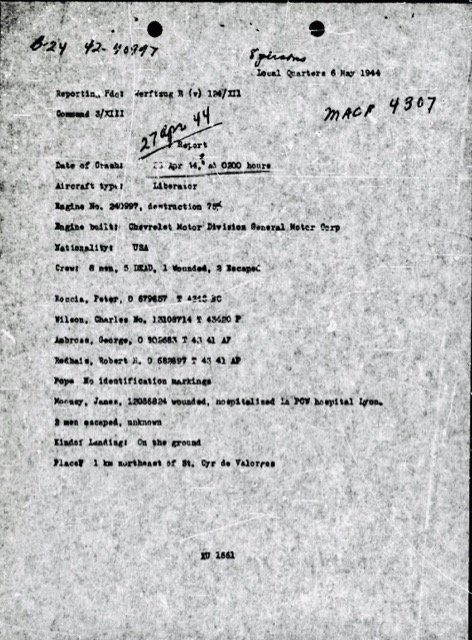
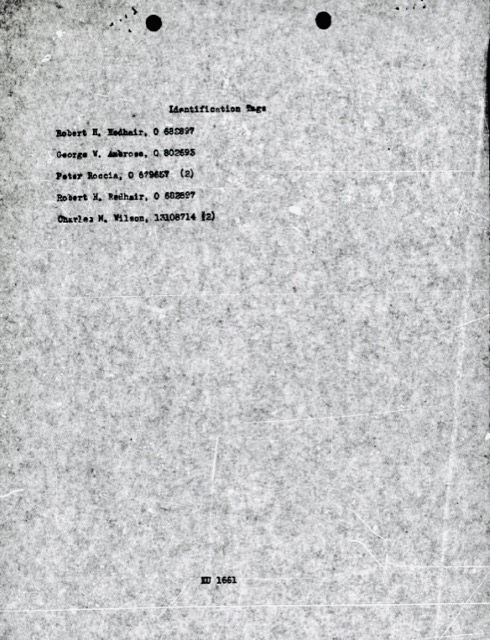
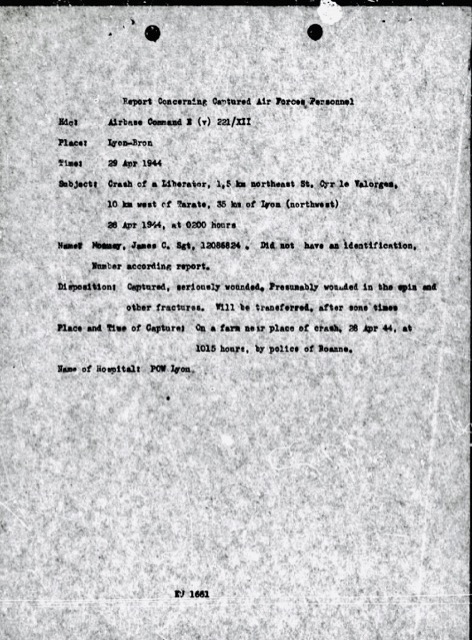
French agent field report to OSS offices in London “Baker Street” that Chuckie was killed.
French agent field report to OSS offices in London “Baker Street” confirming Chuckie’s Identification page found on his body.
French agent field report confirming Sgt. Mooney taken to hospital as POW.

Carpetbagger missions were carried out by the Office of Strategic Services (OSS) to clandestinely deliver agents and supplies into Nazi-occupied Europe. The OSS was a wartime intelligence agency of the United States during World War II, and a predecessor to the Central Intelligence Agency (CIA). The OSS was formed as an agency of the Joint Chiefs of Staff to coordinate espionage activities behind enemy lines for all branches of the United States Armed Forces.

To support the Allied invasion of France on D Day in June 1944 the Carpetbaggers from January – to June dropped three-man parties (a total of 100 men and women) into various parts of France as agents to co-ordinate widespread overt (as opposed to clandestine) acts of resistance. They served in a variety of functions including arms and sabotage instructors, couriers, circuit organizers, liaison officers and radio operators. The names of all 13,000 OSS personnel and documents of their OSS service, previously a closely guarded secret, were released by the US National Archives on August 14, 2008. 

French agents were directed from OSS offices in London “Baker Street” where they occupied much of the western side of Baker Street. The precise nature of the buildings remained concealed. Secure communications were established with OSS HQ in London and Station 179, Harrington where the 801st Bomb Group OSS Liaison Officer, S2 Lt. Sullivan directed the covert Carpetbagger operations.
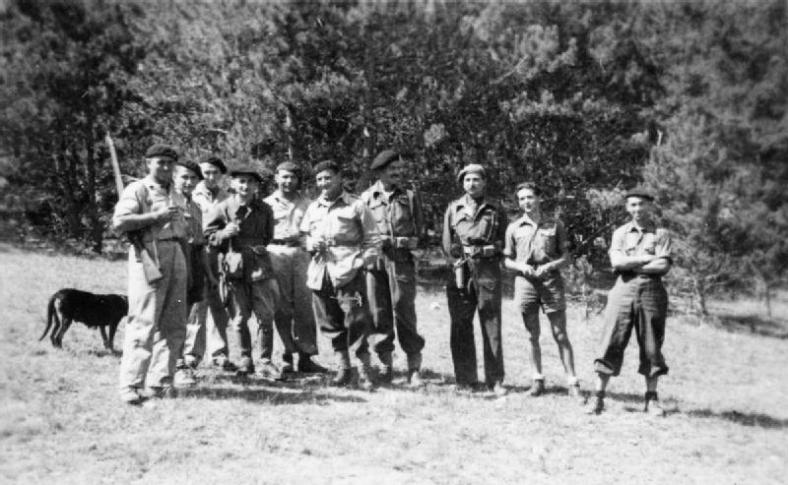
Maquisards (Resistance fighters) in the Haute-Savoie dรฉpartement in August 1944.
Third and fourth from the left are two SOE officers.
Photo Credit
It would be two more years before the Wilson family were told that Chuckie was killed.

The Crash (Part four): 08:00 – 28 April 1944, it was the next day

It was now morning daylight. Sometime in the morning hours, members of the French resistance army removed the remains of Chuckie and his four fellow comrades from the wreckage of the plane in a field near Saint-Cyr-de-Valorges, France and buried them in an unmarked temporary grave. They also worked very hard to quickly retrieve all the container canisters and packages of supplies strewn about and to hide them.

The Nazi’s would soon arrive at the crash site to retrieve any intelligence they could find.

Quickly burying the dead while under threat of the imminent danger of the arrival of the Nazi’s was a humane act of enormous compassion and respect by the French people. They protected Chuckie and the other fallen from any potential further desecration by the Nazi’s. It also allowed for Chuckie’s body to be identified and, at a later point, safely moved to a temporary cemetery and his subsequent permanent interment in December 1948 at his final resting place at Rhone American Cemetery in Draguignon, France.

Chuckie’s parents were never given many facts about how he died because on his “S E C R E T” Carpetbagger mission. They did have the comfort of knowing that their their son’s body was always treated with the dignity and respect he deserved for paying the ultimate sacrifice for Freedom.

Chuckie’s family never saw these photos of his crashed plane.
Today, they are easily findable by anyone on the internet.

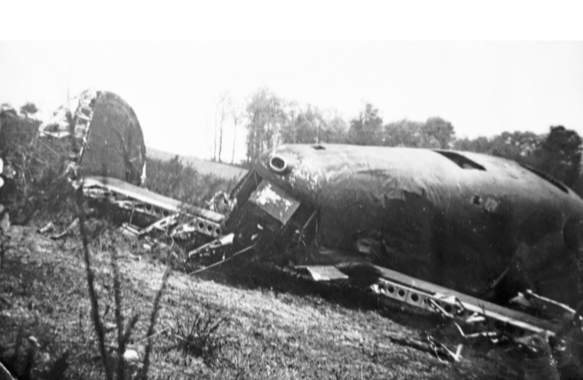
April 1944 B-24 Liberator “The Worry Bird” wrecked upside down in a field west of Lyon, France, after striking a hill near the town of Saint-Cyr-de-Valorges during a night mission. Note the square ‘Joe Hole’ which canisters and packages exited during an airdrop. 

A second photo of B-24 Liberator “The Worry Bird” April 1944
This is the underside of the bombay compartment in the center of the aircraft and the tail section section.

Killed In Action – 28 April 1944
Lieut. George W Ambrose, Pilot; of Springdale, PA
Lieut. Robert H Redhair , Co-Pilot; of Bartlesville, OK
S Sgt. Charles M Wilson, Engineer; of Beaver, PA
Lieut. Arthur B Pope, Navigator; of Fulton, GA
Lieut. Peter Roccia, Bombardier; of Washington, D.C.

It was the next day that they (the French) realized that two more Americans survived (in addition to Mooney). They found the chutes, 1st one and then another, which they immediately buried.

Survivors of the crash included:
Sgt. James J Heddleson, Radio Operator; of Louisville, OH
Sgt. George W Henderson, Tail Gunner; of Santa Monica, CA
Sgt. James C Mooney, Dispatcher; of Englewood, NJ – He volunteered for this mission (his first) – the rest of the crew only met him shortly before take-off, as regular crew member Sgt. W. Bollinger had reported off sick that day.

We assumed everyone was killed except Sgt. Mooney.
His condition was such, I found out later, that the man whose house he was taken to, had to turn him over to the Germans. He told me personally how sorry he was for having to do this. But I tried to assure him that in Sgt Mooneyโ€™s case (broken back) he probably saved his life as I heard the Germans took him to a hospital.

Heddelson and Henderson were now on the move to evade the enemy, as trained

“We moved only at night as we traveled quite a way for the shape we were in. The French started to look for us they said in every direction possible. We skirted villages and main roads, avoiding everyone we saw, especially the Germans. Having no idea where we were, we headed South.”

Edited from transcribed copy of letter by crash survivor James Heddelson in the archives at the Air Force Academy June – 1998

A French secret agent on the ground that day also took the piece of the plane with the serial number.

It would soon be returned back to the Office of Strategic Services (OSS) headquarters at Baker Street in London as part of his field report to the Allied Forces command that the plane had crashed and USAAF men had died.

The Crash (Part three): 02:20 – 28 April 1944, seen like a beacon

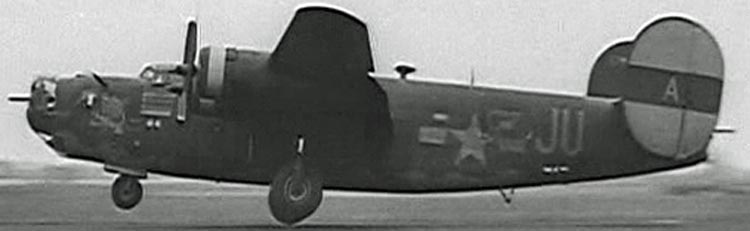
Chuckie and his fellow crew onboard B-24D serial no. 42-40997 The Worry Bird (formerly Screaminโ€™ Mimi of the 565th Bomb Squadron, 389th Bomb Group) clipped a hill near its drop zone in Saint-Cyr-de-Valorges, Loire, and crashed killing him and four other crew; three airmen survived.

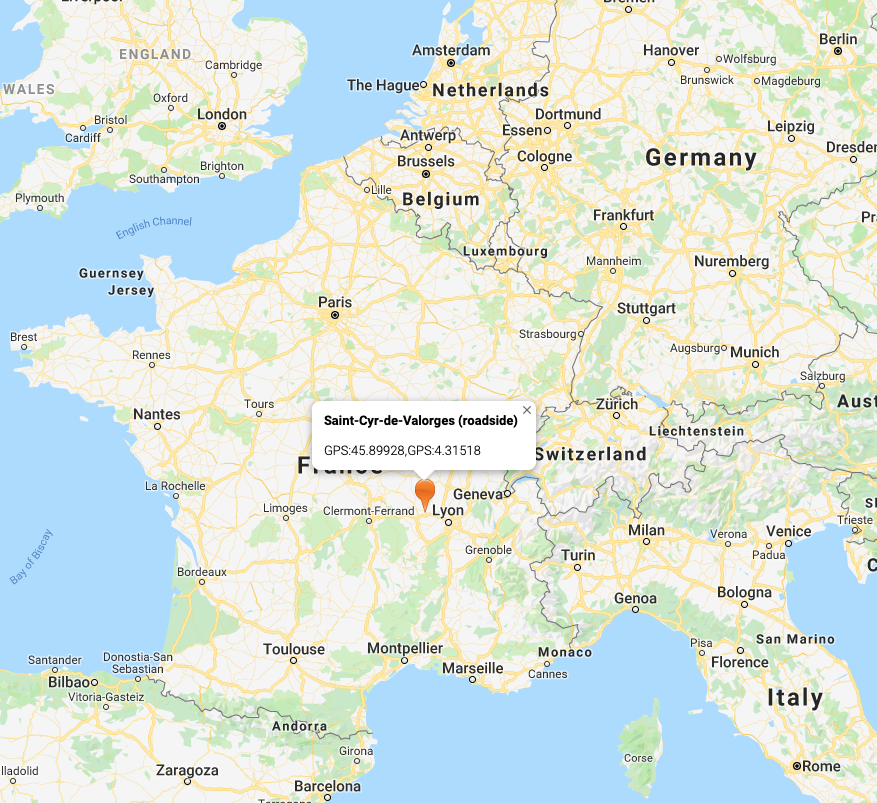
The GPS location of the plane crash

When it struck the ground on the third downward circle, the B-24 divided into four distinct compartments as it crash landed.

Chuckie and the four other airmen in the first to sections were killed; the three airmen in the back two sections survived after being able to parachute out and away from the plane to safety just before the crash landing.

  1. bombardier-navigator’s compartment in the nose of the aircraft which contained the navigational equipment, bomb-sight, bomb controls, and nose guns or nose turret; where navigator Lieut. Arthur B Pope, Navigator; and bombardier Lieut. Peter Roccia, Bombardier were located
  2. flight deck which included the pilot’s compartment, radio operator’s station, and top gun turret; where flight engineer Chuckie along with pilot Lieut. George W Ambrose and co-pilot Lieut. Robert H Redhair were located
  3. bomb bay compartment in the center of the aircraft under the center wing section (half deck is located above the rear bomb bay); where survivor Sgt. James C. Mooney was located
  4. rear fuselage compartment which contains the lower gun turret, waist guns, bottom camera hatch, photographic equipment, and the tail gun turret; where survivors Staff Sgt. James Heddleson and Sgt. George Henderson were located

Radio operator James Heddleson and gunners George Henderson and James C. Mooney survived. Heddelsman wrote a first person account of the crash in a letter to author Ben Parnell for his 1987 book Carpetbaggers: America’s Secret War in Europe. A transcription is in the archives at the Air Force Academy. A portion is reprinted here.

1st I hit my forehead, partly falling out and then I was thrown backwards toward the โ€œJoe Holeโ€ area, with the back of my head slamming into something in the plane. Sgt. Mooney is gone, he apparently fell out of the โ€œJoe Hole.โ€ I found out later he held onto the chutes (packages). Luckily he wasnโ€™t killed, although the poor man must have suffered terribly. His back was broken, this I was told later. Sgt. Henderson was immediately out of the tail section.

We found each other.
Henderson and I were apparently fairly close to each other … as each of us made our way back to the plane.

The plane seemed to be everywhere
Our plane could be seen like a beacon for miles like a beacon.. . . the ammunition exploding and whatever was in the canisters also going off. . . and the noise it made in the still of the night with everything exploding certainly would attract a lot of attention.

The canisters were scattered everywhere.
The French worked very hard throughout the night, very hard, trying to retrieve them. Sgt. Henderson and I were apparently fairly close to each other and as each of us made our way back to the plane, we found each other.

We assumed everyone was killed except Sgt. Mooney.
Mooney, we tried to find him, hoping he was alright, but it was night and in the mountain area and after a while we gave up. We were not only hurting physically, but also emotionally, myself being only 20 years old at the time.

We could hear noises like cars or truck engines or so we thought.
My left leg was hurt and was getting worse as it was swelling around the knee. We had no idea where we were, but the 1st thing we thought of was it could be the Germans.

We started down the hills toward the valley,
Not knowing anything about the territory, we just decided to slip away in the night, the best way we could. 

Edited from transcribed copy of letter by crash survivor James Heddelson in the archives at the Air Force Academy June – 1998

His back broken, Mooney was helped from the crash area by a French women from the village but was soon handed over to the Germans for urgent care when the seriousness of his injuries became clear. He survived as a POW in a Lyon hospital recovering from his injuries. Heddleson and Henderson successfully evaded the enemy by first hiding under cover, then being taken in by the French Resistance Army the Maquis, living with them for three months and even going along one night to help blow up a railway trestle. In early August an RAF Lockheed Hudson picked them up safely and on 27 August 1944 they returned to Harrington.

Coming up The Crash (Part four): What happened the next day when then sun came up and photos of the crashed plane.

The Crash (Part two): 02:10 hrs – 28 April 1944, the plane strikes high ground and crashes

Not only was the B-24 demanding to fly, even for a fully-qualified pilot, it operated at such high weights that takeoffs became dicey even with full power on all engines. Flight stability was marginal, and escape from a stricken machine was extremely difficult once the pilot and copilot had let go of the controls. I imagine these were some of contributing factors on the night Chuckie’s plane crashed.

To better ensure accurate drops, pilots tried to get down to within 400 to 600 feet off the ground and to reduce their flying speed to 130 miles per hour or less. The low speed reduced the chances of damage to parachutes, as the shock of opening is much less at the slower speed. Personnel were normally dropped from a height of 600 ft with containers and packages being dropped from 300 โ€“ 500 ft.

Chuckie’s plane made two passes over the target and on the third pass, “we hit or clipped something”

Once again the flaps start down and the bomb-doors open and we are starting our approach. I can look out and see the hills, or mountains on our left side. Suddenly the plane shakes violently, apparently we hit or clipped something.”

The engines were racing and the plane was climbing, seemingly straight up. He yells for us to get out. . . .We no sooner cleared the plane when it starts down again, only this time it is too late, because it is burning when it crashes.”

Transcribed from copy of letter by crash survivor James Heddelson in the archives at the Air Force Academy June – 1998

At 02:10 hrs local Chuckie’s aircraft landed in a fiery crash in Saint-Cyr-de-Valorges, Loire, near Lyon France.

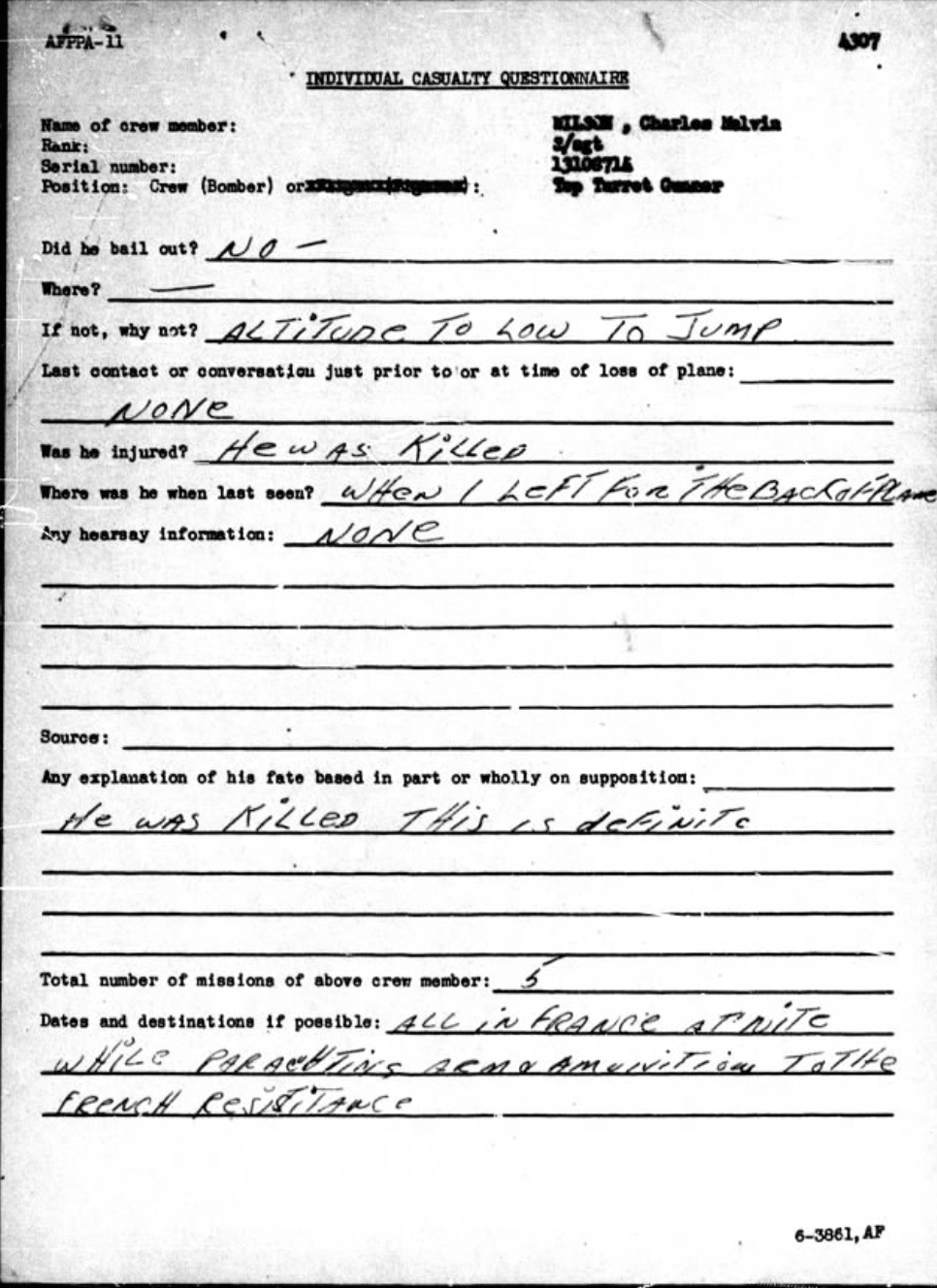
“He was killed. This is a definite.”

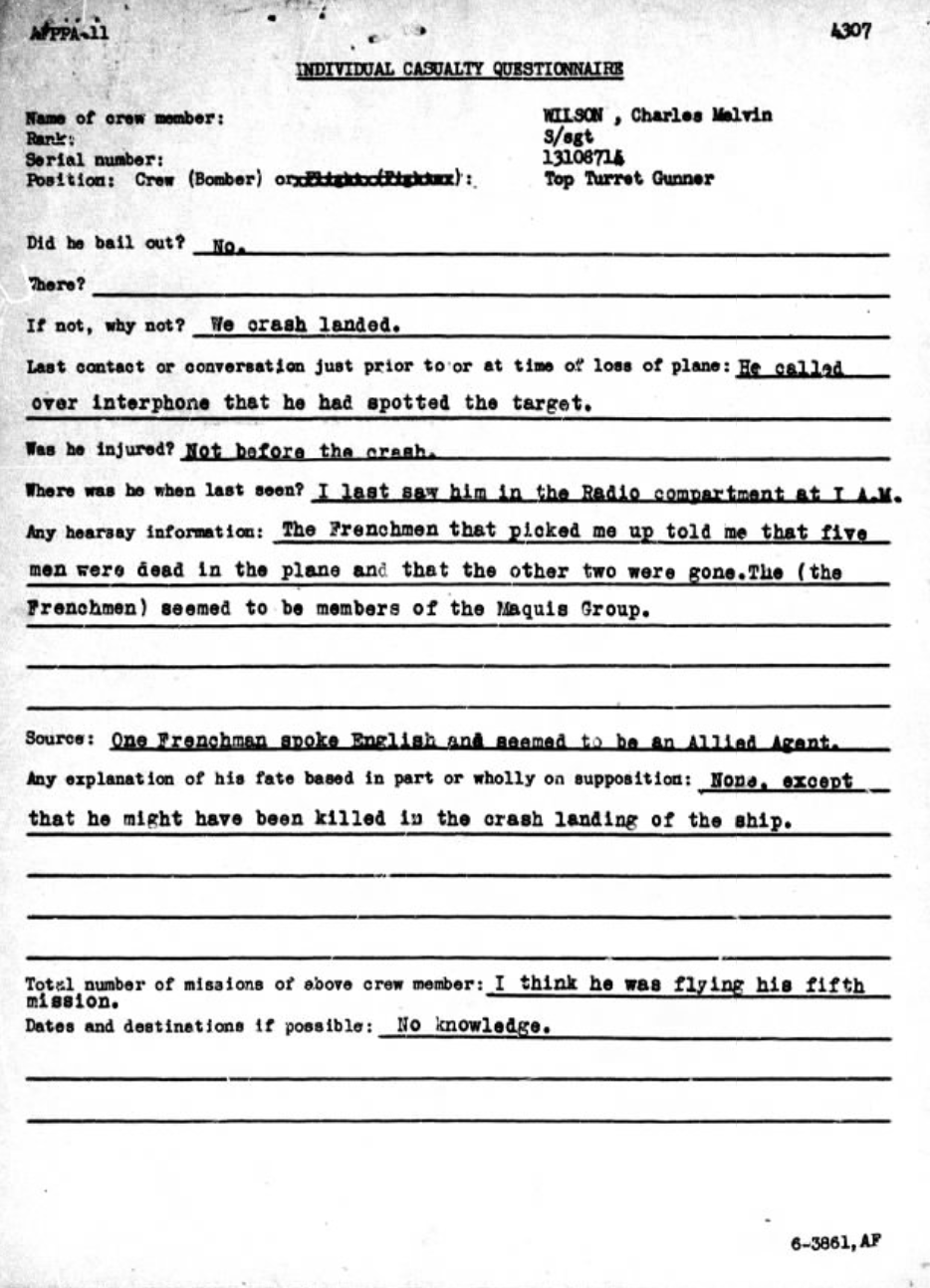
Chuckie was killed on impact. Individual Casualty Questionnaire‘s were completed by two of the three crash survivors when they eventually returned back to Harrington three months later after successfully evading the enemy with the help of the French resistance. Both confirm Staff Sgt Charles. M. Wilson was killed in action when his plane crashed. Copies of the actual questionnaires likely completely sometime in August 1944 were found in the MACR and posted below.

Next up: The Crash (part three) – seen like a beacon

The Crash (Part one): 01:00 hrs – 28 April 1944, target reached

Part one of four posts capturing the story of what actually happened that night of the fiery crash that killed Chuckie compiled from two first person survivor accounts, historical documents filed in the Missing Aircraft Report and WWII archival material.

Chuckie’s Carpetbagger mission the night he was killed was Operation Lackey 3A over the Timdale drop zone detailed in an earlier post. When his aircraft reached a position a few miles from the drop zone near Lyon, France the โ€˜Sโ€™ Phone was used. The system permitted direct two-way voice communication with an aircraft up to a range of 30 miles and the agents on the ground working behind enemy lines to communicate and coordinate landings and the dropping of agents and supplies. It was composed of a “Ground” transceiver and an “Air” transceiver and required the ground operator to face the path of the aircraft. It had the useful trait of transmitting signals that could not be picked up by enemy ground monitoring stations more than one mile away.

He called over the interphone that he spotted the target.”

It was around 1:00AM in the morning when Chuckie and crew reached the target area. According to the first person account from survivor Sgt James Heddelson, they made the 1st pass over the pinpoint and members of the Resistance on the farmland below for identification. While the S-Phone provided directional information to the pilot it gave no range information for the drop. This could only be done by visual sightings of lights on the ground.

A few miles from the target area all available eyes began searching for the drop area, which would usually be identified by three high powered flashlights placed in a row, with a fourth at a 90 degree angle to indicate the direction of the drop. The recognition torches were placed in the pre-arranged pattern and the light codes were exchanged between the ground and the plane. The aircraft was most vulnerable to enemy fire over the drop zone. The pilot 1st Liet. George Ambrose wasted no time lining up the twinkling markers.

We circled around for position to make the drop.”

Pilot Ambrose selected half flaps and made the run in at 135 mph โ€“ not much above stalling speed. He was guided by the bombardier, who would be releasing the containers over the drop zone. Speed was all important on the ground โ€“ the man sized containers were to be quickly taken away into the cover of trees.

(2nd pass) . . . the wing flaps start to come down and the bomb bay doors are starting to open. Suddenly they start back up, we donโ€™t drop and it is like we were practicing and we climb back up.”

“As we start to circle around again, I can still see the lights on the ground in the distance on our drop area. We start in for the 3rd pass.

Sgt James Mooney is over the โ€œJoe Hole.โ€ He volunteered for this mission (his first) we only met him shortly before take-off, as a regular crew member Sgt. W. Bollinger reported off sick. I am over the smaller hole behind Sgt. Geo. Henderson, who is in the tailgunners position, getting ready to throw some packages out. Once again the flaps start down and the bomb-doors open and we are starting our approach. I can look out and see the hills, or mountains on our left side.

“Suddenly the plane shakes violently. Apparently we hit or clipped something.”

The Worry Bird B-24 Liberator

Coming Next: The Crash (Part Two) – The plane hits high ground


Credits: Edited quotes compiled from crash survivor Sgt. Geo. Henderson and Sgt. James Heddelson Interrogation Reports detailing when they last had contact with Chuckie; and a first-person account transcribed from copy of letter from crash survivor Sgt. James Heddelson in the archives at the Air Force Academy.

29 April 1944 – Official Report: Missing in Action

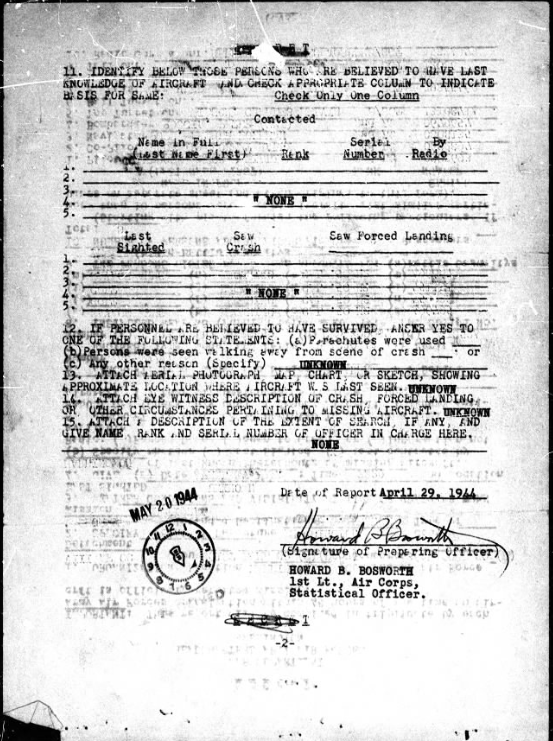
Every Army Air Forces organization was required to file a Missing Aircraft Report (MACR) within 48 hours of when an aircraft was officially reported as missing.

Missing Aircraft Report 4307 officially reported Chuckie and his fellow crew as Missing in Action from their mission that took place on 27 April 1944. The report was made 29 April and date stamped at the War Department in Washington on 10 May 1944. This was the report referenced in the letter to Chuckie’s parents.

The Report listed the official crew:

1st Lieut George William Ambrose , Pilot
2nd Lieut Robert Harry Redhairย , Co-pilot
2nd Lieut Peter Roccia , Bombadier

2nd Lieut Arthur Bozeman Pope , Navigator
Staff Sargeant Charles M. Wilson, Top Turret Gunner
Sergeant James Cyrll Mooney , Tail Gunner
Sergeant James Heddelson, Radio operator & gunner
Staff Sergeantย George W Henderson, Right Waist gunner

Over the following months and years since the crash, the classified “Secret” MACR Report would eventually grow to include additional information uncovered about the crash over time, first hand accounts from the survivors, some photographs, and information about a monument to these brave aviators erected at the crash site by the grateful people of France, and details of the final resting place for each of those killed in action.

The MACR 4307 is now “public information” and available in the National Archives.

Coming up in the next posts, the secret story Chuckie’s parents, brother and sister were never able to know – what actually happened to Chuckie on that night and the gratitude of the people of France for his bravery and heroism and his ultimate sacrifice for freedom that still stands today.

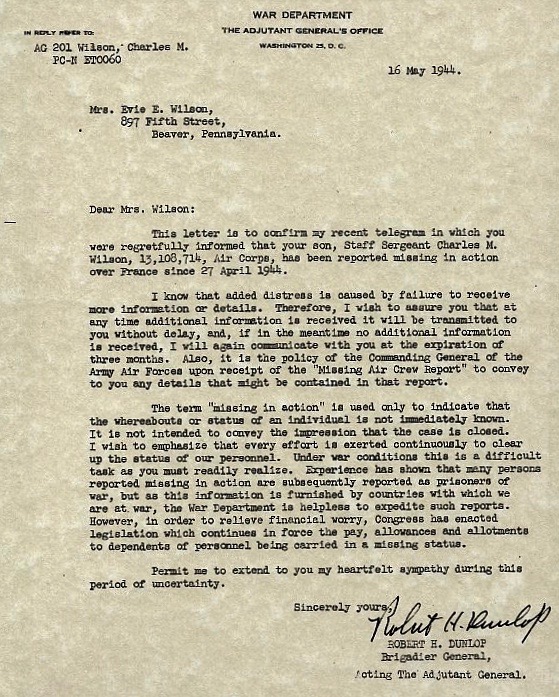
16 May 1944 – Dear Mrs. Wilson, regrettably

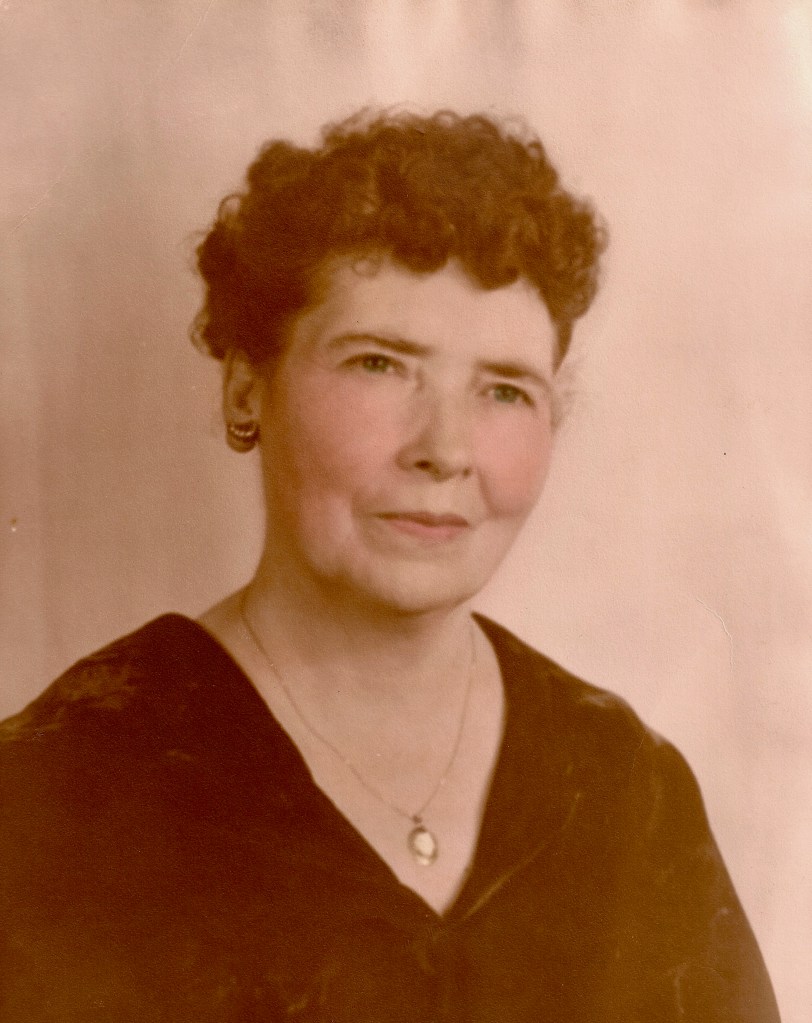
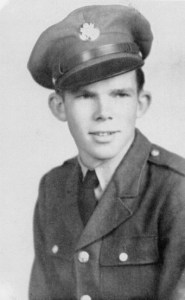
Chuckie’s mother (the author’s great-grandmother) in the 1940s.

Chuckie’s parents first received a telegram sometime shortly before receiving an official letter from the Brigadier General at the War Department notifying her that “regrettably” her son has been reported missing in action. I cannot begin to imagine the heartache my great-grandparents and family members felt in the days, weeks and months following receiving this news. How painful for any family to have to live every day with such uncertainty, no answers and not knowing if Chuckie was dead, alive or a POW.

Dear Mrs. Wilson:

This letter is to confirm my recent telegram in which you were regrettably informed that your son, Staff Sergeant Charles M. Wilson 13,108,714, Air Corps, has been reported as missing in action over France since 27 April 2944.

I know that added distress is cause by failure to recieve more information or details. Therefore, I wish to assure you that at any time additional information is received it will be transmitted to you without delay, and, if in the meantime no additional information is received, I will again communicate with you at the expiration of three months. Also it is the policy of the Commanding General of the Army Air Forces upon receipt of the “Missing Air Crew Report” to convey to you any details that might be contained in that report.

The term “missing in action” is used only to indicate that the whereabouts or status if an individual is not immediately known. It is not intended to convey the impression that the case is closed. I wish to emphasise that every effort is exerted continuously to clear up the status of our personnel. Under war conditions this is a difficult task as you must realize. Experience has shown that many persons reported missing in action are subsequently reported as prisoners of way, but as this information is furnished by countries with which we are at war, the War Department is helpless to expedite such reports. However, in order to relieve financial worry, Congress has enacted legislation which continues in force the pay, allowances and allotments to dependents of personnel being carried in a missing status.

Permit me to extend to you my heartfelt sympathy during this period of uncertainty.

Letter to Chuckie’s mother from Brifadier General Robert H. Dunlap, 16 May 1944

A copy of the letter Chuckie’s mother received.

Sadly, it would be two more years before Chuckie’s parents would recieve confirmation of his death and official change in status to Killed in Action. And many more years after that before any further details emerged. This remarkable story and details will be shared on upcoming posts.

First Letter: 16 May 1944 – Dear Mrs. Wilson, regrettably

Chuckie’s mother (the author’s great-grandmother) in the 1940s.

Chuckie’s parents first received a telegram sometime shortly before receiving an official letter from the Brigadier General at the War Department notifying her that “regrettably” her son has been reported missing in action. I cannot begin to imagine the heartache my great-grandparents and family members felt in the days, weeks and months following receiving this news. How painful for any family to have to live every day with such uncertainty, no answers and not knowing if Chuckie was dead, alive or a POW.

Dear Mrs. Wilson:

This letter is to confirm my recent telegram in which you were regrettably informed that your son, Staff Sergeant Charles M. Wilson 13,108,714, Air Corps, has been reported as missing in action over France since 27 April 2944.

I know that added distress is cause by failure to recieve more information or details. Therefore, I wish to assure you that at any time additional information is received it will be transmitted to you without delay, and, if in the meantime no additional information is received, I will again communicate with you at the expiration of three months. Also it is the policy of the Commanding General of the Army Air Forces upon receipt of the “Missing Air Crew Report” to convey to you any details that might be contained in that report.

The term “missing in action” is used only to indicate that the whereabouts or status if an individual is not immediately known. It is not intended to convey the impression that the case is closed. I wish to emphasise that every effort is exerted continuously to clear up the status of our personnel. Under war conditions this is a difficult task as you must realize. Experience has shown that many persons reported missing in action are subsequently reported as prisoners of way, but as this information is furnished by countries with which we are at war, the War Department is helpless to expedite such reports. However, in order to relieve financial worry, Congress has enacted legislation which continues in force the pay, allowances and allotments to dependents of personnel being carried in a missing status.

Permit me to extend to you my heartfelt sympathy during this period of uncertainty.

Letter to Chuckie’s mother from Brifadier General Robert H. Dunlap, 16 May 1944

A copy of the letter Chuckie’s mother received.

Sadly, it would be two more years before Chuckie’s parents would recieve confirmation of his death and official change in status to Killed in Action. And many more years after that before any further details emerged. This remarkable story and details will be shared on upcoming posts.

27 April 1944 – Daylong preparations for final flight

Operation “Lackey 3A” – Each Carpetbagger mission completed at Harrington took place in a 36 hour cycle, which began at 17:00 hours the day before the flight, when the OSS in London gave Lt. Robert Sullivan a list of approved targets for the following night.  Based on historical documents and the Harrington Museum website, it is possible to frame out Chuckie’s schedule on his last day on earth before he took off with his crew into the dark night sky.

9AM – Weather report & targets

The Commanding Officer selected the nightโ€™s targets according to priority of requests from the Resistance groups, reception record of the group, and availability of crews and aircraft. The lists were then given to OSS, who informed the reception teams on times and recognition codes. The Station Weather Officer advised the Commanding Officer, or his deputy, of weather conditions anticipated in the target areas, and at it is decided where it will be practical to send Chuckie and The Worry Bird aircraft. 

11AM – Target agreed

Chuckie’s Squadron Commander is called in and meets before a map in the Group Operations Room with the tabs pinpointing the targets for the night. Together, the squadron leaders select targets for their crews, balancing the difficult with the comparatively easy, the distant with the near, so that each squadron finally will have about the same work load.

Noon – Navigator receives targets

The navigators of the crews receive their targets from the Squadron Navigator. The Worry Bird crew navigator turns in a flight plan to his Squadron Navigator by 3PM. A take off time for Chuckie and his crew is agreed.

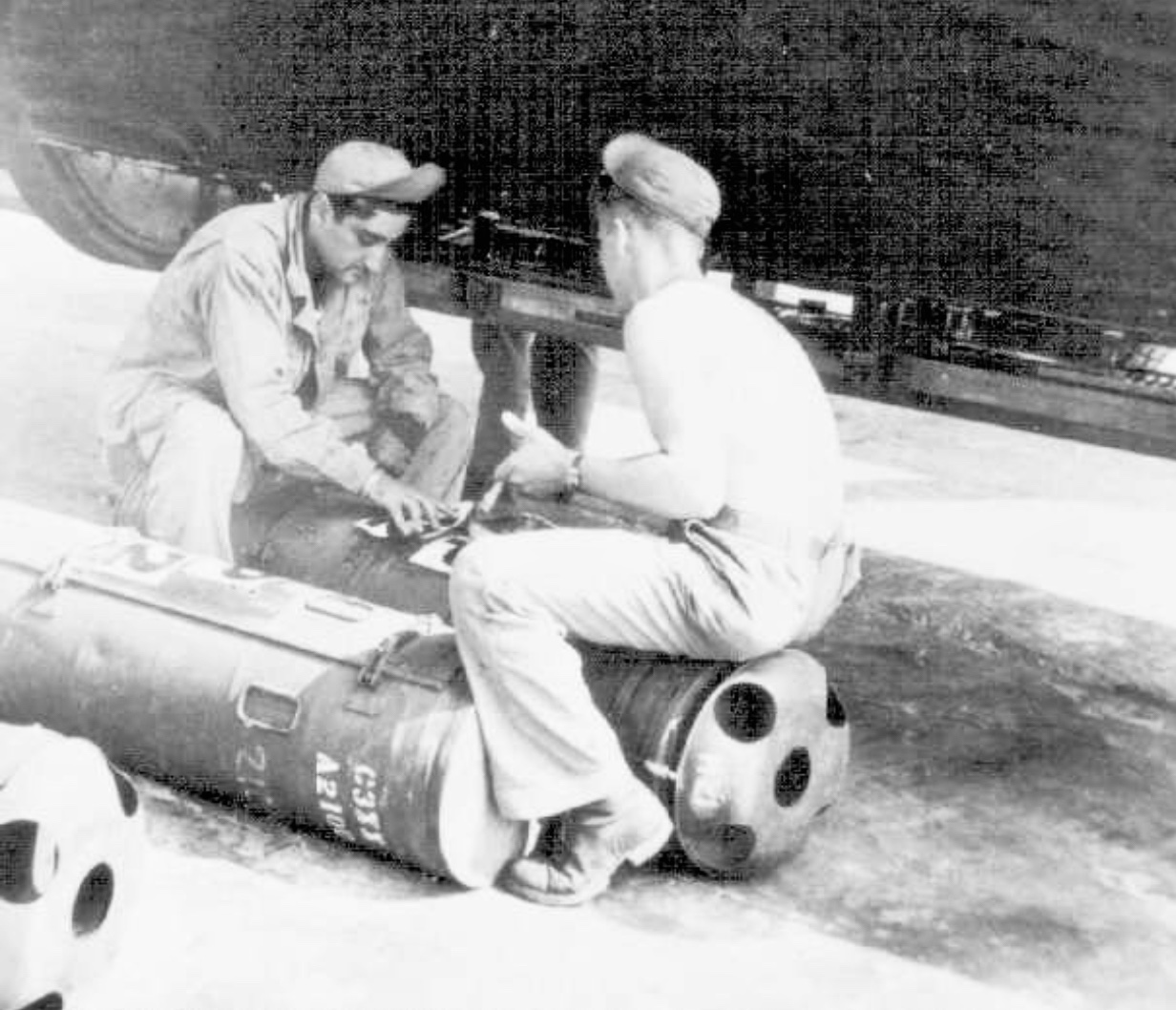
3PM – Loading the aircraft

Photo credit: HarringtonMuseum.org.uk

Chuckie and his crew meet with an S-2 Officer and had the opportunity to study the S-2 map and to compare it with their own map. Crew maps are checked for location of the target (latitude, longitude and terrain features). 

4:30 PM Chuckie attends final briefing

Chuckie attends a final briefing session with all crew members. The Intelligence Officer gives any special information which may affect the crew. Next, the Deputy Commander gives general flying and dropping instructions, and finally the Group Navigator gives instructions on the route to be followed whilst over England and the point and altitude for crossing the English coast. He ends up by giving the men a โ€˜time checkโ€™, on which all crew watches are synchronised.

06:00 PM Squadron Commanders and crew navigators briefed

All details, and weather to be expected en route to the drop zones were reviewed. The Worry Bird crew navigator briefs them on the course, the type of reception signal, the code recognition letters for the target, and the terrain features approaching and around the target.

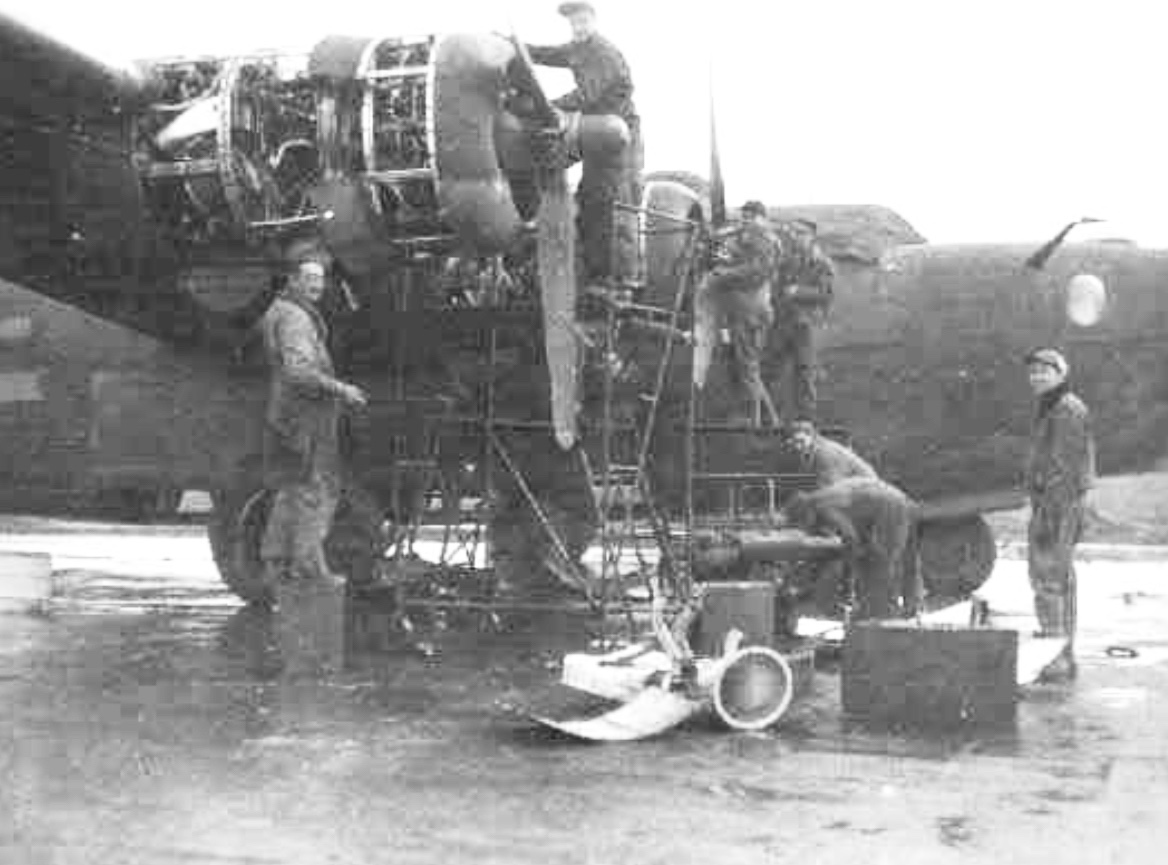
Phot credit: HarringtonMuseum.org.uk

09:00 PM Pre-flight visual check

As the Engineer, Chuckie would have done a pre-flight visual check of the plane prior to take off, and make sure that the gas caps were secured. The Engineer was also responsible to see that the wheels were always locked (prior to landing), and some reports say there were times when he had to lower them by crank, from inside the plane.

Pinpoint Target: A farm near Saint-Cyr-de-Valorges

Records show the secret code name for the Carpetbagger mission Chuckie was flying the night he was killed was Operation Lackey over the Timdale drop zone near Lyon, France –“TIMBALE DZ 45deg 57’N, 04deg 22’E”. The exact location of the planned drop is still a farm today and can be seen on Google maps is here.

On its final approach to make the drop “on lights” where members of the resistance were waiting on the ground, the plane hit a hill at 02:00AM and separated into four parts when crashing at nearby Saint Cyr de Valorges (Loire), France, killing five of the eight crew members including Chuckie.

Curious to see pictures of the village where Chuckie died on that hill, I did a Google search. Right there as I’d imagined. Beautiful, green rolling farmland, high wooded hills, peaceful, wide open expansive views. So familiar. It’s the same topography of Western Pennsylvania where Chuckie and this author grew up.

A very dangerous place to be flying a huge B-24 bomber in the dark of night just 130 feet above the ground at an airspeed of near stalling. The heroism, their bravery now even more clear. God bless them all.

One important lesson taught to the Carpetbaggers was the need to memorize the route to the drop zone. Pilots learned to literally map read their way by moonlight, memorizing landmarks โ€“ the most successful pilot sometimes spent hours studying the route. However, the B-24s were fitted with the best possible flying and navigational instruments. The most important flying instrument was a radio altimeter giving an accurate height readout on the low level flights.

The route to the drop zone was achieved by a team effort, the bombardier sat in the glazed nose on a swivel seat reading off landmarks to the navigator sitting at his table behind the blackout curtains. The pilot was provided with large blister windows giving a good downward view of the ground.

First radio navigation aid to be used on a mission was the Gee set, this recorded directional signals which were marked on a special chart โ€“ accurate within a quarter of a mile over England, but prone to jamming over enemy territory. The Rebecca / Eureka directional system explained on an earlier post consisted of a ground beacon (Eureka) set up on the drop zone, this was triggered by a signal from Rebecca set in the aircraft. Eureka then automatically sent out signals which were picked up by a calibrated receiver, this indicated the aircraftโ€™s position in relation to the drop zone.

Relief map of Saint-Cyr-de-Valorges
Chuckie and his crew flew at night from Great Britain to deep into German occupied France
to drop supplies to the French resistance.
They crash landed at the red dot pinpointing Saint-Cyr-de-Valorges.

Coming up over the next 10 days are daily posts with details of that last mission, monuments to Chuckie and fellow Carpetbaggers by the grateful people of France and, for the first time, a family visits Chuckie’s grave in France for Memorial Day.