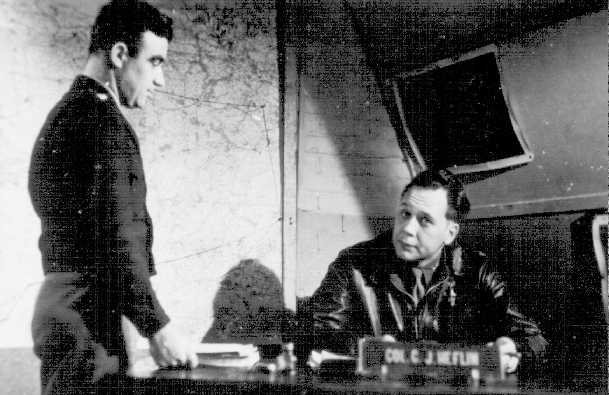
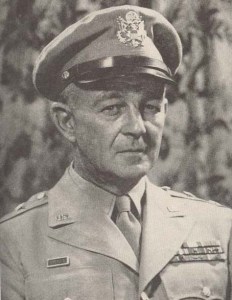
Chuckie’s Commander was Colonel Clifford Heflin, a decorated member of the Armed Forces, serving in the Air Force for 31 years.
Colonel Heflin began his military career in the Air Cadets in 1938 at the age of 21. In just three years, his technical and leadership skills garnered him the rank of Major. At the start of World War II, Colonel Heflin had a succession of roles flying bomber planes involving anti-submarine missions.
He was then given an assignment to work with the Office of Strategic Services (OSS) in England, and in January 1944 became commander of Chuckie’s secret unit known as the “Carpetbaggers.” The Carpetbaggers dropped supplies to the Allies and armed resistance movements in enemy territory.
His second in command Lt Col Bob Fish Fish, left, and Col Heflin, right Photo Credit
Colonel Heflin’s bravery and superior skills in commanding the Carpetbaggers garnered him the Legion of Merit, awarded to him by Eisenhower. He was also given the French Cross of War and the Legion of Honor, award by the French government.
492nd Group Headquarters Officers in front of the Operations Room map
His work with the Carpetbaggers brought him to the attention of the Manhattan Project’s top military commanders, who assigned Colonel Heflin to be commander of the 216th Army Air Forces Base Unit Special Airfield at Wendover during the Manhattan Project. The Manhattan Project was a research and development undertaking during World War II that produced the first nuclear weapons.
After the war’s end, Colonel Heflin was transferred to Stead Air Force Base outside of Reno, Nevada as commander. He went on to become the base commander of Lowry Air Force Base in Denver.
In 1968 Colonel Heflin retired from the Air Force and moved to Reno.
Chuckie’s fellow airman and crash survivor James “Jimmy” Heddelson celebrated his 21st birthday on 19 June 1944 while in hiding behind enemy lines evading the Germans with the help of the French.
“On the 19th of June (1944) it was my 21st birthday and the Boyers family told Henderson and myself to get ready, on a minutes notice, to leave. We accepted our fate, and after dark, they led us through the back streets, often hiding in the shadows as people would approach, so as not to see us. We approached a familiar apartment, I began to get curious as you see it was the house of Rene Simon’s.
When we went inside it was full of people and they actually had a surprise birthday party for me, with a few gifts too. The people had been planning and saving things for this occasion. Such as sugar, butter and meat. They had baked a cake and we had drinks. I had the most memorable birthday of my life, I shall never forget it. You would never believe it could happen under those perilous times.“
Edited from transcribed copy of letter by crash survivor James Heddelman in the archives at the Air Force Academy June – 1998
It is unclear to the author who the ‘Rene Simon’ was Heddelson referring to. The only René Simon at that time I can uncover was a French actor (1898 in Troyes – 1971), founder in 1925 of the Cours Simon drama school in Paris. Somehow that doesn’t seem correct. The French Resistance involved men and women representing a broad range of ages, social classes, occupations, religions and political affiliations. It was estimated there were 200,000 activists and a further 300,000 with substantial involvement in Resistance operations.
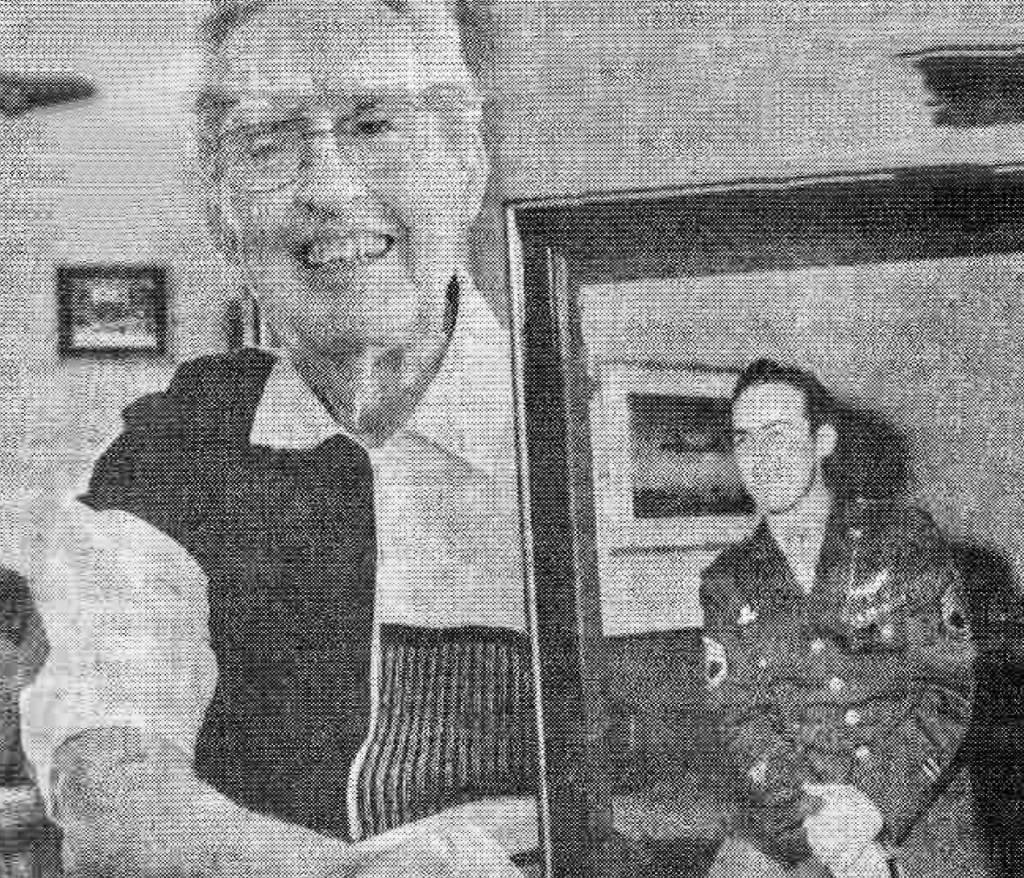
Jimmy Heddelson at age 85 holding a photo of himself at 21 years old. Image is from a poor photocopy scan of an Air Force newsletter article in March 2009
Two months later, Heddelson and Henderson returned safely to RAF Harrington thanks to the French Resistance who helped them.
Two months after Chuckie’s parents first received news that he was missing in action, they received a second letter from the Government. This one from the United States Senate Finance Committee dated 21 June 1944 extending their sympathy. It contained no new information but now addressed as “my dear Mrs. Wilson.”
My dear Mrs. Wilson
I wish to extend to you my heartfelt sympathy because of the report that your son, Staff Sergeant Charles M. Wilson, has been reported as missing in action in the European Area.
If he has not been found or has not returned to his outfit by the time this letter reaches you, I sincerely hope that will occur in the very near future, and that when he does return he will be safe and sound.
With my kindest regards and best wishes, I am Sincerely yours,
Letter to Chuckie’s mother, dated 21 June 1944, from US Senate Finance Committee
Chuckie’s parents in the 1940s
I was curious to know why the Senate Finance Committee would send such a letter so Googled it. The Finance Committee had the responsibility to raise revenue to pay for the buildup to WWII. They also had responsibility for funding and administering pension and benefits programs to veterans, widows and their children.
By 1941, Germany had conquered most of Europe and had begun its bombing campaign against Britain. And the Japanese had joined the Axis powers. Meanwhile, in the United States, the boom in the defense industry had helped bring the country out of the Great Depression.
The Finance Committee had the responsibility to raise revenue to pay for the buildup. The result was some of the largest revenue measures in the nation’s history, affecting all Americans. By early 1942, the Federal Government was spending $150 million a day, or roughly $5 billion a month, with nearly half of this total going towards the war effort.
The letter was signed by two individuals.
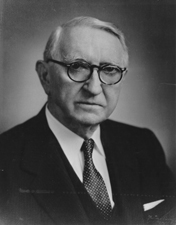
Senator Walter F. George (Georgia) Chairman of the United States Senate Committee on Finance In the 1940s George supported President Roosevelt’s efforts at military preparedness and American defensive buildup in response to the threat posed. Once the United States entered World War II after the Japanese attack on Pearl Harbor, George embraced the president’s vigorous prosecution of the war.
Major General Hugh J. Gaffey At this time, he was chief of staff of the Third Army, serving again under Lieutenant General George Patton. Gaffey served in this capacity through the campaign in Western Europe, from the time the Third Army landed in France in July 1944 and played a major role in Operation Cobra and the Battle of the Falaise Gap, followed by the Allied advance from Paris to the Rhine and the Battle of Metz.
Resistance movements during World War II occurred in every occupied country by a variety of means, ranging from non-cooperation to propaganda to hiding crashed pilots and even to outright warfare and the recapturing of towns. In many countries, resistance movements were sometimes also referred to as The Underground.
Chuckie and the Carpetbaggers supplied the Maquis and the French Resistance before the invasion of Normandy and continued throughout the summer of 1944. A previous post provided information on the B-24 crew preparation of the Carpetbagger missions.
Carpetbaggers parachuted in bazookas, carbines, rifles, Sten guns, small arms, grenades and other items in heavy demand especially designed for sabotage. Explosives had to be handled very carefully. Because they were not units that the United States had formally agreed to logistically support, they were not eligible to receive the standard U.S. equipment that was provided to French regular army units. Thus, the French resistance units often clothed themselves in nonstandard uniforms or uniforms of 1940 vintage. The same condition existed with weapons, with the use of captured German infantry weapons a common practice. Because of the mix of American, British, French, German, and other weapons, the supply of ammunition and spare parts was complicated and often difficult to accomplish.
Medical supplies, radios and other breakable items were placed in tins and baskets that were placed inside wire bins stuffed with moisture resistant corrugated paper to help them withstand the impact of the drop. These were covered with canvas call “panniers.”
The cylindrical containers the B-24s dropped were designed with a shock absorbing buffer on one end. They consisted of five individual cells and carried a variety of items. This included rounds of ammunition, boots, socks and other clothing, bicycles, tires., gasoline, and riffles. The Carpetbaggers supplied over 20,000 rifles during the course of the operations. Parachutes were then attached to the containers prior to take off. Once fully loaded, the containers could weigh up to 300 pounds each.
The bomb bay of the B-24 carried 12, fully packed, 300-pound containers. The same push button method used to drop the bombs was employed to drop the containers. Packages were stored forward in the aircraft until after takeoff and later placed on roller conveyers leading to the Joe Hole.
The Maquis waiting on the ground and gathered the canisters and supplies and dispersed them to the resistance army. The word “Maquis” cam from the type of terrain in which the resistance groups were hiding. Members were called “Maquisards” and operated in the isolated mountainous areas of rural France. The hilly region was perilous and dangerous to the big B-24 Liberators as Chuckie and fellow crew tragically found.
Individual circuits behind enemy lines inside France were identified by a specific code name. Usual, the name referred to a corresponding location or occupation such as ‘Wrestler”, ‘Lockey, or ‘Headmaster’.
The supply requests from each circuit were sent by radio to Special Operations in London and then on the the Carpetbaggers in Harrington. The exact location of the reception committee was determined by matching the code name to the secret files kept at Carpetbagger headquarters in Harringon.
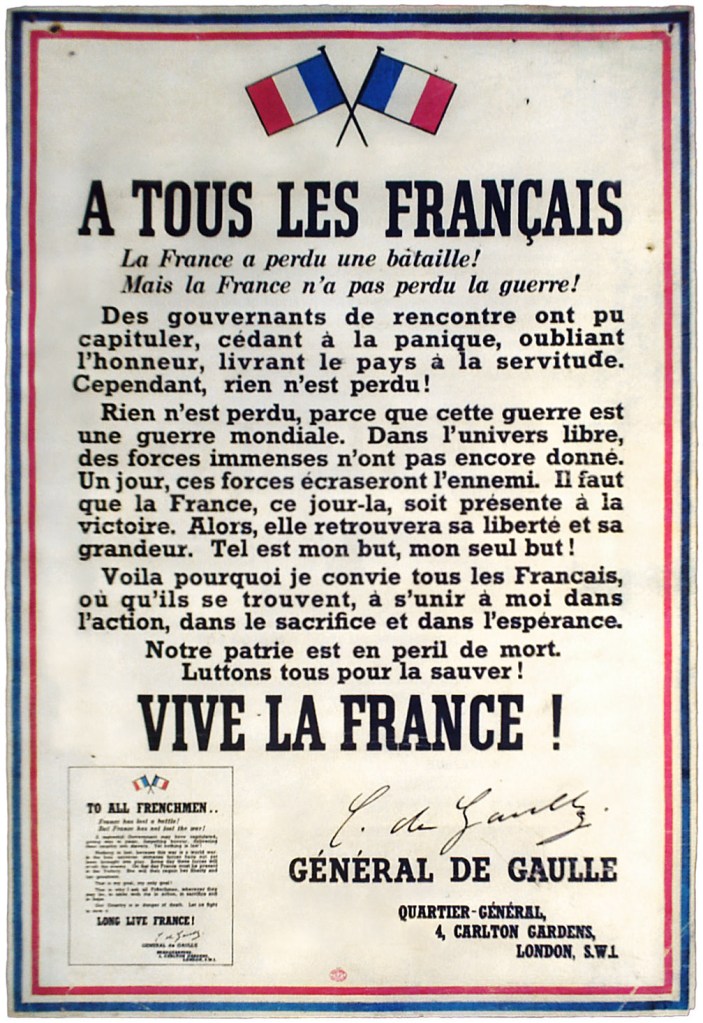
Charles André Joseph Marie de Gaullew was a French army officer and statesman who led the French Resistance against Nazi Germany in World War II and chaired the Provisional Government of the French Republic from 1944 to 1946 in order to reestablish democracy in France after the war.
TRANSLATION: TO ALL FRENCHMEN! France has lost a battle! But France has not lost the war! Some that have happened into governing positions may have capitulated, ceding to panic, forgetting honour, delivering the country to servitude. However, nothing is lost! Nothing is lost, because this war is a world war. In the free universe, immense forces have yet to get into the fray. One day, those forces will crush the enemy. That day, France must be there for victory. Then she will find her liberty and her greatness again. Such is my goal, my only goal! This is why I invite all Frenchmen, wherever they may be, to join me in action, in sacrifice, and in hope. Our motherland is in lethal danger. Let us all fight to save her! LONG LIVE FRANCE! General de Gaulle Head-Quarters, Carlton Gardens 4 London, S.W.1.
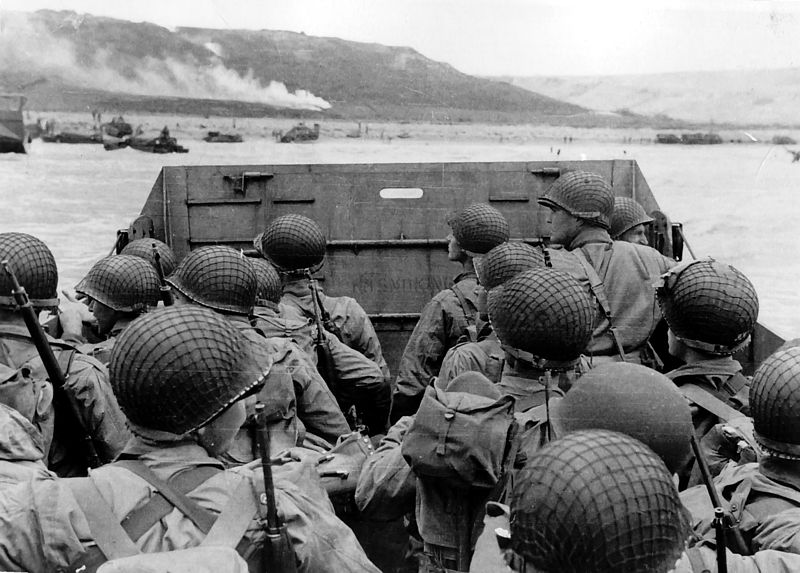
On 6 June 1944. Celebrated as “D-Day”– the Allied Forces began a massive invasion of Europe, landing 156,000 British, Canadian and American soldiers on the beaches of Normandy, France. The Carpetbaggers and the French Resistance were credited with delaying German mobilization by blowing up railroad track and repeatedly attaching German Army equipment and garrison trains.
Omaha, commonly known as Omaha Beach, was the code name for one of the five sectors of the Allied invasion of German-occupied France in the Normandy landings on June 6, 1944, during World War II. “Omaha” refers to a section of the coast of Normandy, France, facing the English Channel.
Taking Omaha was to be the responsibility of United States Army troops, with sea transport, mine sweeping, and a naval bombardment force provided predominantly by the United States Navy and Coast Guard, with contributions from the British, Canadian, and Free French navies.
Many years later, Churchill, Eisenhower and Patton acknowledged the inestimable value of Chuckie and the Carpetbaggers contribution to defeating the enemy. According to General Patton, the rapid advance of his army through France would have been impossible without the fighting aid of the French resistance which the Carpetbaggers supplied.
For eight long days back at Harrington, Chuckie’s Squadron Command didn’t hear anything from the Ambrose Crew or those on the ground about the fate of the Carpetbagger mission or their friends and colleagues of The Worry Bird crew.
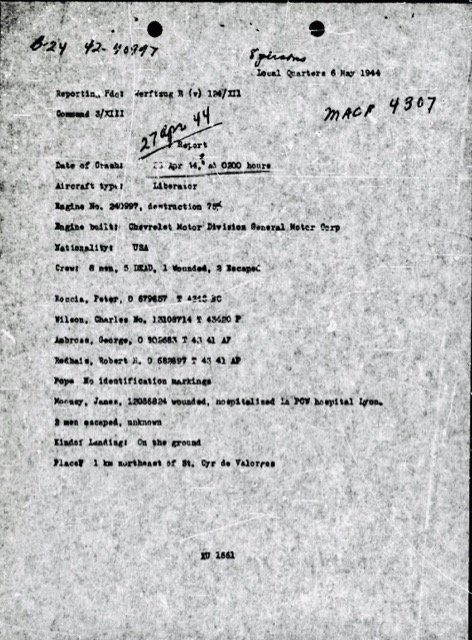
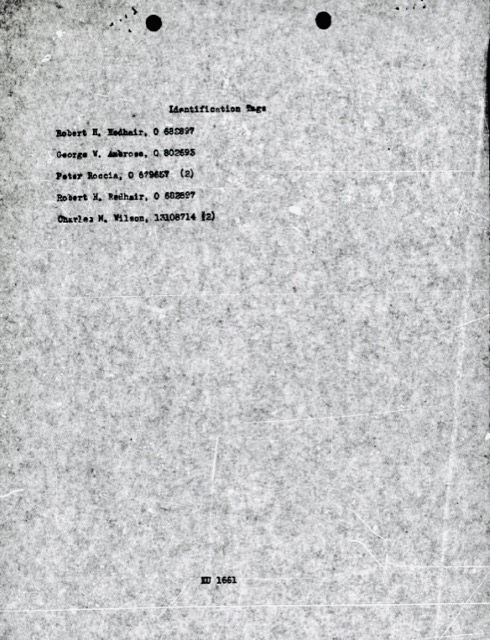
Finally on 4 May 1944 Allied Forces Operations at Baker Street London received a message from French agents in the field that Chuckie was killed, along with a part of Chuckie’s airplane with the aircraft number.
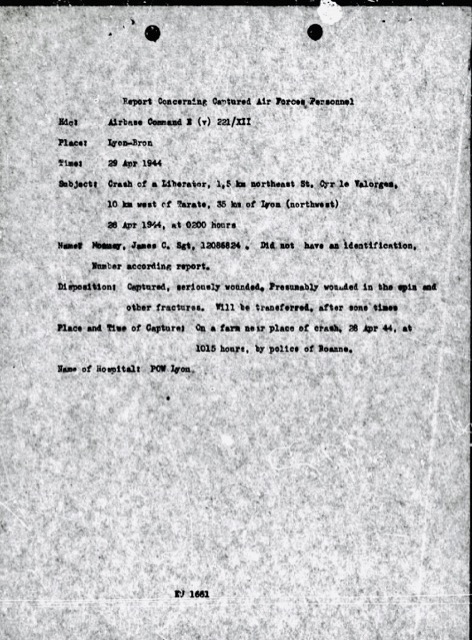
French witnesses on the scene reported the aircraft had arrived over the target and made three descending circles. It struck the ground on the third circle, crashed and burned, killing all crew members except George W. Henderson, S Sgt. James J Hedddleson and St. James C. Mooney.
This is copy of the actual report dated 6 May 1944 which can be found in the National Archives.
French agent field report to OSS offices in London “Baker Street” that Chuckie was killed.French agent field report to OSS offices in London “Baker Street” confirming Chuckie’s Identification page found on his body.French agent field report confirming Sgt. Mooney taken to hospital as POW.
Carpetbagger missions were carried out by the Office of Strategic Services (OSS) to clandestinely deliver agents and supplies into Nazi-occupied Europe. The OSS was a wartime intelligence agency of the United States during World War II, and a predecessor to the Central Intelligence Agency (CIA). The OSS was formed as an agency of the Joint Chiefs of Staff to coordinate espionage activities behind enemy lines for all branches of the United States Armed Forces.
To support the Allied invasion of France on D Day in June 1944 the Carpetbaggers from January – to June dropped three-man parties (a total of 100 men and women) into various parts of France as agents to co-ordinate widespread overt (as opposed to clandestine) acts of resistance. They served in a variety of functions including arms and sabotage instructors, couriers, circuit organizers, liaison officers and radio operators. The names of all 13,000 OSS personnel and documents of their OSS service, previously a closely guarded secret, were released by the US National Archives on August 14, 2008.
French agents were directed from OSS offices in London “Baker Street” where they occupied much of the western side of Baker Street. The precise nature of the buildings remained concealed. Secure communications were established with OSS HQ in London and Station 179, Harrington where the 801st Bomb Group OSS Liaison Officer, S2 Lt. Sullivan directed the covert Carpetbagger operations.
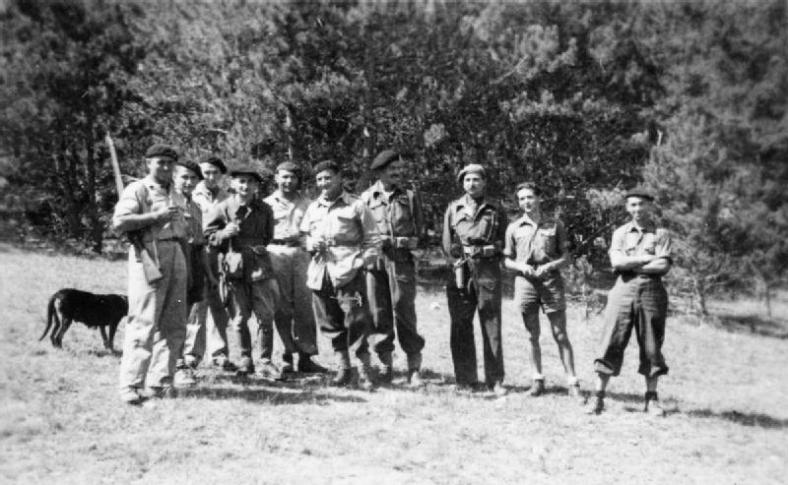
Maquisards (Resistance fighters) in the Haute-Savoie département in August 1944. Third and fourth from the left are two SOE officers. Photo Credit
It would be two more years before the Wilson family were told that Chuckie was killed.
The third crewman to survive the crash that killed Chuckie, Sergeant James Cyril Mooney plummeted through the open “Joe hole” where the bottom ball gun-turret had been removed so agents could parachute from the plane. Mooney was rescued by the French resistance on the morning of 28 April 1944 when The Worry Bird crashed but his back was broken and he was wounded so badly that they had to turn him over to the Germans for medical treatment.
“His condition was such, I found out later, that the man whose house he was taken to, had to turn him over to the Germans. He told me personally how sorry he was for having to do this. But I tried to assure him that in Sgt Mooney’s case (broken back) he probably saved his life as I heard the Germans took him to a hospital.“
Edited from transcribed copy of letter by crash survivor James Heddelman in the archives at the Air Force Academy June – 1998
Mooney was hospitalized for months and then marched on foot back to Germany and eventually to a POW camp in Poland.
Stalag Luft III was located 100 miles southeast of Berlin in what is now Poland. “Luft” means “air” in German, and it designated a camp holding mostly Allied airmen. The officer airmen who were POWs in the German camps at Stalag Luft III arrived there through an accident of war. They varied widely in age, military rank, education, and family background, but had several common experiences:
They all volunteered to go to war as airmen.
They all managed to complete flying training.
They all entered into combat flying in airplanes.
They all were survivors of a traumatic catastrophe in the air.
By early 1945, the war was going badly for the Germans, with Allied forces poised to overrun Hitler’s homeland. As the Russian army approached from the east, the Germans decided to move the occupants of certain POW camps, called stalags, farther west.
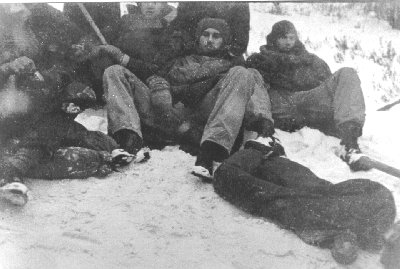
From a total of 257,000 western Allied prisoners of war held in German military prison camps, over 80,000 western Allied prisoners of war held in German military prison camps were forced to walk on foot on “The Great March” westward across Poland, Czechoslovakia, and Germany in extreme winter conditions to prisoners of war (POWs) camps (with part of the distance covered by cattle train) over about four months between January and April 1945.
The march started at Stalag Luft IV in German Pomerania (now part of Poland), a POW camp for US and British aircrew men which likely held Mooney and an estimated 9,000-10,000 other POWs.
It was later estimated that a large number of POWs had marched over 500 miles by the time they were liberated, and some had walked nearly 930 miles.
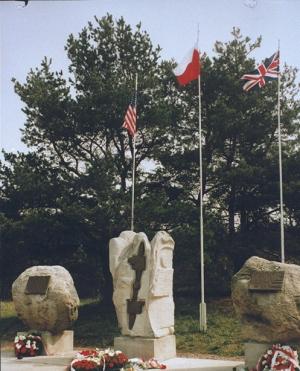
POW Monument at Luft 4 Published in AIR FORCE Magazine September 1997, Vol. 80, No. 9
In 1992, the American survivors of the march funded and dedicated a memorial at the former site of Stalag Luft IV in Poland, the starting place of a march that is an important part of Air Force history.
Mooney was held prisoner in a German POW camp until the British liberated his POW camp in Poland at the end of the war in 1945.
Of the three airmen to survive the crash that killed Chuckie and four other airmen, two successfully evaded the enemy before safely returning four months later to RAF Harrington.
Just before the crash Sergeant James Heddleson had gone to an open hatch in the tail to exchange recognition signals, flashing lights, with people waiting below in a clearing surrounded by high hills. Suddenly the plane shook violently, as if the aircraft or its wingtip had hit something. Heddleson fell across the hatch. Both he and the tail gunner Sergeant George Henderson were thrown free as the rear fuselage tumbled and broke apart.
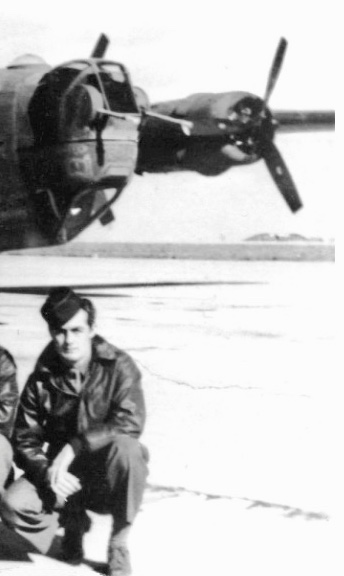
Sergeant James Heddleson under the Worry Bird 1943
Heddleson and Henderson found each other amid the burning remains of the plane and exploding bullets. Staggering on battered but fortunately unbroken legs, they limped to the nearby woods, then turned and watched The Worry Bird erupt in a final fireball.
The pair spent the next few days traveling across the countryside, begging food from startled French civilians and eluding Germans searching for them with dogs and planes.
After several days of hiding and only moving at night, we ended up in a cemetary, when daylight came we decided we better hole up for the day, when we saw an old man walking towards us. We really scared him when we approached him for food or help or anything. I showed him my “wings” and he motioned for us to follow him, at a distance. Eventually we ended up in the garage of a schoolhouse.
They eventually met a man who told the airmen to stay in a vineyard where they had hidden, then returned an hour later with a note, in English, from the local school master, who promised to meet them at 5 p.m. The teacher kept his promise and after bringing them food, left to bring back a member of the local Resistance, or Maquis, who was so heavily armed that “he looked like a walking arsenal,” Heddleson said.
We were given some bread, cheese and wine and after dark a group of men came in a car, it was M. Benoit the school teacher. They were all armed with pistols and rifles. After a few questions and some very vague answers, they decided we were the two Americans that everybody was looking for. I also knew then, that at last, we had made contact with the French underground (Maquis). We then were taken to a farm (in the car) and hidden in the barn. This place was owned by a Mme. De Havrincourt. We stayed there a couple of weeks, hiding sometimes in the nearby woods and barn and house. She had a doctor come and he fixed up my forehead, he opened up the gashes and re-stitched them. I mean the hard way , with a needle and thread. I can still remember that. We were spotted by the wrong person at this farm and she told the Germans “she thought she had seen some English fliers”. When the Germans came through the gate, we escaped out the back of the barn to the woods. We could see them looking everywhere, but to no avail. Mme. De Havrincourt convinced them (the Germans) the woman was demented and they finally left.
Sergeant George Henderson in front of The Worry Bird 1943
Heddleson and Henderson were given false identity cards during the four-month stay with the French Resistance. It identified the as deaf-mutes, to reduce the risk of exposing them as a fugitive, non-French-speaking Allied airman.
Needless to say the Maquis decided it was time for us to move on. We were taken to the Jean Crozet farm near St. Germain Laval. The main structure was walled in and a person could feel slightly safer. While there, we participated in two different night parachute drops. This was not only dangerous but a lot of work. The parachutes were everywhere. We loaded them into trucks and even oxen-drawn wagons. We stored them in various barns before daylight. I can still remember looking up and seeing those B-24’s flying very low and turn and head back to England, Harrington, I assumed. It gave you an empty feeling in your stomach. I spelled my name with a flashlight in Morse code several times but I never knew if they received it.
Heddleson and Henderson were shuttled from one hideout to another, narrowly escaping capture several times. Heddleson learned later that the Germans had posted a 25,000-franc reward on the heads of two surviving downed Allied airmen.
From the Crozet farm we went to the village of St. Germain Laval to stay. We first stayed at the home of Rene Simons for a few days, never venturing out of doors. From here we went to the home of Jean Boyer. He was an officer in the Maquis. We stayed with the Boyers the longest, about 8 weeks. It was through Jean Boyer that we participated in several raids with the Maquis. I can recall one raid in particular that involved Jean Boyer, Henderson, Joseph Tournaire, and myself.
Heddleson and Henderson started working with Maquis groups in the area, assembling Carpetbagger-dropped weapons and training partisans in their use. They accompanied resistance fighters in raids on the homes and shops of suspected collaborators. As the Allied D-Day of France neared, the underground was ordered to destroy railroads and bridges that the Germans could use to resupply their coastal defenses.
We rode at night on a bicycle, quite a distance from St. Germain Laval to a railroad trestle that we were going to blow up (sabotage). It crossed over a small river. Boyer and myself went to the center of the trestle and we climbed down over the side carrying our explosives. We had a timing device for it, and we thought we had plenty of time to make our escape and would be well on our way back to St. Germain Laval, before any action took place. I could look back over my shoulder and see the trestle behind us, when all hell broke loose. Obviously our timer was wrong. ( I believe these were from a parachute drop). In the still of the night the explosion was felt from where we were.
We made our departure immediately away from there. Several times we would hide along the road as the Germans would pass us on their way to the trestle, or what was left of it, not seeing us. We made it back to the Boyer’s house just as the sun was coming up. Needless to say we were very shaken and tired. The Boyer’s house was located almost in the center of St. Germain Laval and had a small walled-in area about 24ft by 20ft. It was here we would spend our time cleaning and assembling British machine guns, that were parachuted to the Maquis at night. Many a time we would go to the basement of the schoolhouse where the walls were about 4 to 5 feet thick, and testfire these weapons, always on the lookout for the enemy, because of the noise.
Edited from transcribed copy of letter by crash survivor James Heddelson in the archives at the Air Force Academy June – 1998
After D-Day, Heddleson hoped he could return to his unit in England, but it was another two months before he and a handful of other escaped fliers could hop on a British plane that landed by moonlight in a field behind enemy lines.
Brian Albrecht interviewed Heddelson, shortly before his death at aged 85, for an article which ran in the The Plain Dealer in March 2009 portions of which have been reprinted here.
It was now morning daylight. Sometime in the morning hours, members of the French resistance army removed the remains of Chuckie and his four fellow comrades from the wreckage of the plane in a field near Saint-Cyr-de-Valorges, France and buried them in an unmarked temporary grave. They also worked very hard to quickly retrieve all the container canisters and packages of supplies strewn about and to hide them.
The Nazi’s would soon arrive at the crash site to retrieve any intelligence they could find.
Quickly burying the dead while under threat of the imminent danger of the arrival of the Nazi’s was a humane act of enormous compassion and respect by the French people. They protected Chuckie and the other fallen from any potential further desecration by the Nazi’s. It also allowed for Chuckie’s body to be identified and, at a later point, safely moved to a temporary cemetery and his subsequent permanent interment in December 1948 at his final resting place at Rhone American Cemetery in Draguignon, France.
Chuckie’s parents were never given many facts about how he died because on his “S E C R E T” Carpetbagger mission. They did have the comfort of knowing that their their son’s body was always treated with the dignity and respect he deserved for paying the ultimate sacrifice for Freedom.
Chuckie’s family never saw these photos of his crashed plane. Today, they are easily findable by anyone on the internet.
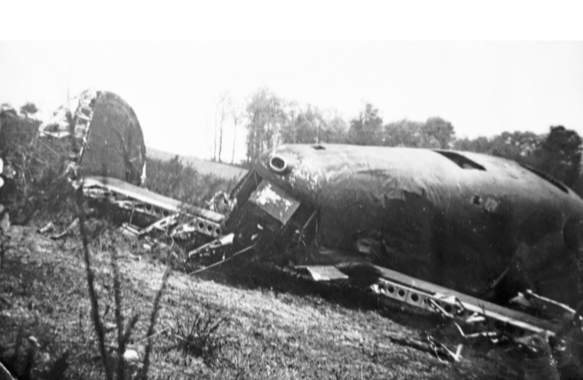
April 1944 B-24 Liberator “The Worry Bird” wrecked upside down in a field west of Lyon, France, after striking a hill near the town of Saint-Cyr-de-Valorges during a night mission.Note the square ‘Joe Hole’ which canisters and packages exited during an airdrop. A second photo of B-24 Liberator “The Worry Bird” April 1944 This is the underside of the bombay compartment in the center of the aircraft and the tail section section.
Killed In Action – 28 April 1944 Lieut. George W Ambrose, Pilot; of Springdale, PA Lieut. Robert H Redhair , Co-Pilot; of Bartlesville, OK S Sgt. Charles M Wilson, Engineer; of Beaver, PA Lieut. Arthur B Pope, Navigator; of Fulton, GA Lieut. Peter Roccia, Bombardier; of Washington, D.C.
“It was the next day that they (the French) realized that two more Americans survived (in addition to Mooney). They found the chutes, 1st one and then another, which they immediately buried.“
Survivors of the crash included: Sgt. James J Heddleson, Radio Operator; of Louisville, OH Sgt. George W Henderson, Tail Gunner; of Santa Monica, CA Sgt. James C Mooney, Dispatcher; of Englewood, NJ – He volunteered for this mission (his first) – the rest of the crew only met him shortly before take-off, as regular crew member Sgt. W. Bollinger had reported off sick that day.
“We assumed everyone was killed except Sgt. Mooney. His condition was such, I found out later, that the man whose house he was taken to, had to turn him over to the Germans. He told me personally how sorry he was for having to do this. But I tried to assure him that in Sgt Mooney’s case (broken back) he probably saved his life as I heard the Germans took him to a hospital.“
Heddelson and Henderson were now on the move to evade the enemy, as trained
“We moved only at night as we traveled quite a way for the shape we were in. The French started to look for us they said in every direction possible. We skirted villages and main roads, avoiding everyone we saw, especially the Germans. Having no idea where we were, we headed South.”
Edited from transcribed copy of letter by crash survivor James Heddelson in the archives at the Air Force Academy June – 1998
A French secret agent on the ground that day also took the piece of the plane with the serial number.
It would soon be returned back to the Office of Strategic Services (OSS) headquarters at Baker Street in London as part of his field report to the Allied Forces command that the plane had crashed and USAAF men had died.
Chuckie and his fellow crew onboard B-24D serial no. 42-40997 The Worry Bird (formerly Screamin’ Mimi of the 565th Bomb Squadron, 389th Bomb Group) clipped a hill near its drop zone in Saint-Cyr-de-Valorges, Loire, and crashed killing him and four other crew; three airmen survived.
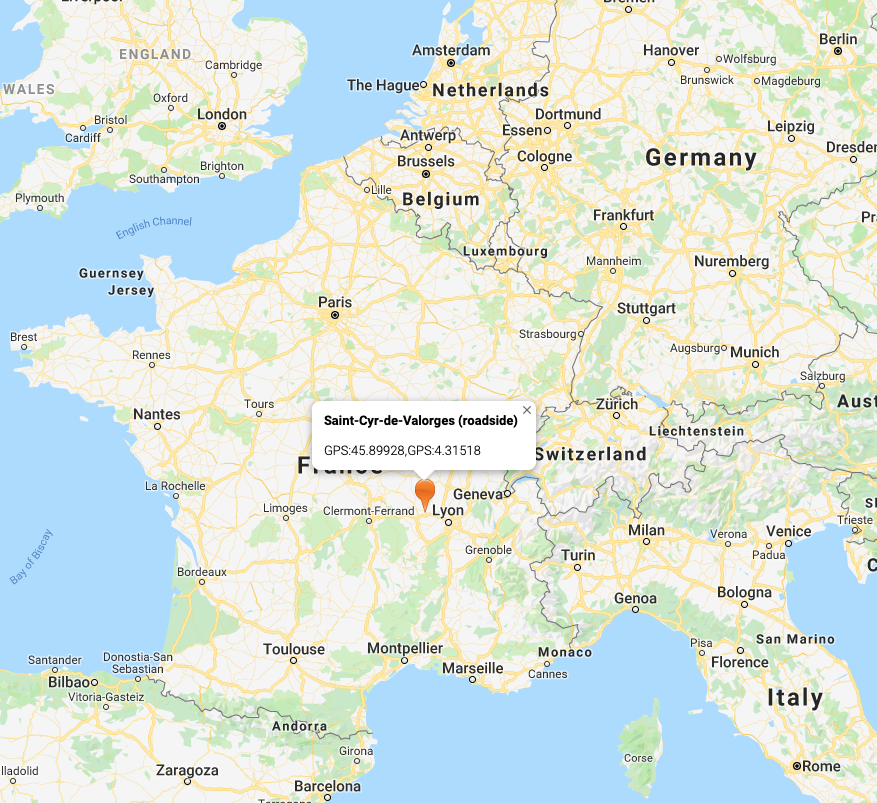
The GPS location of the plane crash
When it struck the ground on the third downward circle, the B-24 divided into four distinct compartments as it crash landed.
Chuckie and the four other airmen in the first to sections were killed; the three airmen in the back two sections survived after being able to parachute out and away from the plane to safety just before the crash landing.
bombardier-navigator’s compartment in the nose of the aircraft which contained the navigational equipment, bomb-sight, bomb controls, and nose guns or nose turret; where navigator Lieut. Arthur B Pope, Navigator; and bombardier Lieut. Peter Roccia, Bombardier were located
flight deck which included the pilot’s compartment, radio operator’s station, and top gun turret; where flight engineer Chuckie along with pilot Lieut. George W Ambrose and co-pilot Lieut. Robert H Redhair were located
bomb bay compartment in the center of the aircraft under the center wing section (half deck is located above the rear bomb bay); where survivor Sgt. James C. Mooney was located
rear fuselage compartment which contains the lower gun turret, waist guns, bottom camera hatch, photographic equipment, and the tail gun turret; where survivors Staff Sgt. James Heddleson and Sgt. George Henderson were located
Radio operator James Heddleson and gunners George Henderson and James C. Mooney survived. Heddelsman wrote a first person account of the crash in a letter to author Ben Parnell for his 1987 book Carpetbaggers: America’s Secret War in Europe. A transcription is in the archives at the Air Force Academy. A portion is reprinted here.
1st I hit my forehead, partly falling out and then I was thrown backwards toward the “Joe Hole” area, with the back of my head slamming into something in the plane. Sgt. Mooney is gone, he apparently fell out of the “Joe Hole.” I found out later he held onto the chutes (packages). Luckily he wasn’t killed, although the poor man must have suffered terribly. His back was broken, this I was told later. Sgt. Henderson was immediately out of the tail section.
We found each other. Henderson and I were apparently fairly close to each other … as each of us made our way back to the plane.
The plane seemed to be everywhere Our plane could be seen like a beacon for miles like a beacon.. . . the ammunition exploding and whatever was in the canisters also going off. . . and the noise it made in the still of the night with everything exploding certainly would attract a lot of attention.
The canisters were scattered everywhere. The French worked very hard throughout the night, very hard, trying to retrieve them. Sgt. Henderson and I were apparently fairly close to each other and as each of us made our way back to the plane, we found each other.
We assumed everyone was killed except Sgt. Mooney. Mooney, we tried to find him, hoping he was alright, but it was night and in the mountain area and after a while we gave up. We were not only hurting physically, but also emotionally, myself being only 20 years old at the time.
We could hear noises like cars or truck engines or so we thought. My left leg was hurt and was getting worse as it was swelling around the knee. We had no idea where we were, but the 1st thing we thought of was it could be the Germans.
We started down the hills toward the valley, Not knowing anything about the territory, we just decided to slip away in the night, the best way we could.
Edited from transcribed copy of letter by crash survivor James Heddelson in the archives at the Air Force Academy June – 1998
His back broken, Mooney was helped from the crash area by a French women from the village but was soon handed over to the Germans for urgent care when the seriousness of his injuries became clear. He survived as a POW in a Lyon hospital recovering from his injuries. Heddleson and Henderson successfully evaded the enemy by first hiding under cover, then being taken in by the French Resistance Army the Maquis, living with them for three months and even going along one night to help blow up a railway trestle. In early August an RAF Lockheed Hudson picked them up safely and on 27 August 1944 they returned to Harrington.
Coming up The Crash (Part four): What happened the next day when then sun came up and photos of the crashed plane.
Not only was the B-24 demanding to fly, even for a fully-qualified pilot, it operated at such high weights that takeoffs became dicey even with full power on all engines. Flight stability was marginal, and escape from a stricken machine was extremely difficult once the pilot and copilot had let go of the controls. I imagine these were some of contributing factors on the night Chuckie’s plane crashed.
To better ensure accurate drops, pilots tried to get down to within 400 to 600 feet off the ground and to reduce their flying speed to 130 miles per hour or less. The low speed reduced the chances of damage to parachutes, as the shock of opening is much less at the slower speed. Personnel were normally dropped from a height of 600 ft with containers and packages being dropped from 300 – 500 ft.
Chuckie’s plane made two passes over the target and on the third pass, “we hit or clipped something”
Once again the flaps start down and the bomb-doors open and we are starting our approach. I can look out and see the hills, or mountains on our left side. Suddenly the plane shakes violently, apparently we hit or clipped something.”
The engines were racing and the plane was climbing, seemingly straight up. He yells for us to get out. . . .We no sooner cleared the plane when it starts down again, only this time it is too late, because it is burning when it crashes.”
Transcribed from copy of letter by crash survivor James Heddelson in the archives at the Air Force Academy June – 1998
At 02:10 hrs local Chuckie’s aircraft landed in a fiery crash in Saint-Cyr-de-Valorges, Loire, near Lyon France.
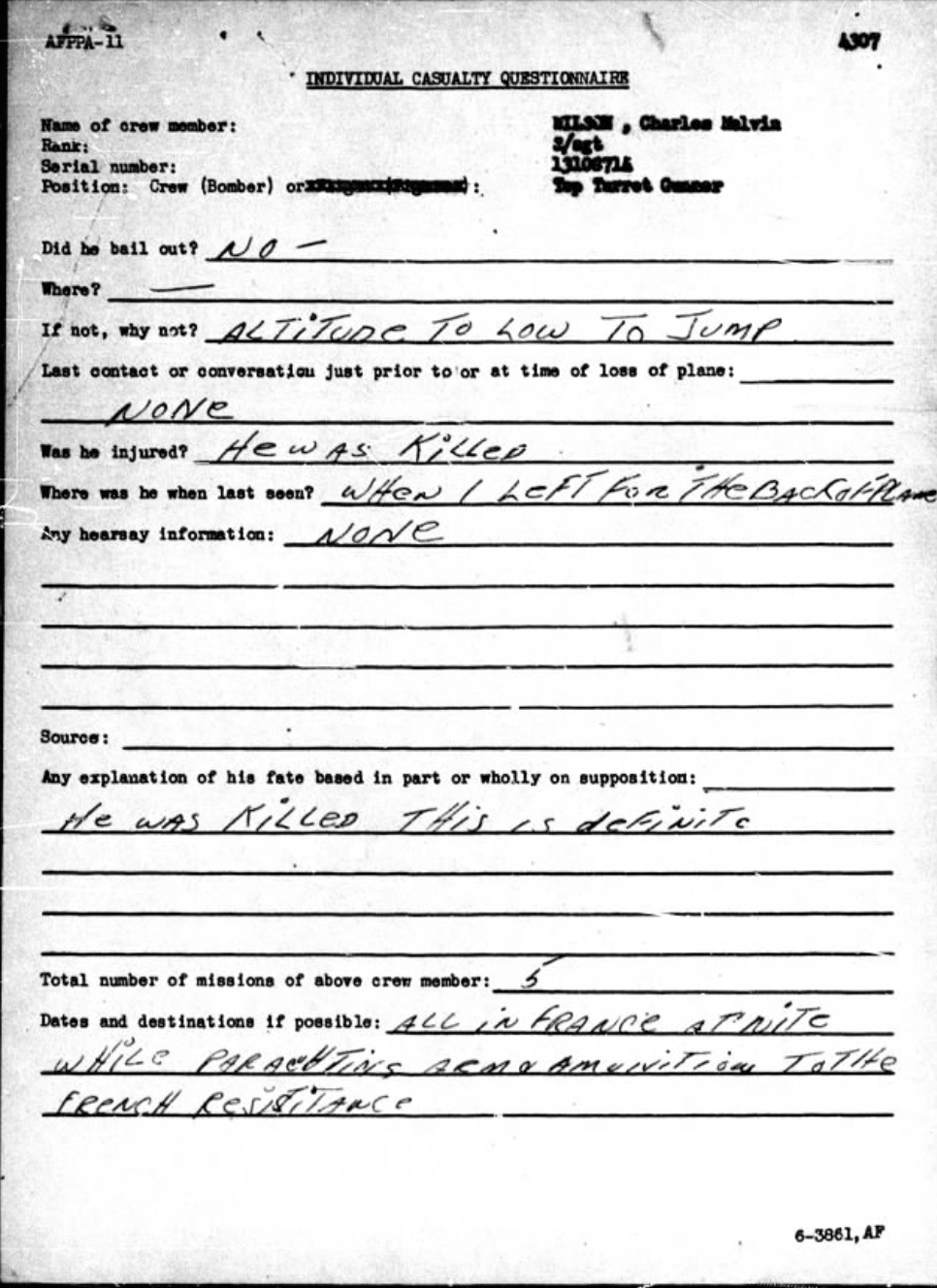
“He was killed. This is a definite.”
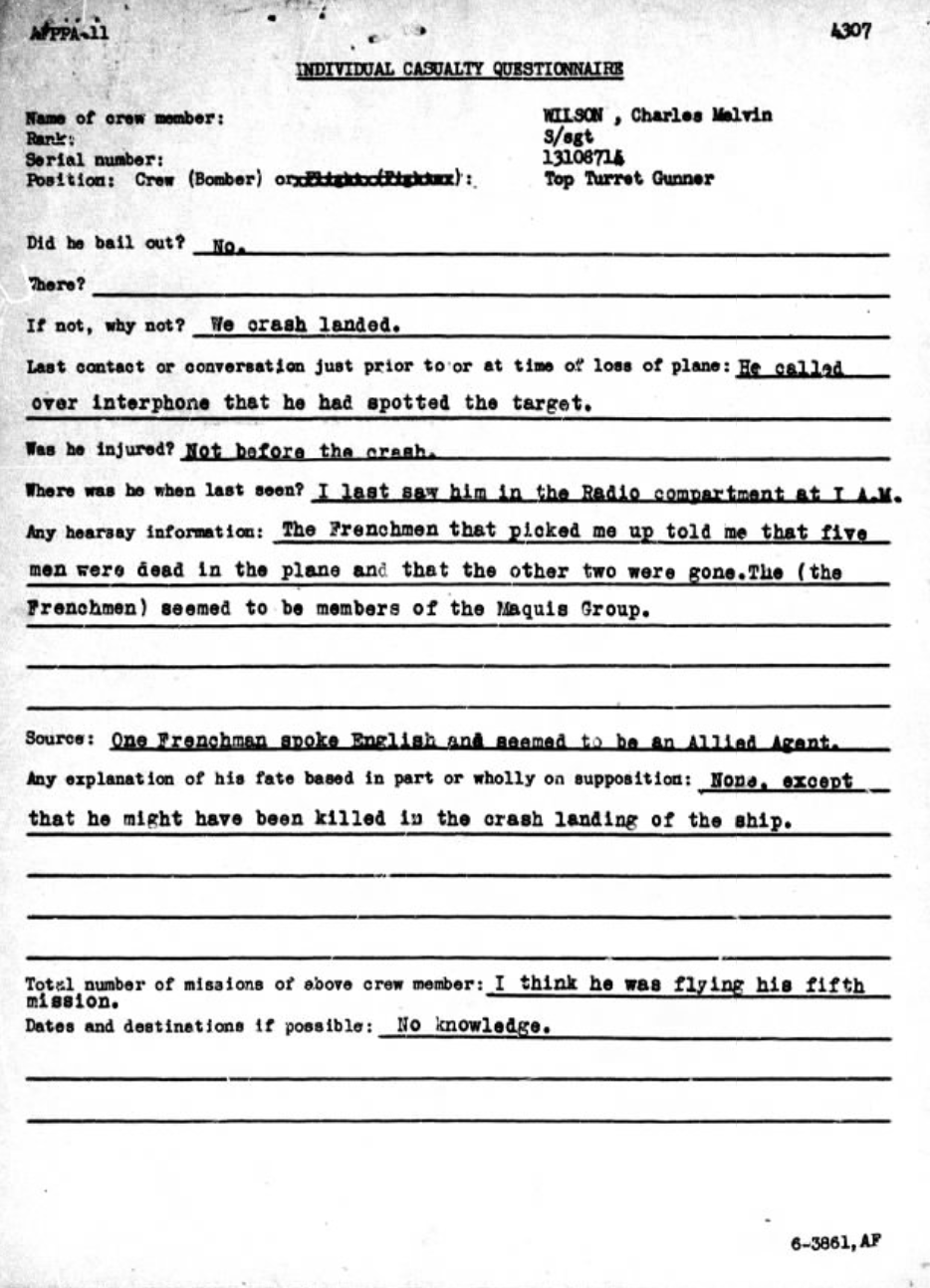
Chuckie was killed on impact. Individual Casualty Questionnaire‘s were completed by two of the three crash survivors when they eventually returned back to Harrington three months later after successfully evading the enemy with the help of the French resistance. Both confirm Staff Sgt Charles. M. Wilson was killed in action when his plane crashed. Copies of the actual questionnaires likely completely sometime in August 1944 were found in the MACR and posted below.
By survivor Sgt. George Henderson
By survivor Sgt. James Heddelson
Next up: The Crash (part three) – seen like a beacon






 Unforgotten Glory